






The Middle Class is Shrinking … Yeah!
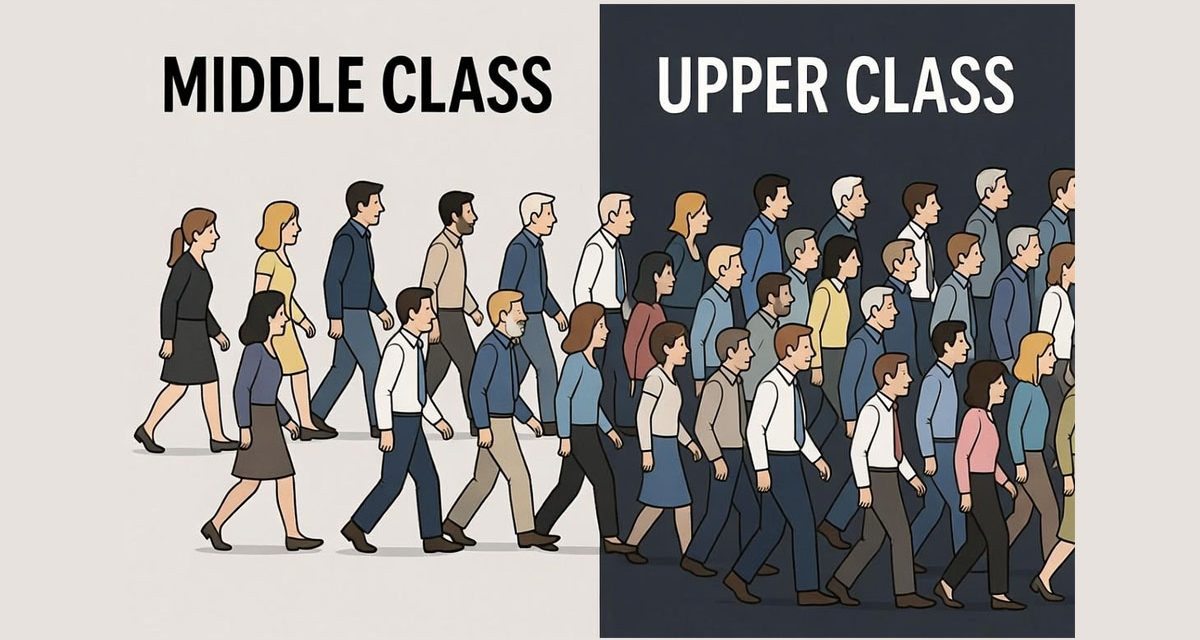
The political class and its media echo chamber have spent decades peddling convenient fiction. They insist the American middle class is shrinking because ordinary families are tumbling downward into poverty. The narrative serves their political purposes perfectly. It fuels demands for ever larger government programs, higher taxes on the productive, and the endless expansion of the welfare state. The only problem is that the story is largely false.
The middle class is indeed smaller as a share of the population than it was a generation or two ago. Yet the primary reason is not decline. It is advancement. Far more Americans have moved upward out of the traditional middle into the ranks of the upper middle class and beyond than have fallen into the lower ranks.
Consider the work of economists Stephen Rose and Scott Winship. Using fixed, inflation-adjusted thresholds rather than the constantly rising relative measures preferred by the left, they found that the core middle class declined from 36 percent of families in 1979 to 31 percent in 2024.
That sounds alarming until one examines where the people went. The upper middle class exploded from 10 percent of families to 31 percent over the same period. Meanwhile, the share of families below the core middle class threshold fell sharply from 54 percent to roughly 35 percent. For the first time in American history, more families now sit above the core middle class than below it.
This is not the portrait of a society in decline. It is the portrait of a society in which millions have climbed the ladder. Pew Research data tells a compatible story. The share of Americans in middle-income households fell from 61 percent in 1971 to 51 percent in 2023. Yet the upper-income share rose from 11 percent to 19 percent, a larger gain than the increase in the lower-income share.
The stock market has been a powerful engine of this upward movement. In 2025 alone the United States added more than 440,000 new millionaires, an average of over 1,200 every single day. Strong equity gains, combined with broad participation through retirement accounts, turned hundreds of thousands of solidly middle-class households into millionaire households almost overnight. Total household net worth in America now exceeds $174 trillion. Median household net worth stands near $193,000. These are not the numbers of a nation sliding into economic ruin.
Americans are wealthier than ever. Real incomes have generally risen across the board – with occasional short term declines.
Even families near the bottom of the income ladder are better off in absolute terms than their counterparts decades ago. The upper middle class has become the largest single income group in the country. This is success, not failure.
Yet stubborn and destructive poverty persists at the lowest economic levels. While many in the middle class have moved up, large numbers in the lowest class have not. There is a perniciousness in deep poverty that resists simple upward mobility. Generational dependence, family breakdown, poor education, and cultural norms that discourage work and delayed gratification create traps that income transfers alone cannot break. The same political forces that cry loudest about a shrinking middle class have spent half a century constructing and defending the very policies that lock people – mostly urban minorities — into these politically managed welfare traps.
The left prefers the downward mobility story because it justifies permanent grievance and permanent redistribution. The upward mobility reality is far less useful to them. It suggests that free markets, private investment, and personal responsibility still work. It suggests that the American economic system continues to deliver rising living standards for those who participate in it.
The middle class has not been hollowed out by collapse. It has been thinned by success. Millions of former middle-class families now enjoy upper middle-class incomes and wealth. That is a triumph worth celebrating, not a crisis to be exploited. The real challenge lies not in the middle moving up, but in finding ways to help those still stuck at the bottom climb out of the pernicious poverty that government policy promotes and protects.
So, there ‘tis.



When in doubt, change the definition and all will be OK…. These guys are libertarian labor economists that have been pitching this strange brew for decades. They are AEI, American Enterprise Institute, a right-wing conservative think tank around since the 40’s. They are neoconservatives. They are pro-Brexit. While they often partner, they are the mirror to The Brookings Institution. They are funded by a who’s who in industry, big oil, big pharma, Koch Bro’s, EJ Lilly, Rockefeller, Bethlehem Steel, and Chase Manhattan. The other approach, the mainstream view is by Pew and can be found there.
Larry’s screed serves as a foil for trickle-downers to oppose raising the minimum wage, to not improve economic outcomes for working Americans, and to combat inequality by concluding not that it’s OK, but it’s actually better today than even yesterday. Printed this month in the best of places, even the New York Times’s allows these arguments to plaster over the economic realities for the vast majority of Americans. Smooth-talkers like Larry use it to make economic arguments that would never fly in polite company. Let’s debunk this cotton candy for the bitter pill that we all feel in our bones.
The article notes that in 1979, 36% of families were in the middle class; the middle class that they define using their ideas and numbers. It looks foreboding by 2024 that a smaller number: only 31% are in the middle class. Of course, that same 31% grew from 10% in that same time period but Ssssh on that. Meanwhile, the over 50% of Americans that fell short of middle class dropped to 35% in the same period. The authors, and Larry therefore conclude that the traditional middle class shrank because so many families became better off over time, not because more people fell short; they too climbed out of the abyss of poverty.
Feeling better yet? Richer?
Devils in the details and when they change a definition, your spin radar or “spindar” should be code red.
AEI’s definition of the term “middle class” begins to shed light on the brightness Larry offers. Larry, good news, spindar is code red again… AEI measures the 1976 inflation-adjusted “middle-class” against the 2025 poverty line. They measure 1976 incomes, given a modest bump for inflation, against our modern standards of living. The Pew report on fiscal inequality, by contrast, has, for decades, measured family wealth and class against that year’s median income. Kind of like Larry saying looking at yesterdays income against what it can buy today is better than looking at each year’s wealth against that year’s median income. IMO, Pew’s findings line up much more cleanly with the typical American’s assessment that the rich have gotten richer while everyone else has lost ground. It’s how do YOU feel about YOUR income and what YOU can get for it. Not yesterday’s income against what you can get for it today as Larry promotes.
Pew said in 2022 that the “widening of the income gap and the shrinking of the middle class has led to a steady decrease in the share of U.S. aggregate income held by middle-class households.” “In 1970, adults in middle-income households accounted for 62% of aggregate income, a share that fell to 42% in 2020.”
What’s in your wallet and what do you feel? Let your own spindar rule you.
Larry hides it, but if you read the report, it states: “using a definition of the middle class that keeps the entry and exit points constant in terms of purchasing power tells an unappreciated story.” Yeah, if you fix purchasing power, of course it gets better over time. IOW, let’s change the definition of the middle class, broaden it, and then cluster-muddle the numbers to support their view.
This is very important—and, again, it’s never mentioned in the Times piece. Rose and Winship are comparing two American families from two different time periods—one family from today and one from 1976. And to measure their economic health, they ask: “Does the 2026 family have more purchasing power than it did in 1976?”
When you just measure those two families together using economic tools that purposefully undercount inflation, it is strictly true that modern families across the economic spectrum have more purchasing power.
But do they have more or less wealth? Just because our long distance is cheaper, does not mean we can obtain the American dream easier because Larry and his report writers don’t look at the entire worlds of 76 and 26. They cherry-pick from the good, bad, and ugly to make their case as the spindar needle break
WAPA noted that in 2024, families spent about a third less on groceries than families 50 years ago. They spent about half as much on clothing. Hey, fucking blame the new world order, global markets, and not-made-in-America. But there it is. In 2024, we paid almost a third more for housing, double on health insurance. LD calls, the internet, all dirt cheap while smart phones did not even exist in `1976.
You can’t just compare a 1976 family directly against a 2026 family without accounting for all the complex economic changes that have occurred in between. Larry is cherry picking his cream skimming of the truth, the whole truth.
Today, wealth is accrued differently, people spend money differently and on different goods and services, and goods are manufactured, distributed, and purchased differently.
Larry has one thing correct: there are not lower, middle, and upper classes anymore; it’s a complex matrix with many more than three dividing points. As to his definitions, well, they are his. Might as well say here are the classes: “poor, working poor, working, investor, ownership, and entitled classes.” Maybe just boil it down to two classes: “working and investing.” I was working, but now make more than you investing and I will never work again; my kids will see it as an option, not mandatory.
Bottom line: if you measure as Larry does, then you just have to know and believe that: “In inflation-adjusted terms, workers have now seen zero wage gains since Trump returned to office.”
Need I say more? Not BUSTED, but spindar is code red for sure and numbers never lie, but liars do use numbers. To spin at least.
Dunger you really should lose the idea that it’s the government’s responsibility to make us wealthy. They can push good policies but it’s up to me to succeed in life. I’ve worked two jobs before and would do it again. And vote republican every time. I’m not hard to please.
Jim Dung: except I never had that idea nor spoke of such idea. You apparently suffer from TDS or Trumper’s Delusional Syndrome where you make up what you think your perceived enemy says and believes. Oh my, you have worked, at two jobs. What a guy. After your two jobs, it’s good to here you might work again. Keep up the good work.
Too bad that has nothing to do with the article or what I said.
At least I pulled my own weight. Something democrats don’t believe in. It’s easy to live on other people’s money until it runs out. How’s Cuba doing these days? Maybe Dunger will want to move there.
Jim Dung seems to be searching for an attaboy for pulling his weight while decrying democrats for not. Jim-of-the-dung speaks for all Democrats that which we all know Jimmy Dungster does not know. Thing is unemployment, SNAP, welfare are actually used by both parties, according to PEW. Dems may use a bit more, by a few points, but certainly both parties pull their weight, or not, a lot, pretty much the same, or a small skew to the left.
More interesting per chance is that Jim Excrement exhibits an archetype propensity (try the dictionary, son, you can figure it out), to to prop himself up by tearing others down as many a racist is prone to do. Basically Jim the Shit says “look at me, I am better because they are worse.” “I treat them as subhuman, even calling them excrement.” That is his man-child response for my catching of him in an egregious lie. A total flipping fabrication. He does not accept that, he does not step to it; he does not step back, apologize, in a manly manner for his fantasy fabrications about me, a Democrat. Instead, he avoids the hard stuff and deflects to say that he pulls his weight and Democrats don’t. Not a lie per se, but certainly a big spin.
A real man would step up and speak to the issue. A man-child would deflect and blame someone else.
And then he suggests that I move to Cuba, swell fellow that Jimbo the Load is not.
Jimminy Dungster: I am not going to Cuba, or anywhere you threaten me with. You do not frighten me with your taunts, your meaningless demeaning of others, or the other trailer-trash-talk you spew. And I will not manly-measure with you over work or anything else, but suffice it to say, I win and mine is bigger than yours, nah, nah, nah, de ,nah nah.
Now, about your lie….. still waiting for you to respond to what you did.
I spell my name: D A N G E R, and this loser can’t even do that. I am frank, he is a
I think they are talking about me and mine; the ones who moved up a bit from our parent’s version of the middle class. Get real — the money was tighter, even more so for my kids, but the things we can buy are cheaper and more splendiffinous. But, fuck you, respectfully. We worked harder than shit, harder than our parents to achieve not much more than they. We were told it wouldn’t happen, we couldn’t achieve what they did. And they were right. We had to double-down to do it. You seem to miss that change.
Throughout life, I took no loans except one for fun: an auto paid off in two years to build credit and the resulting mortgage, paid off in less than 15 years. Like my parents did, everyone in my family went to good colleges, we always drove new cars, have a nice home, acreage, etc. No student loans, we saved.
I started working at 13 for spending money. Allowance is a four letter word for us. I worked in college holding four part-time jobs my last years of college to be able to strike out post-graduation. Never went home after high school. My parents taught fierce independence which I have passed to my kids.
First goal post college was to establish a fund to carry me for a year, just in case. I prayed to God for money. God delivered by way of a horrific auto accident shattering my right arm with a good concussion. Ultimately got $30K for my troubles, never again a passenger even today. The money became my investment seed bed; I never spent it, invested it over and over. Tempered prayers as God has a miraculous sense of humor as my 15% disability proves. Thank God it was my right arm since I am a lefty. Miraculous sense of humor on top of a miracle. I got the message. I didn’t go to church, but did start living the right way. A Democratic way. I give a good amount to charity. I leveraged the money for my new car by taking an on-demand loan on the seed bed, two points above prime, building credit. Paid off car in two years. Credit established. The seed bed then became the down payment in our first home. We refinanced three times, each time rolling costs into the principal for another 30 years. I used to laugh about truly living the American dream by owing more but paying less. Didn’t matter as we paid off early by working, scrimping, and saving. Yeah, I get tweaked when I feel people are getting free money or bailouts for bad choices or being a demographic, I am not. But my mother’s words: “get over it, stiff upper lip, you’re luckier yet.” Tis true: we were never laid off, never downsized, whatever, until we reached retirement age. A little sooner for me, but my retirement planned to be in my 50’s as I wanted to be with kids for a bit before graduation so became work-at-home Dad/investor. Forty three years after my work start at 13, I retired to work on home, cooking, cleaning, and family. My post college construction experience was put to good use in this old house. I shared end of High School with the kids and we had a blast hosting field parties, concerts, and scouting adventures. Bought a few dirt bikes to share my love of riding in summer, skiing in winter, tennis whenever. And a WRX to feed my mid-life crisis.
I do not feel rich, or even upper middle class as I live in NJ, land of the largest property taxes in America, a land where nothing is free and you must pay for everything. Vastly different from my start in DC where almost everything fun can be free. Museums, concerts, events, always something good to do that’s free. Just head down to the nation’s mall. Yes, our salaries are higher here, but we drive 45 minutes for anything, including work. Heck, it takes me 20 minutes to get to fast food and just had a bear at my back door. Cute young guy, teenager. And almost everything except gas and food are more expensive.
How did we get here? We both worked 60-hour weeks for over 40 years. I worked decades for one corporation, my spouse the same, but a bit longer, for three corporations. She didn’t start until college so I guess we’re even. I once went three months, 7 days a week, 16-20 hours a day. I called it the death march. They found me sleeping in the lobby once. I was on the road once or twice a month. We took all but a few vacations at Mom’s home on a lake in vacationland. I made it a rule to take two weeks every year. Saved all sorts of cash and, turned out, kids loved the tradition as I had growing up vacationing the same way on Lake Seneca. We only drove new cars because we commuted 25 miles or more to work. We live our spacious country lifestyle in this old house. I can see two houses in winter only, none post Spring. It wasn’t that we saved on purpose. We just were always working. We had nannies for kids, in-laws followed us to NJ, we had in-house for all sorts of services from haircuts to auto service, but I mowed, plowed, painted, patched, and worked on property in any spare time. Tis an old place, on land first settled by a Revolutionary War hero, but ultra-modern infrastructure now. We actually hired out very little; I mostly did it all.
We moved up beyond our parents, wasn’t that the idea? The American dream? While we are at a similar place as our parents, the world has all sorts of changes and new inventions. I have active and passive solar. All sorts of integrated electronics in this old house, skylights with solar shades. Heat from renewable, clean, pellets. Inverter-based AC using variable driver handlers. Air scrubbers though out, electronic air cleaners on air handlers, radon system, and an attic fan system that impresses rocket scientists. Heck, my bbq has wifi!
Our parents dabbled with two people working; it was Dad who worked full time. We both worked all the time, too much time, we felt it needed to match our parents. That’s a sea change Larry ignores. We were driven by the American dream making our parents proud. Larry seems to miss that in the 70’s only Dads worked, Mom most often was a housewife. By 1985, more often, both parents worked. My wife and I reached similar educational levels, she before me; we worked different jobs at similar pay levels, sometimes for the same corporation (and yet were never able to see each other at work). Larry misses that today that’s what it takes to get ahead, our parents did it with one working. How’s that figure into his “we all be richer” theory. Didn’t see it, did you? I think Larry and his wife both worked, but did his parents both work?
While we surpassed our parents; they left a surprise inheritance. We now have created multigenerational wealth and our kids will find work to be optional well before retirement; we already know that to be true. Just not letting them in on that now; incentive drove us and tis good it drives them too. The nest egg has grown to lifetime salary levels. For multiple future generations. And God’s miraculous sense of humor continues. As does our charity increase multifold; I have not forgotten. As my spouse retires, I find myself doing a budget for the first time in my life. I really don’t have to, I just like to count things and it helps easily manage the bills coming in. I find as a senior, if the price goes up, I can call, speak of fixed income, and often they lower the bill. It’s fun.
Throughout life, we had emergencies, but we always found the best support, we were tough, strong, and lucky. We got through them all. A few times dangerously so close to the edge that I still advocate that all Americans be protected from falling into debt just because they get sick. IMO, that’s a better investment than taking potshots at Iranians because you hate Obama. Healthcare SHOULD be a right, not a privilege, and fuck the founders; it’s up to us where we draw the lines. We are just better than letting our fellow citizens go down the financial shitty chute just for getting a disease. Much less all of us paying more for the process. They should not have to “go fund me” out of debt or have our insurance premiums cover their bills to get cured at ER prices as is now accelerating under the Trump cuts. But I digress.
Our middle class is not our parent’s middle class; everything is mostly better, a few things worse, but everything is different. We work different, spend different, and live different. One thing is the same: disaster for the much of the middle class is always just one emergency away.
The middle class “bar” has moved, I understood that at age 22 and always prepared for the move. Our ability to get cool “stuff” is way cooler than in the 70’s. I mean we have large screen tv’s for hundreds of $$$, not thousands, the internet is cheap access to everything in the world, laptops and smart phones are magic, amazon delivers in one day, sometimes less, and unlimited LD makes the world infinitely smaller. We have two cars and a truck; our parents, one car. Growing up, it was small black n white tv, newspapers, paper and pencil, and we could not afford to call Illinois, much less California. In the 60’s, I had friends, big Catholic family with 12 kids, and when they moved here from CA, they left three of the older, now working, ones behind. It took then five years to get the cash to afford to come out where these older kids met the 10-year-olds who didn’t even remember them or what they looked like. Today, we would just hop a plane for the weekend. Big changes there, Larry. To our parents, it was a major financial decision to make a trip like that.
I think Larry, and the report writers, fixing the numbers for inflation, and then cherry-picking some favorable prices, miss the totality of the changes that surround 1976 versus 2026.
What really matters is how YOU feel. Do you have a nest egg? An emergency stash. Do you live from paycheck to paycheck where the next emergency might sink you? I am comfortable, but have been working very long hours for over half a century, so telling me I am upper middle class really falls on deaf ears. I just don’t feel it. I suggest you find a new definition like I have noted above.