






Trump’s Smithsonian Showdown Centers on Bunch’s DEI Vision
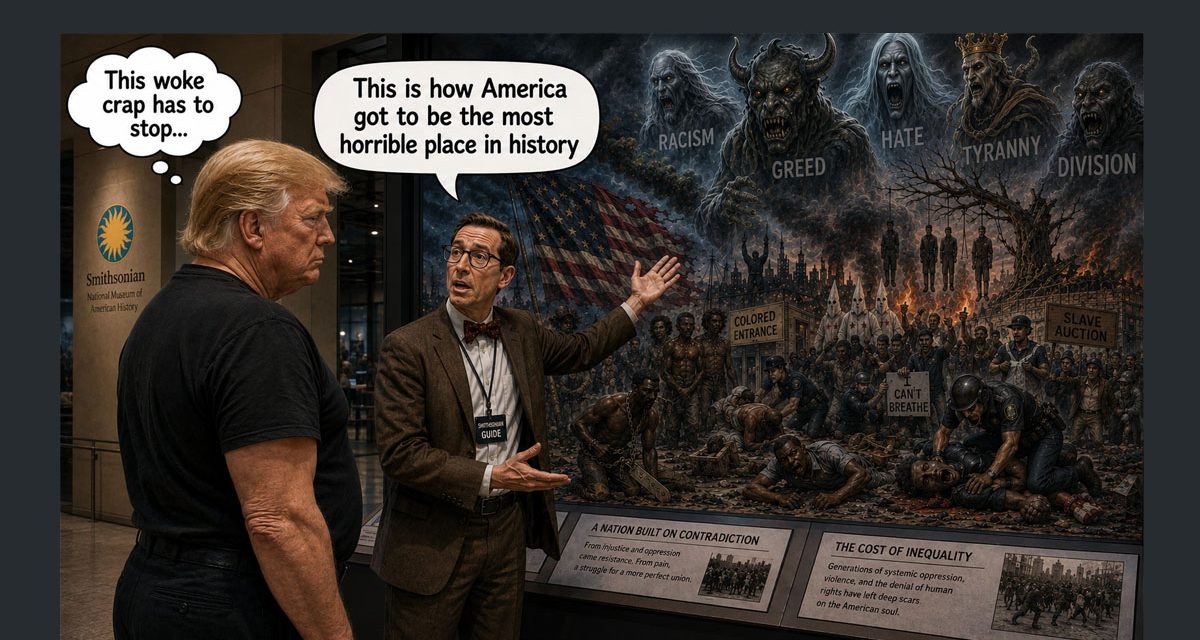
Trump Says America’s Museum Has Lost Its Way
President Donald Trump has opened one of the most consequential cultural battles of his administration, accusing the Smithsonian Institution of allowing ideology to overshadow the nation’s history.
The dispute intensified after the White House released a report titled Saving America’s Story, which argues that the National Museum of American History has drifted away from its mission of historical education and scholarship. The report contends that museum leadership has embraced political activism, presenting American history through a modern ideological lens rather than as “a shared national inheritance to be taught and celebrated.”
Because the Smithsonian operates independently of the executive branch, Trump cannot simply order exhibits to be rewritten. Instead, his administration directed that warning signs be placed outside the National Museum of American History informing visitors that the White House believes portions of the museum present an inaccurate depiction of the nation’s history. The administration also called for exhibits to better commemorate the nation’s 250th anniversary and to place greater emphasis on America’s founding principles, achievements, and shared heritage.
Trump summarized his criticism in a Truth Social post cited in the source material.
“The Smithsonian is OUT OF CONTROL,” he wrote. “Everything discussed is how horrible our Country is, how bad Slavery was, and how unaccomplished the downtrodden have been. Nothing about Success, nothing about Brightness, nothing about the Future.”
Those criticisms have placed Smithsonian Secretary Lonnie Bunch III squarely at the center of the controversy.
Why Lonnie Bunch Became the Focus
The Trump administration’s criticism is rooted not only in museum exhibits, but also in Bunch’s own public statements describing how he believes the Smithsonian should evolve.
Bunch became the Smithsonian’s 14th Secretary in 2019 after serving as the founding director of the National Museum of African American History and Culture. As secretary, he oversees the Smithsonian’s 21 museums, 21 libraries, the National Zoo, research centers, and thousands of employees.
Soon after taking the position, Bunch outlined a philosophy that made diversity and inclusion central to the Institution’s future.
“I want the Smithsonian to make diversity and inclusion so central that it’s no longer talked about,” Bunch told Smithsonian Magazine in 2019.
He also described the Smithsonian as playing a broader role than preserving historical artifacts.
“We call ourselves the Great Convener, but we’re really a Great Legitimizer,” Bunch said. “I want the Smithsonian to legitimize important issues, whether it’s 1619 or climate change.”
Discussing the Smithsonian’s participation in The New York Times’ 1619 Project, he added:
“Everybody that thought about the 1619 Project, whether they liked it or disagreed with it, saw that the Smithsonian had fingerprints on it. And that to me was a great victory.”
To supporters, those remarks reflect an effort to broaden historical interpretation and include perspectives that were often overlooked. Critics argue they demonstrate a deliberate shift toward using the Smithsonian to shape contemporary cultural debates.
The Conservative Critique
One can easily argue that DEI is focused on the worst of America – or at least the liberal illusion thereof. It accused America of heinous crimes against various people at various times, and demands that institutions private and public act to correct those crimes, to the exclusion of all other factors – including whether or not it is good for the institution.
Some important conservative point:
- Christopher Rufo argues that DEI replaces merit-based hiring and promotion with identity-based decision making.
- Heather Mac Donald contends that DEI elevates race and gender over qualifications and competence.
- Mike Gonzalez of the Heritage Foundation argues that DEI shifts institutions away from education and toward ideological activism.
- John Sailer of the Manhattan Institute argues that diversity statements increasingly function as ideological screening mechanisms in hiring.
- Heritage Foundation scholars argue that many DEI programs compel ideological conformity, expand bureaucracy, and produce little measurable benefit.
- Christopher Rufo argues that DEI transforms museums and universities from educational institutions into activist organizations.
- Mike Gonzalez contends that some museums increasingly interpret American history primarily through themes of oppression, identity, and social justice rather than presenting a broader national narrative.
- Heather Mac Donald argues that DEI abandons the traditional ideal of judging individuals without regard to race.
- Heritage Foundation scholars argue that publicly funded institutions should remain politically neutral rather than promoting contested ideological frameworks.
In short, this is institutionalized racism, sexism (and a few other -isms…)
Bunch Rejects the White House’s Characterization
Bunch has rejected the administration’s assessment of the Smithsonian.
In a message to employees, he wrote that the White House report “is not a fair characterization of the work and totality of the National Museum of American History.”
He said the Smithsonian remains committed to “scholarship, nonpartisanship, independence, accuracy and integrity” and to presenting “the fullness of America’s story.”
That response reflects the fundamental disagreement at the heart of the controversy.
The Smithsonian has allowed ideology to overshadow patriotism and national achievement. Bunch has allowed his own cynical view of American to influence Smithsonian content to emphasize the few (relative to most other countries) flaw and provide a dark view, rather than to emphasize the progress and triumphs of the greatest country in world history.
And Trump is pushing back.




Ben, as I have shown, with facts, you are not 100% correct on many a Trump edict. Only a blowhard…
But we are 100% right Frank
Ben, makes sense to me except for a few things you think you see that obviously are just not true…
Good talk Frank. But I speak for what I see. And I see serious consequences if democrats get control. And…
Ben, thanks for sharing your feelings. Good luck, you will need it as most of America hates you, your Felon…