




Newsom’s EV Mandate Now a Political Millstone Around His Neck
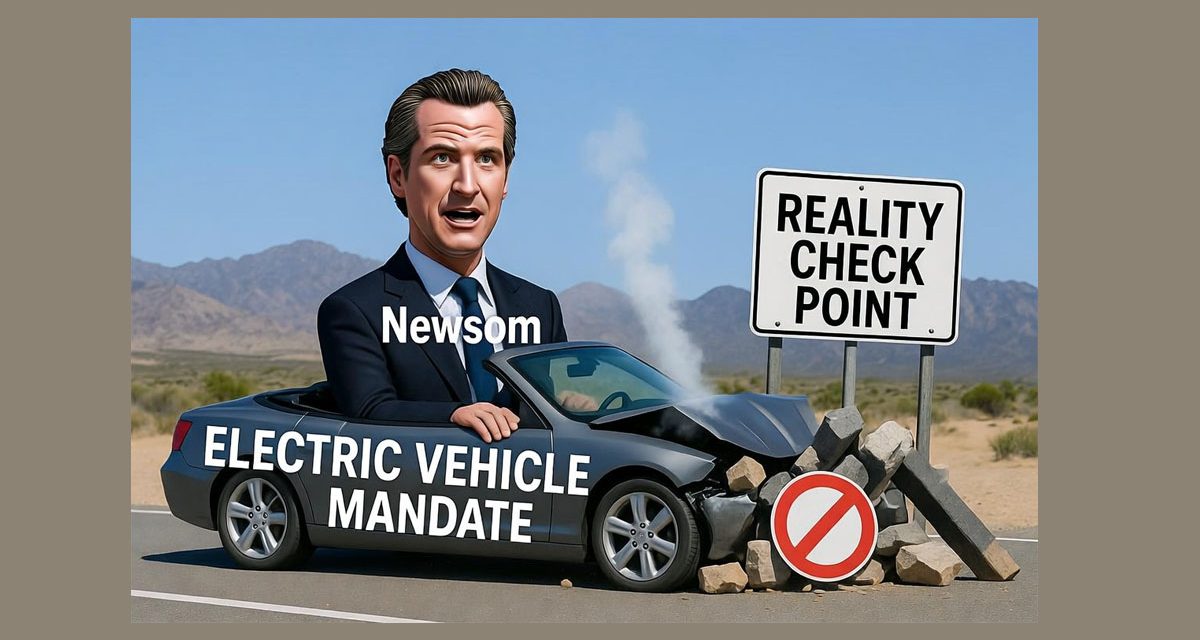
In 2020, California Governor Gavin Newsom was riding high on the left’s climate change ideology. Those greenhouse gases would be reducing planet earth to a sterile lifeless cinder in a relatively short time. In response, Newsom mandated that by 2035, every new passenger car and light truck sold in California must be a zero-emission vehicle. No more internal combustion engines for the masses. The state would simply decree the future of transportation, and the citizens would obediently comply. Uh huh.
It was a preposterous, impossible goal at the onset—and totally out of line with the realities of climate change and its causes. Newsom issued the order by executive fiat. Neither the voters nor the legislature had a meaningful say. The unelected California Air Resources Board then built the regulatory machinery around it. (Left-wingers love creating bureaucracies). One board member called the shift “monumental” and “the most important thing” the board had done in three decades. Words like “arrogant overreach” might have been better suited.
(For the sake of the record – and in the spirit of I told you so — this writer declared Newsom’s mandate political chicanery and impossible to achieve at the time he issued it. But I digress — smugly.)
Fast forward six years, and the political bill has come due. A recent Public Policy Institute of California survey shows that nearly two-thirds of state residents—66 percent of adults and 65 percent of likely voters—oppose the governor’s EV decree. Opposition has climbed 17 points since 2021, when the public was roughly split. Republicans reject it overwhelmingly. Even independents reject it. And Democrats have grown far more skeptical. The resistance stretches across every region of the state and every income bracket that actually has to buy a car.
California Democrats enjoy feeling virtuous about climate change when the costs fall on someone else. Most Democrat voters cheer radical green restrictions aimed at corporations because they have succumbed to gospel according to Gore. But when the price lands in their own driveway, the green ardor stalls out like an EV with a dead battery on a cold winter morning. They have no interest in being forced to purchase more expensive vehicles of uncertain long-term cost, limited range, and dependence on a grid that has a documented history of blackouts and deliberate shutoffs.
Large majorities still claim the state’s climate laws are good in the abstract. Vast majorities conversely complain that they already pay too much for energy and rebel against many alternative energy sources and energy saving sacrifices. Such inconsistencies are inherent in left-wing theology.
Newsom’s war on fossil fuels does not merely raise the price of gasoline. It drives up the cost of living across the board. Every climate regulation, tax, and fee is passed along to residents in higher prices for food, housing, retail goods, and any product that must be moved, manufactured, or delivered.
All that for rules that enrich political donors and green-industry cronies while producing near-zero measurable effect on global temperatures—the ostensible point of the entire exercise.
Later climate information has only sharpened public doubts. The apocalyptic timelines once treated as settled science by the likes of a climate change guru Al Gore have ebbed. Extreme predictions have repeatedly failed to materialize on schedule – and may never.
Meanwhile, the practical costs of the transition have become impossible to ignore — higher energy prices, strained electrical infrastructure, and the simple reality that many Californians live in apartments, older homes, or rural areas without easy access to charging.
Public opinion has shifted accordingly. People remain concerned about the environment, yet they rank affordability and energy reliability far higher than forced technological conversion on a political timetable.
This mandate is not an isolated misjudgment. It is part of a broader pattern of elite overreach that is steadily eroding Newsom’s standing. (Did the never-ending high speed rail fiasco come to mind?) Soaring taxes, housing shortages, crime, homelessness, and regulatory hostility to business already define the California model in the eyes of much of the country. The EV order simply adds another vivid example of a governor who believes ordinary citizens should be told what they may buy and how they must live. Most Americans, including Californians, do not respond well to that message – unless it is by moving out of the tarnished Golden State.
National polls reflect the damage. Newsom once positioned himself as a leading contender for the 2028 Democratic presidential nomination. Recent surveys consistently place him well behind former Vice President Kamala Harris and sometimes trailing other potential rivals – including AOC. His early advantage has faded as voters take a longer look at the record of expensive boneheaded policies and projects. A governor who cannot sell his signature climate policy even in deep-blue California faces an uphill climb explaining that same vision to the rest of the nation.
If electric vehicles are truly superior, consumers will choose them without compulsion. Some already have. Others will. Still others cannot afford them, have no practical way to charge them, or simply prefer the range and convenience of gasoline. The market is capable of sorting this out. Newsom’s mandate tries to short-circuit that process by political command.
Continuing to defend a pie-in-the-sky policy that two-thirds of his own constituents now reject only tightens the millstone around his neck. In politics, as in driving, ignoring the gas gauge eventually leaves you stranded.
So, there ‘tis.



Ben, as I have shown, with facts, you are not 100% correct on many a Trump edict. Only a blowhard…
But we are 100% right Frank
Ben, makes sense to me except for a few things you think you see that obviously are just not true…
Good talk Frank. But I speak for what I see. And I see serious consequences if democrats get control. And…
Ben, thanks for sharing your feelings. Good luck, you will need it as most of America hates you, your Felon…