






Will Senate Midterms Defy History? Republicans Seem to Hold the Advantage
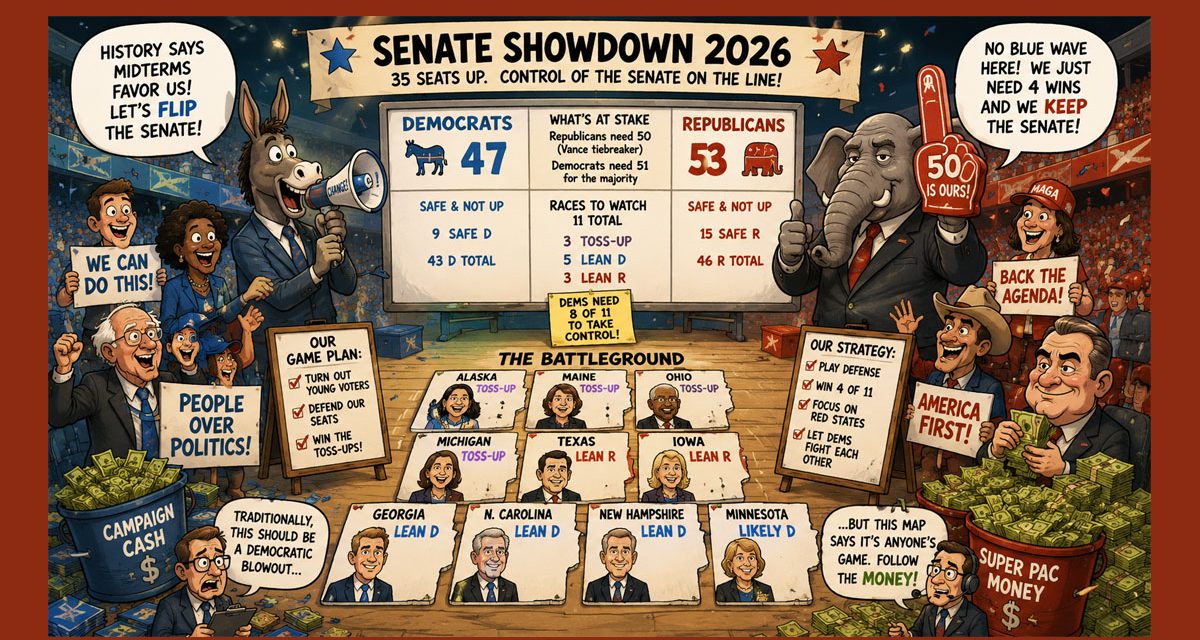
Predictions for the 2026 Senate elections are producing an unusual picture. Midterm elections almost always favor the party out of power, and Republicans are facing many of the traditional headwinds that come with controlling the White House. President Donald Trump is in office, Republicans hold a 53 to 47 majority in the Senate, and history suggests Democrats should be well positioned to make significant gains.
Yet the current forecasts tell a more complicated story. Rather than showing a Democratic wave that is likely to sweep Republicans from power, most major nonpartisan election analysts still believe Republicans are favored to retain control of the Senate, even if several races remain highly competitive.
A difficult map for Democrats
Republicans currently hold 53 Senate seats while Democrats, including two independents who caucus with them, control 47. Thirty five Senate seats are on the ballot this year. Of those, 23 are currently held by Republicans and 12 by Democrats, giving Democrats more opportunities to make gains than usual. Even so, the map remains challenging.
Current forecast aggregations compiled from the Cook Political Report, Inside Elections, and Sabato’s Crystal Ball classify nine races as safely Democratic and fifteen as safely Republican. Eleven additional contests are considered competitive enough to watch, ranging from likely races to true tossups.
Under the current Senate balance, Republicans need only 50 seats because Vice President JD Vance can cast the deciding vote in a tied Senate. Democrats therefore must reach 51 seats to regain control. According to the current forecast, Republicans need to win only four of the eleven competitive races to preserve at least a 50 seat majority, while Democrats must capture eight of those contests to take control of the chamber.
Why this midterm looks different
Political analysts note that Republicans are confronting many of the same conditions that traditionally produce losses for the president’s party. Concerns over inflation, gasoline prices, President Trump’s approval ratings, and international events have created an environment that would normally favor Democrats. Fox News described these factors as “a perfect storm” for the GOP.
Yet Democrats face significant challenges of their own. Polling has shown continued weakness in the party’s national image, while several contentious Democratic primaries have highlighted divisions between establishment candidates and more progressive challengers. Republicans have used those internal disputes to argue that Democratic nominees are becoming increasingly ideological.
Sabato’s Crystal Ball recently shifted three Senate races in Democrats’ favor, moving North Carolina to Lean Democratic while changing Alaska and Ohio to Toss-up. Even after those changes, however, the analysts concluded that Republicans remain better positioned overall because Democrats must win nearly every major battleground while Republicans can afford to lose several.
The races most likely to decide the majority
Eleven races currently make up the competitive Senate battlefield.
Nebraska (Likely Republican)
Republican incumbent Pete Ricketts seeks a full six year term against independent Dan Osborn. Nebraska remains a strongly Republican state, with Donald Trump winning by more than 20 percentage points in 2024. Although Osborn is again mounting an independent campaign, the race is still rated Likely Republican.
Texas (Lean Republican)
Democrat James Talarico faces Republican Ken Paxton after Paxton defeated longtime Senator John Cornyn in the Republican primary. Democrats hope Talarico’s strong fundraising can make the race competitive, but Texas continues to lean Republican after multiple Trump victories statewide.
Iowa (Lean Republican)
Ashley Hinson, backed by President Trump, is running to replace retiring Senator Joni Ernst. Democrat Josh Turek emerged from a contested primary. Iowa has steadily shifted toward Republicans during the Trump era, making Democrats’ path difficult despite the open seat.
Alaska (Toss-up)
Former Representative Mary Peltola challenges Republican Senator Dan Sullivan in one of the year’s most competitive contests. Although Trump carried Alaska by double digits in 2024, analysts believe Peltola’s statewide appeal and Alaska’s ranked choice voting system could produce an unusually competitive race.
Maine (Toss-up)
Republican Senator Susan Collins again finds herself defending a seat in a state won by Kamala Harris. Collins remains one of the nation’s strongest crossover Republicans, but Democrats have struggled with controversy surrounding nominee Graham Platner and his tossing, raising questions about whether they can capitalize on favorable political conditions.
Ohio (Toss-up)
Former Senator Sherrod Brown is attempting a political comeback against appointed Republican Senator Jon Husted. Ohio has become significantly more Republican in presidential elections, yet Brown’s long statewide record has kept the race highly competitive according to multiple forecasting organizations.
Michigan (Toss-up)
With Senator Gary Peters retiring, Michigan features an open seat. Republicans have united behind former Representative Mike Rogers, while Democrats have experienced a divisive primary contest. Analysts believe the eventual Democratic nominee could determine whether this seat remains Democratic or flips to Republicans.
Georgia (Lean Democratic)
Senator Jon Ossoff seeks reelection against Representative Mike Collins. Although Trump narrowly carried Georgia in 2024, Ossoff has built a substantial fundraising advantage and currently enters the general election with a modest edge according to most forecasters.
North Carolina (Lean Democratic)
Former Governor Roy Cooper gives Democrats one of their strongest pickup opportunities against Republican Michael Whatley. Cooper’s statewide popularity and fundraising strength prompted Sabato’s Crystal Ball to move the race into the Lean Democratic category.
New Hampshire (Lean Democratic)
The retirement of Senator Jeanne Shaheen has created an open seat. Democrats are expected to nominate Representative Chris Pappas, while Republicans are holding a competitive primary. The state continues to lean Democratic in federal elections, giving Democrats an advantage.
Minnesota (Likely Democratic)
Senator Tina Smith’s retirement created another open seat. Republicans hope to capitalize with conservative commentator Michele Tafoya, but Minnesota remains a Democratic leaning state and analysts continue to rate the race as Likely Democratic.
Money may determine the outcome
While history favors the party out of power, analysts increasingly suggest that campaign resources could become the deciding factor in several close races. North Carolina illustrates the point. Roy Cooper has significantly outraised Republican Michael Whatley, although outside Republican organizations may narrow that financial gap before Election Day. Similar fundraising battles are unfolding in Texas, Georgia, and Michigan, where both parties are expected to invest heavily.
The unusual structure of this election means Democrats have little margin for error. They must win nearly every major battleground while successfully defending all of their own vulnerable seats. Republicans, by contrast, can lose several competitive contests and still maintain Senate control.
That is why, despite the traditional expectation that the president’s party suffers in midterm elections, most current forecasts still give Republicans the upper hand. Democrats appear capable of making gains, but unless they can convert nearly all of the closely contested races, Republicans are positioned to emerge from November with control of the Senate intact.


Read it and weep Dunger
Jim Dung: I smile at the thought that I reside right between your eyes: 24×7. Priceless.
Blame it all on me. I am the bane of your meager existence. Frustrated? Must be my fault. Ear worm’s on fire. Keep up the fine work and way to stay on target. Unless I’m your target. I’m your huckleberry.
Sorry, dude, I don’t dance to that beat: try weird Uncle Dung, or maybe Howeird and you can Blankenship together.
Jim, James, Iacobus, Jacobus, the supplanter, the holder of the heal. While it has many accolades, let’s face it, the crudest, earliest definition ain’t grand. Last guy I would expect to be name calling giving his is renown for sucking hind tit.
Better than left nut.
No one would know that better than Howeird Whitesheeple who spends his days thinking of crude things to say about me to get his ya ya’s off.
Someday, if he grows up, he may actually have something to say on topic versus his little boy name calling act.
Under three months to begin the process of dethroning and defanging of Trumpism. If his deficit doesn’t sink us by then.