






Is America Tired of Pizza?
An Industry That Lost Its Momentum
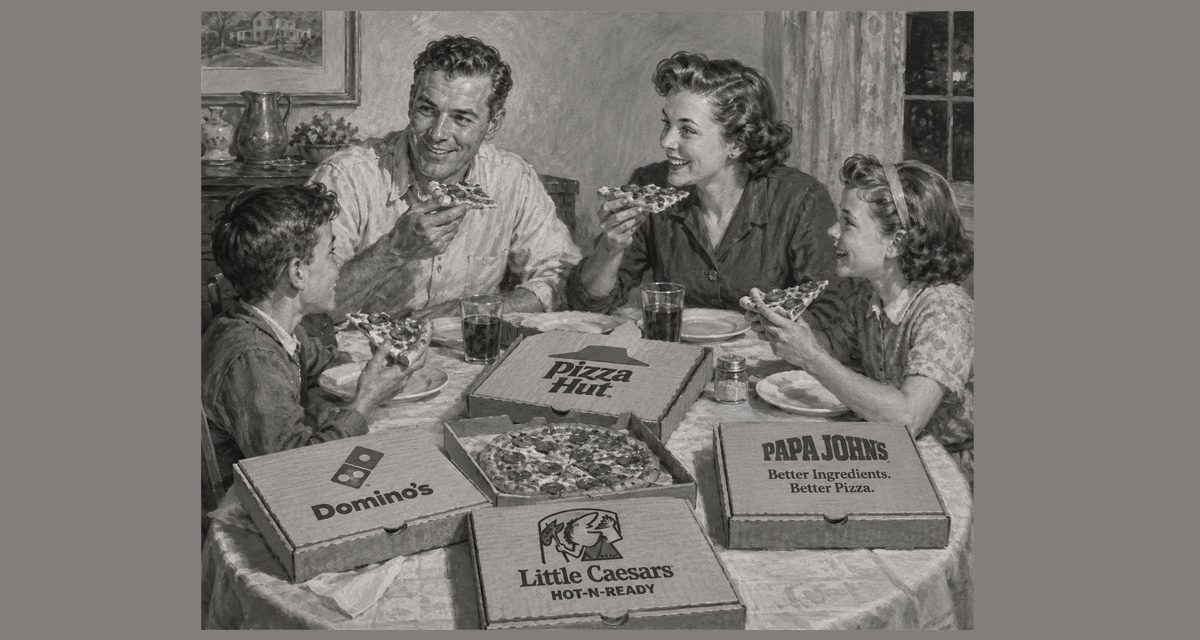
For decades, pizza was one of America’s safest restaurant investments. Families gathered at Pizza Hut for dinner, Domino’s built an empire on dependable delivery, Papa John’s expanded rapidly across the country, and Little Caesars became synonymous with inexpensive carryout. Investors rewarded these companies with steadily rising valuations, particularly during the COVID-19 pandemic when consumers stayed home and ordered takeout in record numbers.
That picture has changed dramatically. Pizza stocks and sales have cooled across much of the industry as consumers return to restaurants, explore a wider variety of food choices, and face tighter household budgets. The key question for investors is whether Americans are simply moving on from pizza or whether the industry is merely settling back to normal after an extraordinary pandemic boom.
Domino’s: Still the Industry Leader Despite a Sharp Decline
Domino’s remains the strongest publicly traded pizza company, but even it has not escaped investor pessimism. The company’s shares have fallen nearly 40 percent over the past year as slowing sales and management changes rattled Wall Street. First quarter same store sales grew only 0.9 percent, prompting management to abandon its previous growth target for 2026.
The broader competitive landscape has also changed. Delivery services such as DoorDash and Uber Eats have eliminated one of Domino’s greatest competitive advantages by allowing local pizza shops to compete alongside national chains on the same platform. Consumers shopping for dinner now see local pizzerias alongside Domino’s, while tacos, chicken, burgers, and frozen pizzas compete for the same dollars.
Yet many analysts believe Domino’s remains the best positioned company in the sector. It continues to expand while Pizza Hut and Papa John’s are shrinking, and its share of sales among the three largest public pizza companies has climbed from 38 percent in 2016 to 54 percent in 2025. The company’s efficient supply chain, strong franchise economics, growing free cash flow, dividends, and aggressive share repurchases have led some analysts to argue that the recent selloff has created an attractive long term buying opportunity rather than signaling permanent decline.
Pizza Hut: From Industry Giant to a Company for Sale
Few stories illustrate the industry’s struggles more clearly than Pizza Hut. Once the dominant force in American pizza, the company has steadily lost market share over the past decade. Its share among the three largest public pizza chains has fallen from 41 percent in 2016 to just 27 percent in 2025.
The decline became significant enough that parent company Yum! Brands decided to sell Pizza Hut’s operations in two major transactions totaling approximately $2.7 billion. The sale marks the end of an era for one of the most recognizable restaurant brands in America.
Pizza Hut has struggled to compete in an environment where delivery apps reduce the value of large national chains and consumers increasingly seek variety beyond pizza. Store closures and shrinking market share have reflected those challenges, making the chain one of the clearest examples of how difficult the pizza business has become after the pandemic surge.
Papa John’s: From Pandemic High to Investor Disappointment
Papa John’s has experienced one of the sharpest reversals among the major pizza companies. During the pandemic, investors viewed the company as a major beneficiary of stay at home dining. Its stock climbed from roughly $110 during mid 2021 to an all time high near $140 later that year.
That enthusiasm faded quickly. Rising labor and food costs, slowing delivery demand, weaker consumer spending, and leadership changes combined to pressure profits. Comparable store sales frequently disappointed investors, and the stock entered a prolonged decline.
By 2026, shares had fallen to roughly $34, leaving the company trading about 70 percent below its pandemic peak. Reports that the company has explored a possible sale underscore the challenges facing the business. While Papa John’s remains one of the nation’s largest pizza chains, investors have become increasingly skeptical about its ability to regain the rapid growth that once justified much higher valuations.
Little Caesars: Declining Sales but Relative Strength
Unlike its publicly traded rivals, Little Caesars is privately owned, so investors cannot track its stock price. Instead, industry observers focus on sales performance.
The company experienced record demand during the pandemic, with estimated U.S. systemwide sales reaching approximately $4.2 billion in 2021. As consumer behavior normalized, those sales declined to roughly $3.5 billion by 2024, representing a drop of about 17 percent from the pandemic peak.
Even so, Little Caesars has performed better than many competitors. It remains the nation’s fourth largest pizza chain with approximately 4,285 locations and average restaurant sales of about $900,000 annually. While much of the pizza industry reported declining sales during 2025, Little Caesars actually posted modest growth, supported by its value oriented business model and inexpensive carryout offerings. Rather than signaling collapse, its recent performance suggests that the company has successfully adapted to a more challenging market.
Bubble or Changing Consumer Tastes?
The central debate surrounding the pizza industry is whether America has permanently lost its appetite for pizza or whether investors are simply witnessing the end of an unsustainable pandemic bubble.
There is evidence supporting both views. Market research indicates pizza’s share of U.S. restaurant spending has slipped as consumers increasingly choose chicken, Mexican food, and other dining options. Delivery apps have also intensified competition by placing independent restaurants on equal footing with national chains.
On the other hand, the pandemic created unusually favorable conditions that were unlikely to last indefinitely. Families confined to their homes ordered far more pizza than normal, producing exceptional profits and inflated stock prices. As life returned to normal, some decline was almost inevitable.
For investors, that distinction is critical. If Americans are permanently abandoning pizza, the industry’s best years may be behind it. If the recent weakness simply reflects the unwinding of an extraordinary COVID era bubble, today’s lower valuations, particularly for companies like Domino’s, could represent an attractive long term opportunity. Time will determine which interpretation proves correct, but one thing is already clear: the easy gains that once made pizza one of Wall Street’s favorite restaurant investments have become much harder to find.




I find pizza a most interesting topic starting with how can there be all those shops. Only nail salons, Starbucks, and gas stations are as plentiful. I mean how can you have all those shops and they rarely seem to go broke; competition never seems to deal the death blow. It’s inexpensive and kids love it.
First, there are five different market alternatives, the Quick Service Retail sector is what’s discussed here including the biggies like Dominoes, then there’s the Fast Casual sector where you will wait 5-10 minutes, maybe make your own like Chuckie Cheese, the newer take n bake segment like Papa Murphy’s, and NJ’s favorite, the FSR, Full-Service Retail or corner pizza shops. And lastly, gourmet pizza is a niche making inroads. To compete with NYC, our NJ “gold coast” which became established as a safer, cleaner, hot spot for city-folk to live starting post 9/11 is now replete with the fanciest pies you could imagine, designed by chefs and without take-out. Definite fork fare.
Growing up, Mom would roll her own, the dough sitting on the front porch in a bowl, under a dish clothe, rising ever so slowly. Oh what a treat pizza night was, but a lot of effort for such a simple dough.
Of course, in NJ, being so close to the best pizza in the world, NYC’s, we take our pizza seriously, even having two places for the historic tomato pie (don’t ask me). After a life’s migration around the mid-lantic region to New England to Lake Erie, when I returned to NJ in the 80’s, we sojourned to NYC’s Broadway where we went for a slice before the play. Something happened and the result was the guy gave me two slices for free. I turned to my spouse and declared: “it’s pretty good around this NYC urban jungle.” And the za was never more marvelous: free does that. We have pizza wars over how to eat: straight-up, fold, or fork? I prefer fork to help limit me from devouring the whole pie although often use “the fold.” And deep dish, Chicago, whatever, there’s only one dough, New York Style. At least for us. The rest is just more dough.
My top choice, an FSR outside of Newark, Star Tavern, been tossing pies since 1945 and consistently is in the top five in NJ. Pies are thin and crisp. Kitchen is open and boisterous. Just don’t make a wrong turn in Orange. For tomato pie, you have to go near Trenton, two shops vie for first pie, have not made that journey yet, on the list.
In my study of pizza, I wondered why so many shops that never seem to fail? Ever notice that everyone has a shop nearby and will drive right past it for their favorite pie? And that’s it: pizza is a substance of varying personal tastes for no consistent particular reason. Everyone has their fav, and favs seem spread across all shops in the area. I used to like the Greek guy who won the pizza spinner contest three years running in Allentown. Fun to watch and funnier to get a decent pizza from a Greek. He learned his spin there. It’s weird that no clear market winner emerges and people will drive past a dozen pizzerias for their favorite. Star Tavern has been in the top five since 1985 at least and yet there are many other shops in close proximity. In NJ, the fact Dominoes exists against FSR with take-out seems impossible, but there it is. Our Piza Hut went bust, but that was more a local store issue than a vote against the chain. Then covid hit and we, like many, tried Dominoes. Tastes OK, pretty meh, but so damned easy to get. Much easier than door-dash.
So, like everyone, we started using it but have slowed down post covid. Also, other shops began to compete with either curb-side or delivery. Panera’s outsources to door dash, but you see single supplier from Panera’s website and that’s important. I hate having two or three in the value chain for a meal, each pointing to the other when your food arrives cold. And fast food is not cheap food anymore, nor is pizza, so other restaurants are competing on price now.
After all, variety is the spice of life. Plus, with food inflation, we are using less takeout in general.
I will continue on this story, the numbers side, on a latter tome, but will note that you can’t use stock prices to assess market size or sales even. There’s a relationship but not direct and not consistent between companies. Just does not work that way. Dominoes has a $9.99 sale for up to seven toppings which means they have to sell 50% more pizzas to equal revenues from before the deal. A deal like that screws with tracking market size.
We have also move to making our own and just got the Ninja flexfire that is also a pizza oven. Can even smoke em. Should try that any day now. The new ready-made crusts make this easier than ever.
Frank Danger … as a 75 years connoisseur of pizza, I can assure you Chicago style — think crust cut in squares — reigns supreme. I have never known any place that serves traditional Chicago pizza go out of business. In south Florida, Windy City Pizza in Delray Beach thrives as others come and go. I meet a lot of New Yorkers there. I suppose you will next claim that a New York hot dog is superior to a Chicago Vienna dog properly dressed.
I’m a second day Domino’s guy myself…
As I said; pizza is a substance with so many variables of taste and quality making all those shops exist and survive.
I love Chicago for food. But face it; Chicago pie is just more dough. NY style in NYC reigns. Our Star Tavern is NYC in essence.
Chicago Hot dog: never had one but your story put it on my list. I believe. Plus, never liked Nathan’s.
How about Buffalo: Beef on Wick! Lost in history as last family tappy sold out. Can’t find real kummelwick.
And in your backyard: Stone Crab Claws! The only renewable meat supply by woke laws and harvested by dei denisons. Once a year treat for me now.
And Joe’s home style Tennessee treat: squirrel brains. Like cracking walnuts. Do I hear Deliverance dueling banjos? Ben doing Ned Beatty?
Pizza by the numbers: quick-service pizza sales (QSR) have not been in freefall, but in deceleration for four years since covid. In 2025, we went deeper hitting a 0.3% year-over-year sales slide following an actual gain of a mere 0.6% in 2024 and an increase of 2.8% in 2023, according to the Technomic Top 500 Chain Restaurant Report. Unit count has followed a similar trajectory, with just a 0.1% gain last year, following 0.6% in 2024 and 1.1% in 2023. Note the Dominoes $9.99 effect: dollars down, units up. In 2025, the category’s performance was skewed by an outsized impact from some of its biggest players hemorrhaging sales. Pizza Hut, No. 2, lost 8.2% of its sales in 2025, for instance. Six out of the top 10 QSR pizza chains were negative last year. In addition to Pizza Hut, they included: No. 4 Papa Johns, -1%, No. 5, Marco’s, -2.4%, No. 6, Papa Murphy’s, -3%, No. 8, MOD Pizza, -10.6% No. 10, Hungry Howie’s, -5.2%
Little Caesars (No. 3, 1.4%) and Chuck E. Cheese (No. 9, 0.6%) were steady as it goes, while Domino’s extended its market share dominance with a 4.8% gain and No. 7 Jet’s Pizza provided a bright spot with an 11.5% increase.
The overall restaurant industry was up just 3% in 2025, marking the fourth consecutive year that Top 500 sales gains decelerated compared to the prior year. Within that overall cooldown, pizza was the only category to turn negative for sales year-over-year.
Every single category in Technomic’s newly released Top 500 report turned in a stronger year-over-year sales performance in 2025, including sandwich, which was up just 0.2%. The QSR pizza category was No. 6, outpaced by burger ($113.3 billion), chicken ($56.3 billion), coffee/café ($53.9 billion), sandwich ($37.4 billion), and Mexican ($35.1 billion) categories, with $31 billion in sales
According to Technomic, much of pizza’s challenges have come from an increase in competition from other food segments. Sales at Asian concepts last year. I have noticed a general slide of many “upscale” or “premium brands’ coming under pressure from lower priced alternatives as inflation continues its effect of making us pay more for energy and suck it up in commodities while postponing upgrades or fixes to our property assets. General Mills down, P&G flatlining, in general, premium commodity stock prices are down or under pressure.
While premium price pressure is expected in this mixed economy, the fact it’s hitting competitive priced food means people are tightening belts across the board now, pruning back on anything that moves. Worse yet, this is a world phenomenon and we are just Queen of the pigs; we are all pigs looking for a less expensive trough. Good time to look for sales at specialty shops before they go out of business or recover.
FYI: I never buy restaurant stocks, too fickle a market. Rarely buy apparel stocks except for “up and comer” growth stocks like Under Amor before people could spell UA. Usually go for commodities like Kraft, General Mills, etc. and lately, they have been meh. I mean when you buy GIS at a 52 week low and it goes lower in this market, you really scratch your head. Except for that 6.7% dividend yield as commodities and value stock can often be one. Dominoes yield is around 2.5%.
So, there you go. Pizza decelerating as is all restaurants but pizza losing to other types of food. Dominoes aggressive pizza is gaining market share but is it at the cost of profits? Every premium product or retailer is under pressure in Trump’s inflationary world where affordability is a dirty word.