






With Platner … Democrats Stand Against Alleged Rape but Not Antisemitism
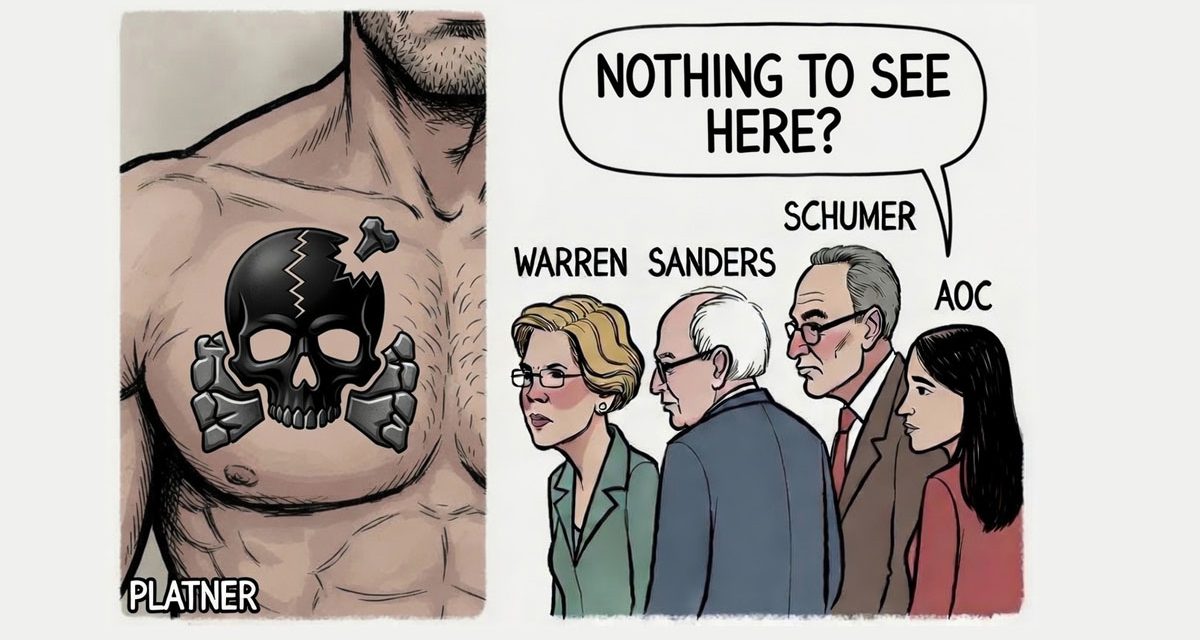
By the time you read this, Maine’s Democratic Senate candidate Graham Platner may have already withdrawn from the race in the wake of an accusation of rape leveled against him from nearly five years ago. The accuser, Jenny Racicot, a woman with whom Platner maintained an on-and-off relationship for more than two years, claims that in late 2021 he entered her rural Maine home uninvited while deeply intoxicated and forced himself upon her despite her repeated and clear objections. She has characterized the encounter as non-consensual.
Platner denies the allegation outright (well, duh) — declaring any suggestion of non-consensual conduct “categorically untrue.” He does not deny categorically having had a sexual relationship with Racicot. He insists that all his sexual indiscretions – before and during his marriage — were entirely consensual.
For the most part, this remains another classic she said/he said dispute with little in the way of corroborating physical evidence. Yet the left leaning media – operating in the court of public opinion — have swiftly deemed the accusation “credible.” They are surrounding Platner like sharks smelling blood in the water.
This development lands atop a lengthy catalog of prior controversies and misbehaviors. Among the most notable is the Nazi Totenkopf tattoo – the unmistakable death’s head emblem of Hitler’s SS – that adorned Platner’s chest for more than 18 years. He only arranged to have it covered at the launch of his Senate campaign, when it drew public criticism.
Platner has claimed he remained blissfully unaware of its Nazi significance until recently — an explanation that strains credulity. An ex-girlfriend had already described it in private messages as a “Nazi tattoo” and specifically as a “Totenkopf” months before Platner professed ignorance.
In addition to the Nazi fascination, Platner has other issues – including a documented pattern of sexting multiple women during his marriage and reports of physically threatening or disturbing conduct toward former romantic partners.
His archived Reddit comments have also drawn scrutiny, including praise for the “damn fine looking and successful” tactics of a 2014 Hamas raid that killed Israeli soldiers, as well as his public characterization of Israel’s actions in Gaza as “genocide.” These statements — combined with the tattoo and other associations — fueled widespread credible accusations of antisemitic and pro-Hamas sympathies long before the current scandal.
The rape allegation has produced a dramatic collapse in support from leading Democrats. Senators Bernie Sanders and Elizabeth Warren, along with California Representatives Ro Khanna and Ruben Gallego, have rescinded or distanced themselves from their earlier endorsements. The Democratic Senatorial Campaign Committee and other major funders are dropping Platner faster than billionaires are fleeing New York City. The Maine Democratic Party has formally called for his withdrawal ahead of the candidate filing deadline.
Conversely, the sudden elevation of this accusation raises questions. Racicot had accused Platner of sexual misconduct in 2023 – following earlier allegations from other women. Interestingly, the story gained explosive traction only now – at the precise moment Platner’s prospects against incumbent Republican Senator Susan Collins appeared to be fading.
Democrats are exhibiting the same cold calculus they applied to President Biden: Stand by the candidate for as long as politically expedient, then jettison him without hesitation the instant he looks like a loser. The fact that they are now rolling back their support and endorsements is less interesting than the fact they gave that support and those endorsements in the first place. Their newfound opposition to Platner’s candidacy makes their initial support much more offensive. They should have opposed him from the get-go. It is just that they should have done it before they made him their candidate.
What remains most remarkable is the magnitude of the Democratic Party’s hypocrisy. With few exceptions – such as Pennsylvania Senator John Fetterman, Massachusetts Congressman Jake Auchincloss –- most powerful Democrats were supporting Platner.
The very same progressive politicians and activists now expressing outrage over an unsubstantiated sexual assault accusation had exhibited no such qualms about Platner’s Nazi tattoo, his apparent antisemitic leanings, his praise for Hamas tactics, his “genocide” rhetoric against Israel and a history of sexual improprieties.
Hatred of the Jewish state, contempt for Jewish political influence, and tolerance for symbols of the regime responsible for the murder of six million Jews constituted no barrier to their enthusiastic backing during the Maine Democratic primary. Those endorsements helped deliver him the nomination — and they were hoping their endorsements would get him elected in November. That was until Platner became more toxic than Chernobyl.
Abandoning Platner – justifiable as it may be — exposes the party’s cynical opportunism. Democrat leaders overlooked the antisemitism and sexual misconduct accusations when it advanced their dream of taking control of the Senate — and became concerned only when it appeared that Platner was losing.
In the final analysis, this episode illuminates the moral flexibility and selective outrage that define today’s Democratic Party far more than it indicts any single candidate. The Democratic Party is no less antisemitic today than it was when all those party leaders were piling on the Platner bandwagon.
So, there ‘tis.



To quote you: it’s legal. Maybe we don’t like the process, certainly the Maine Democrats and probably Democrats have a vetting issue as in they didn’t do it right at all, plenty of warning signs. And you can stick you antisemitic where the sun don’t shine: your nation under Trump.
Calling Bernie Sanders antisemitic is as silly as me calling you a racist.
Calling Chuck antisemitic is as funny as me calling you nonpartisan.
You are just pandering to the masses for your strange need of political gain.
And you missed the perfect candidate, one with most of the checkboxes and the most experience in these things: Kamala Harris for Maine Senator!!!! Let’s hear that laugh again and tell stories about Mom.
Dunger you are a racist you asshole
Henry Dungface: that’s laughable. Prove it. You can’t. I don’t even think you know what a racist is except someone you choose to hate to make yourself feel better about your life’s failures.
Oh yeah, good to meet you. You have quite the style for an icebreaker.
Kumbreath Harris will never be senator for any state. So dream on Dunger.
Ben Dung: Sarcasm and humor are lost on the braindead like Slur Ben of the House of Dung. She would need to establish residency. Just like your state, no doubt.
As Larry notes, Benjamin Franklin issued the famous quote on “can you keep the Republic. Of course, in his cherry-picking, he didn’t not look deeper, as is his way when it suits his caustic cause. Franklin, who issued that famous quote also gave a restrained opinion of what he meant in his final speech before the Constitutional Convention, you know, the stuff that’s actually on the record that Larry ignores because his audience is ignorant: “…when you assemble a number of men to have the advantage of their joint wisdom, you inevitably assemble with those men, all their prejudices, their passions, their errors of opinion, their local interests, and their selfish views.” He concluded it impossible to expect a “perfect production” from such a gathering, but believed that the Constitution they had just drafted, “with all its faults,” was better than any alternative that was likely to emerge. IOW – Franklin thought our Constitution could be improved by future generations. So much for traditionalists although I always think that’s a good place to start. On the keeping it, I noted elsewhere: “But wait, there’s more. In the diary of James McHenry (Franklin’s fellow delegate), Franklin expounded on his thought shortly after the famous quote. When asked why it might not be kept, Franklin warned that people are naturally “disposed to eat more of it than does them good, “implying that greed, corruption, and the lust for unchecked power could lead to the republic’s undoing.” I think with Trump we have the trifecta. And Larry loves ceding the field of power from our three equal branches to one man, a man who would be King, if we just put that name on a bridge or airport somewhere.
Almost all delegates had objections to parts of the Constitution. Persuaded by Franklin’s logic, they put their signatures to it. I think three did not. Their general issue they had was that our rebellious democracy was prone towards disorder, dysfunction, and disintegration. Americans had just used “democracy”–as the rationale for their rebellion against English authority in 1776. It worked! They felt the Constitution had not yet fully defined how to implement principles of popular majority rule preserving a stable government that protected the rights and liberties of all citizens. They feared that another rebellion, this time against them, which might be right around the corner, and it was.
Few among the founders, believed that the new federal constitution alone would be sufficient to create a unified nation out of a collection of independent republics spread out over a vast physical space, extraordinarily diverse in economic interests, regional loyalties, ethnic and religious beliefs. Communication was ponderous and a rebellion might be in motion for weeks or months before the nation even knew. They were spot on, again. In 1794, settlers in western Pennsylvania rebelled about taxes on locally distilled whiskey, a Kash business no doubt; in western North Carolina, a number of abortive attempts to create the independent republic of “Franklin” as an ally to Spain in order to insure its independence from the United States. All across the western frontier there was constant conflicts with Indians led by the locals looking for free land, not there’s. Then the slave-led revolution in Haiti brought fears of the same revolution on America’s shores.
Luckily, we had a lot to hold us together contributing to a national consensus and cohesion. We had a common language; we all ostly be devotees of English common law and constitutionalism; a widespread commitment to the Protestant religion; a shared bonding revolutionary experience; and, an economic environment which promised free, white Americans, a good chance for independence, self-sufficiency, and even higher wealth in the future. You bet your assets that’s a glue that binds. Still does as a lack of it causes societal frustrations, like today. It is perhaps this economic vision that did the most for preserving our democracy. That, and the belief that the Constitution was not perfected, was still the best around, and, most important, it had an established process to make it better. Lincoln’s 1861 quest for “a more perfect union” came directly from the Constitution which he used in his inaugural address speaking to our continued and hopefully constant search to be better, a little more perfect. Having all powers resting in one man is not a union.
The American statesmen who succeeded those of the founding generation served their country with a self-conscious sense that the challenges of maintaining a democratic union were every bit as great after 1787 as they were before. For the most part, they represented men of impeccable and unimpeachable honor, a code if you will. Some aspects of nation-building fostered by these men countered our vision: the toleration of slavery, genocidal policies toward Native Americans, shameful, not honorable. Yet statesmen of all succeeding generations—Lincoln foremost among them–would continue our national quest for a “more perfect union.” Only one President calls half the nation unpatriotic destroyers of our democracy, vermin, traitors, and the like. And Larry in this article mimics that tune.
Such has been our success in building a powerful and cohesive democratic nation-state in post-Civil War America that most Americans today assume that principles of democracy and national harmony somehow naturally go hand-in-hand. As we look at RoW, we see plenty of examples that democratic revolutions do not inevitably lead to national harmony or universal justice. We see that “free speech” and “popular will” can create a cacophony of discordant voices, nationalism unleashing primordial forces of tribal and religious hate conflicting with the goal of building stable and consensual government.
As we look at the state of our federal union 250 later, we can see we have avoided many of the plagues afflicting so many other societies, but IMO, that’s no cause for complacency about Franklin’s warnings. Our Constitution, even amended, is still our nation’s most powerful symbol of unity, better than any monarch or religion. Our Constitution is a stronger, better document than it was when it initially emerged from the Philadelphia Convention. Through the amendment process (in particular, through the 13th, 14th, 15th and 19th Amendments), it has become the protector of the rights of all the people, not just some of the people.
On the other hand, the challenges to national unity under our Constitution are, if anything, far greater than those confronting the infant nation in 1787. Although the new nation was a pluralistic one by the standards of the 18th century, the face of America in 2026 looks very different from the original: we are no longer a people united by language, religion or culture and while our overall level of material prosperity is staggering by the standards of any age, the widening gulf between rich and poor is perhaps the most serious threat to a common definition of the “pursuit of happiness.”
Instead of working towards the common good, to strive for the more perfect union, people like Larry point the finger saying: “it’s their fault, they are our largest threat.” I still say it takes all of us to make this work and if we spend our time pointing fingers instead of listening, compromising, and striving for a more perfect union versus my way or the highway, we will fail and the barbarians will topple the gate and take all of our cheese. It’s a Republic if you can keep it where the you is actually us, or more important, U.S.