






Spain Opened the Door. Then 60,000 Migrants Came Through
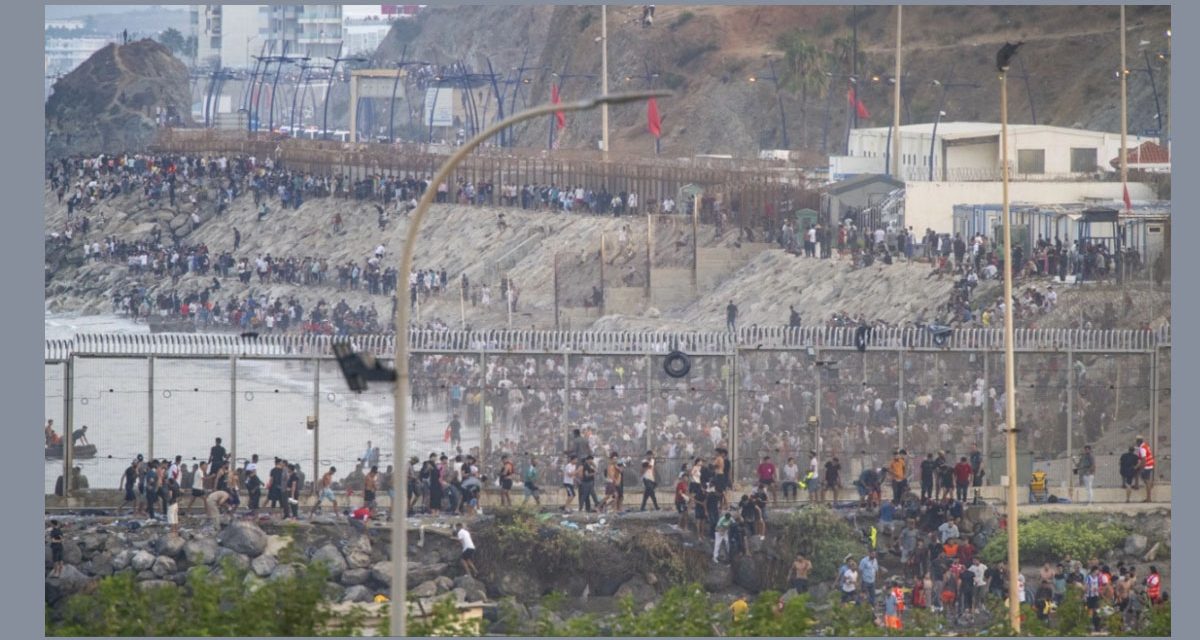
Spain is confronting an extraordinary border crisis after roughly 60,000 migrants poured into the tiny Spanish territory of Ceuta from Morocco in about 24 hours, overwhelming a city whose normal population is only about 85,000.
The surge came after two major changes in Spain’s treatment of illegal immigration. Prime Minister Pedro Sánchez’s government moved earlier this year to grant residency and work permits to hundreds of thousands of migrants already living illegally in Spain. More recently, Spain’s Supreme Court ruled that migrants arriving in Ceuta or Melilla by sea could not simply be returned immediately to Morocco under the expedited procedures used for people crossing by land.
Spanish officials now acknowledge that word of the court decision spread rapidly through migrant and human-smuggling networks.
Then the border effectively collapsed.
Ceuta President Juan Jesús Vivas called the situation “absolutely unsustainable.” Spain deployed soldiers and additional police as thousands of migrants flooded beaches, streets, parks and sidewalks.
For critics of Spain’s immigration policies, the sequence raises an obvious question: What message is sent when a government legalizes hundreds of thousands of people already living in the country illegally, and its courts then make it more difficult to immediately return new arrivals who come by sea?
President Donald Trump believes Americans should pay attention.
“It’s terrible. Remember that picture. That’s going to be us in three years if the wrong side gets in,” Trump warned Friday.
60,000 People in About 24 Hours
The sheer scale of the migration stunned Spanish authorities.
Vivas estimated that approximately 60,000 migrants had crossed from Morocco into Ceuta, an influx equal to about 70 percent of the city’s existing population.
Spain’s Interior Ministry produced a somewhat lower estimate of approximately 50,000. By Friday evening, however, it said 48,300 had already voluntarily returned to Morocco, with hundreds more leaving by the hour.
Many apparently discovered that getting into Ceuta was very different from finding somewhere to live, work or even sleep.
Thousands were left sleeping in parks and on sidewalks. Others wandered through the streets. Unaccompanied children were among them.
“It’s chaotic,” said Rachid Sbihi, who represents Civil Guard officers in Ceuta.
Businesses closed as owners worried about the disorder. Migrant reception facilities that had already been struggling with overcrowding were suddenly faced with a population surge that no local system could reasonably absorb.
Swimming Into Spain
Ceuta’s unusual geography makes it particularly vulnerable.
The Spanish city sits on the North African coast surrounded by Morocco. It has been controlled by Spain since 1580 and represents one of the European Union’s few land borders with Africa.
Many of those involved in the latest surge were Moroccans, although migrants from sub-Saharan Africa were also reported among the crowds.
Some came from the Moroccan city of Fnideq and attempted to swim approximately three miles through the sea to reach Spanish territory. Others entered the water near Belyounech, where the distance is shorter.
Video showed migrants using inner tubes and other flotation devices. Others attempted to get around breakwaters or through border barriers.
Moroccan authorities responded with water cannons, tear gas and warning shots as they tried to stop additional people from reaching Spanish territory.
The crossing proved deadly.
The latest Associated Press account included in the reports put the death toll at 57, although earlier reports gave lower numbers as the crisis developed. Some migrants drowned. Others were reportedly killed during a stampede near the breakwater fence at Tarajal Beach.
Shoes, buoys and abandoned possessions were left floating in the water.
Spain Calls Out the Military
The volume of people overwhelmed the border operation so rapidly that Spain called in its armed forces.
Military personnel, additional Civil Guard officers, specialized diving units and naval resources were dispatched to Ceuta as authorities attempted to restore control.
The pressure also spread eastward.
Migrants attempted to enter Melilla, Spain’s other autonomous territory on the North African coast. In the neighboring Moroccan town of Bni Nsar, migrants clashed with police, threw rocks and reportedly set police vehicles on fire.
The crisis quickly ceased to be merely a Spanish problem.
Italy temporarily restored border controls with Spain under the normally open Schengen system. France announced that it would strengthen its own checks on people arriving from Spain.
European Commission President Ursula von der Leyen declared that the images from Ceuta were “unacceptable.”
“We cannot allow anyone to come to our Union without abiding by our rules,” she said. “Dangerous crossings must stop immediately. Smuggling networks must be dismantled. And returns must be swift, as our rules allow.”
The Court Ruling That Changed the Calculation
Spanish authorities have directly linked the surge to a recent Supreme Court decision.
The court ruled that migrants who reach Ceuta or Melilla by sea cannot be summarily returned in the same manner as migrants crossing by land or climbing the border fence.
According to Spanish officials, crossings began increasing after the ruling and then exploded into the enormous surge seen Thursday and Friday.
Sánchez himself acknowledged how quickly information about the decision traveled.
The interpretation of the ruling “spread like wildfire over the past few hours through the networks of human trafficking organizations,” he said.
Sánchez argues that smugglers misinterpreted the ruling and that trafficking organizations bear responsibility for encouraging people to make dangerous crossings. Some Moroccan activists also questioned whether ordinary migrants would have known enough about a Spanish court decision for it to explain the surge.
But Spain’s own authorities are linking the ruling to what happened.
And the court decision did not occur in a vacuum.
Spain Had Already Legalized Hundreds of Thousands
Earlier this year, Sánchez’s Socialist government moved to provide residency and work permits to hundreds of thousands of migrants already living in Spain without legal permission. One account described the program as potentially legalizing approximately 500,000 people.
Sánchez argued that Spain needs the workers and that immigration can help support an aging population.
Critics saw another message entirely.
If migrants who successfully enter Spain illegally can eventually receive legal status, critics argue, future migrants have an incentive to attempt the same thing.
Spanish conservative politician Isabel Díaz Ayuso was direct about what she believes happened.
“Sánchez allows Spain to be invaded through Ceuta,” she wrote.
The Spanish government insists the legalization program “has nothing to do” with the Ceuta crisis. Technically, the Supreme Court ruling governing sea arrivals and the government’s regularization of migrants already inside Spain are separate policies.
But critics argue that the larger message matters.
When governments repeatedly make illegal entry less consequential, whether through legalization programs or restrictions on immediate deportation, migrants and smugglers may reasonably conclude that reaching the territory is the most important objective.
Trump Warns America to Watch Spain
The Trump administration has seized on Ceuta as a warning for the United States.
The State Department blamed the crisis on what it called the Spanish government’s “deliberate efforts to enable and facilitate mass illegal migration into Europe.”
Vice President JD Vance similarly portrayed the scenes as evidence of the consequences of permissive immigration policies.
Trump’s warning was simpler.
“Remember that picture.”
Spain changed its policies toward people who entered illegally. Its Supreme Court then restricted immediate returns for migrants arriving by sea. Spanish officials say word of that ruling raced through trafficking networks.
Then tens of thousands of people headed for Ceuta.
Whatever combination of desperation, economics, smugglers and policy produced the explosion, Spain is now confronting the practical consequences: troops at the border, overwhelmed facilities, people sleeping in the streets, neighboring countries tightening their borders and dozens of people dead.
Trump’s argument is that the United States should look carefully at what happened next.




Ben, as I have shown, with facts, you are not 100% correct on many a Trump edict. Only a blowhard…
But we are 100% right Frank
Ben, makes sense to me except for a few things you think you see that obviously are just not true…
Good talk Frank. But I speak for what I see. And I see serious consequences if democrats get control. And…
Ben, thanks for sharing your feelings. Good luck, you will need it as most of America hates you, your Felon…