












Xi Jinping’s Summit Challenge to American Leadership
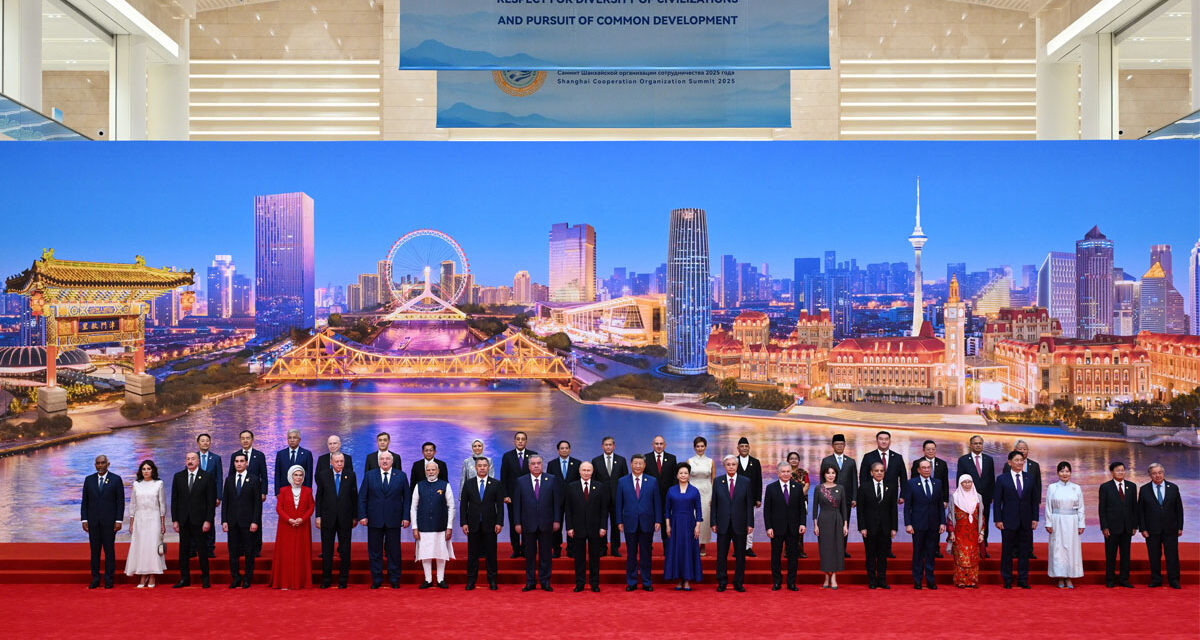
The recent gathering of world leaders in Tianjin, China, for the Shanghai Cooperation Organization (SCO) summit and the subsequent military parade in Beijing was more than a diplomatic spectacle—it was a strategic power play by Chinese President Xi Jinping. With President Vladimir Putin and North Korean leader Kim Jong Un at his side, Xi orchestrated an image that harkened back to the old Cold War. The message was clear. China is no longer content to play second fiddle to the United States. It seeks to lead—not just in commerce, but in military might, ideology, and global governance.
It was the largest SCO meeting ever, with 23 nations participating – including one NATO nation, Turkey. India, long considered an ally of the United States participated.
Xi’s hosting of the SCO summit was a masterclass in geopolitical theater. Leaders from Russia, India, Iran, Pakistan, and Central Asia stood shoulder to shoulder with Xi, many of them united by a shared skepticism of the U.S.-led international order. Xi used the summit to unveil his “Global Governance Initiative,” a blueprint for a multipolar world that challenges Western dominance in institutions like the United Nations and the World Bank.
In his opening remarks, Xi criticized “hegemonism” and “Cold War mentality,” phrases often used by Beijing to rebuke Washington. “The house rules of a few countries should not be imposed on others,” he declared. This was not just rhetoric—it was a direct challenge to the norms and institutions that have underpinned American leadership since World War II.
The Belt and Road … and Beyond
China’s economic ambitions are equally bold. Through the Belt and Road Initiative (BRI), Xi has built a vast network of infrastructure projects across Asia, Africa, and Latin America. From the Chancay megaport in Peru to high-speed rail in Kenya, China is exporting its development model while deepening its influence. At the SCO summit, Xi pledged billions in grants and loans to member states, reinforcing China’s role as a financial lifeline for the Global South.
Meanwhile, the United States under President Trump has retreated from global economic leadership. The closure of USAID and the slashing of $5 billion in foreign aid have left a vacuum that China is eager to fill. As Olusegun Obasanjo, former president of Nigeria, put it: “China’s remarkable progress is a source of inspiration and opportunity for Africa”.
Military Might on Parade
The military parade in Beijing was a chilling display of China’s growing hard power. Advanced stealth drones, intercontinental ballistic missiles, and a new cyberspace combat unit were showcased as Xi stood alongside Putin and Kim Jong Un. The symbolism was unmistakable. A new axis of authoritarian power is rising — defiant in the face of Western condemnation.
Xi’s embrace of Putin was particularly provocative. Despite Putin’s indictment by the International Criminal Court for war crimes in Ukraine, Xi welcomed him as an “old friend” and hailed their relationship as being at an “unprecedentedly high level”. This public show of solidarity not only rehabilitates Putin’s image but also signaled China’s willingness to defy Western norms in pursuit of strategic alliances.
This assertive posture from Beijing is made possible, in part, by the vacuum left by Trump’s “America First” policy. By withdrawing from international agreements, launching trade wars, and alienating allies, Trump has weakened the very architecture of American global leadership. His tariffs on Indian goods, for example, have pushed New Delhi closer to Beijing. His failure to confront Putin over Ukraine has emboldened autocrats and undermined U.S. credibility.
Xi is exploiting this moment with precision. He is offering an alternative vision of global leadership—one that prioritizes sovereignty over human rights, economic development over democratic norms, and multipolarity over American primacy. And he is finding willing partners in such nations as Iran, Myanmar, Serbia and others.
A New … or Old … World Order?
The SCO summit and military parade were not just events—they were declarations. Xi is building a coalition of states that reject the Western liberal democratic order. He is positioning China as the champion of the Global South, the architect of a new governance model, and the guarantor of security in Eurasia. In many ways, it is the re-establishment of the Cold War world of the mid twentieth century.
This is not merely a challenge to American leadership—it is a threat to the values that underpin it. If China succeeds in reshaping the global order, the consequences will be profound — diminished influence for democratic institutions, weakened norms around human rights, and a world where authoritarianism is not just tolerated but celebrated.
A Test of Resolve
The United States must recognize the gravity of this moment. Xi’s ambitions are not hidden—they are paraded through Tiananmen Square and etched into summit communiqués. The question is whether America will respond with renewed leadership or retreat further into isolation.
Trump’s America First doctrine may have been intended to restore national strength, but in practice, its isolationist features have ceded ground to rivals who are eager to fill the void. Xi Jinping is not just challenging American leadership—he is redefining it. And unless the U.S. reclaims its role on the world stage, the future may be written in Mandarin.
So, there ‘tis.





Geez, Larry saying I don’t know my stuff seems insulting. I would be offended, but consider the source. It’s all…
Frank Danger ....You really do not know your stuff. You argue that the fact that since Congress consents to presidential…
Frank Danger .... good try, but no cigar The usual Frank Danger insults and misinformation. Not all those agencies you…
I have written many a speech for executives; I have constructed more business cases asking for development dollars than I…
Postmarked by election date says they are in the hands of the government on time. The fact that a final…