























The Rock Returns: Trump’s Alcatraz Plan Is About More Than a Prison
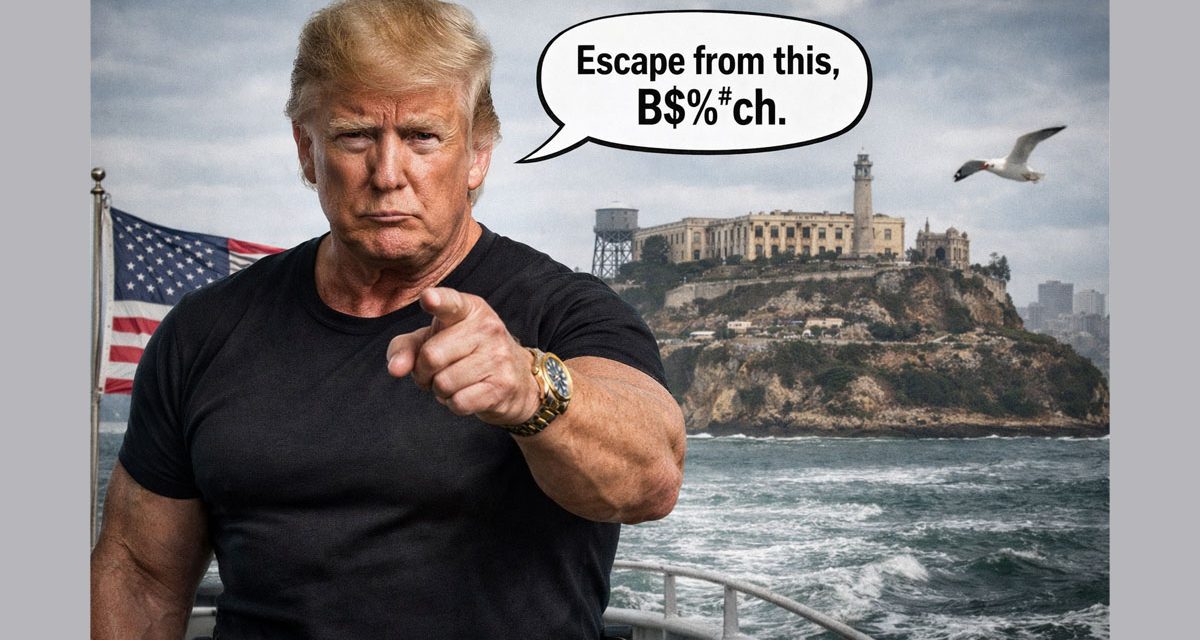
President Donald Trump is reviving one of the most iconic names in American criminal justice, and he is doing it with purpose. His proposal to reopen Alcatraz Island is not just about adding prison beds. It is about sending a message that the era of softness on crime is over.
The White House’s 2027 budget includes a request for $152 million to begin rebuilding Alcatraz into a modern, high-security prison. It is the first step in what could become a multi-billion dollar project.
This is not a quiet bureaucratic move. It is a statement.
A Prison That Means Something
Trump has been pushing this idea for months, and he has been clear about why. He wants a facility that can house the country’s most dangerous criminals, and just as importantly, he wants the country to see it.
He called for a “substantially enlarged and rebuilt” Alcatraz designed specifically for “America’s most ruthless and violent offenders.” He also made the bigger point unmistakable: reopening Alcatraz would stand as a symbol of “Law, Order, and JUSTICE.”
That word symbol matters. Because Alcatraz has always been more than concrete and steel.
Why Alcatraz Still Looms Large
When Alcatraz opened in 1934, it was not just another prison. It was THE prison. Sitting alone in the cold waters of San Francisco Bay, surrounded by strong currents, it was designed to be inescapable.
And it worked.
It held some of the most notorious criminals in American history, including Al Capone. Its reputation for isolation and control became part of American mythology, reinforced by stories like the 1962 escape attempt that still fuels speculation today.
But that reputation came at a cost. By 1963, the federal government shut it down because it was simply too expensive to operate. Everything had to be brought in by boat, including fresh water. Running Alcatraz cost nearly three times as much as other prisons.
Since then, it has become a tourist attraction, drawing more than a million visitors each year.
A relic. A museum. A memory.
Trump wants to change that.
The Real Price Tag
The $152 million request is just the opening move. Estimates suggest the total cost of rebuilding Alcatraz into a modern supermax facility could reach $2 billion.
And the challenges are real. The island currently lacks basic infrastructure. No modern water system. No reliable power. No sewage system capable of supporting a functioning prison.
In other words, this is not a renovation. It is a full rebuild.
Critics say that makes the entire idea impractical from the start.
The Pushback Is Loud
Opposition has been swift and sharp.
Gavin Newsom dismissed the plan as a “colossally bad fiscal idea,” arguing that it makes no sense to pour billions into a remote island prison.
Nancy Pelosi went further, calling it “a stupid notion” and “a waste of taxpayer dollars.”
Others point out that Alcatraz is now a major tourist destination and historical landmark. Turning it back into a prison would mean sacrificing that role.
On paper, the critics have a case.
But This Was Never About Paper
Looking at Alcatraz strictly through a cost-per-inmate lens misses the entire point.
Trump is not just trying to build a prison. He is trying to redefine the tone of American law enforcement.
Alcatraz is uniquely suited for that. It is a place that already carries meaning. Fear. Finality. Consequence.
Reopening it signals something simple and powerful: the worst offenders will be removed completely, not just processed through a system that too often feels overwhelmed.
Even if the economics are imperfect, the message is unmistakable.
A Broader Strategy Taking Shape
The Alcatraz proposal sits inside a larger $1.7 billion push to strengthen the federal prison system, including improving staffing and upgrading facilities.
Seen in that context, Alcatraz is the flagship. The headline move. The part people will remember.
It is the visual representation of a tougher approach to crime.
What Happens Next
Congress will ultimately decide whether this plan moves forward. And given the political resistance, approval is far from guaranteed.
But the impact of the proposal is already being felt.
Trump has forced a national conversation about crime, punishment, and what it means to keep Americans safe. He has taken a historic symbol and placed it back into the center of modern policy.
Whether Alcatraz reopens or not, the signal has been sent.
The Rock is no longer just a memory. It is back on the table.





Mike f as in fag you and cunt Killery should eat deplorable shit and line up and kiss Trump’s ass.…
Israel will someday own all of the Middle East. God promised it to the descendants of Abraham.
Sorry Bill, but if you can't see the Israeli land grabs, you are blind. If you can't see the virtual…
Interesting commentary Larry-but flawed as always. In the current regime, there is more commentary about trump and the toadies that…
Finally got one right. Do you now have to turn in your red hat?