
















The Iran Blockade May be the Best Move of the War
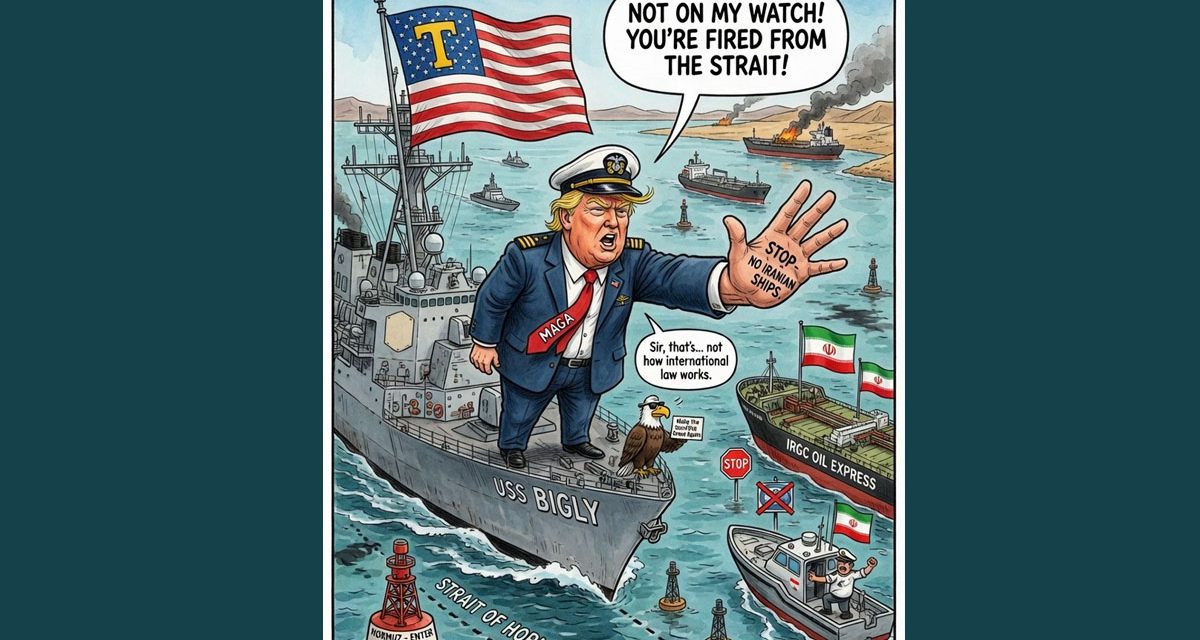
President Trump has executed a masterstroke in the conflict with Iran. While critics wring their hands and demand endless diplomacy or reckless escalation, the naval blockade arguably stands as the most effective and decisive action taken thus far.
It is not mere military theater. It is a strategic chokehold that targets the very lifeblood of the Iranian regime — its money supply. In one bold move, the United States has placed Tehran in an economic stranglehold from which there is no easy escape. Some have described it as checkmate. White House Deputy Chief of Staff Stephen Miller put it plainly on Jesse Watters Primetime: “President Trump has put Iran in a box. He has played the checkmate move.” No matter which path Iran now chooses, America wins.
The blockade works because it severs Iran from its primary source of revenue — oil exports. For years, crude sales have formed the backbone of the Iranian economy. Reliable estimates indicate that oil accounts for more than forty percent of total export revenue and nearly forty-five percent of the government budget.
China alone purchased ninety percent of those exports in recent years, funneling tens of billions of dollars directly into Tehran coffers. Those funds do not support schools or hospitals. They finance the Islamic Revolutionary Guard Corps, the nuclear program, ballistic missiles, and terrorist proxies across the region. Every tanker denied passage through the Strait of Hormuz or barred from Iranian ports represents hundreds of millions of dollars that will never reach the mullahs in Tehran.
Analysts project that the blockade will cost Iran approximately $435 million per day. That is not a theoretical figure. It is the daily hemorrhage of cash that once propped up a regime already strained by sanctions. Without those revenues, imports collapse. Food, medicine, industrial parts, and consumer goods become unaffordable. The rial plummets. Hyperinflation sets in. Factories idle. Unemployment surges.
The very economic activity that sustains the regime implodes in a devaluation spiral. Unlike past sanctions that could be evaded through smuggling or shadow fleets, the physical naval presence makes evasion nearly impossible. Tankers simply cannot load or depart. Alternative routes do not exist at scale. The world will simply have to bypass Iran.
This is why the blockade may prove the best move of the entire war. It achieves regime-weakening objectives without casualties or the massive financial drain of full-scale ground operations. It forces Iran to confront a binary choice — negotiate from weakness or watch its economy disintegrate. Either outcome serves American and allied interests. A deal that dismantles the nuclear threat delivers immediate victory.
Economic strangulation turns Iran into a footnote on the world stage, as its influence evaporates along with its cash flow. The blockade buys time, maintains pressure, and reshapes the balance of power in the region for decades, perhaps a century.
Predictably, the usual chorus of critics erupted in outrage. They decry the blockade as reckless, inhumane, or escalatory. They demand its immediate lifting. Yet their complaints rest on nothing more substantive than blind Trump hatred. These voices oppose anything the President does simply because he does it. It is the familiar pathology of Trump Derangement Syndrome in full flower. They ignore the strategic brilliance, the documented economic devastation it inflicts, and the initial positive results. They parrot Tehran talking points while pretending to champion peace. Their selective outrage reveals the truth — facts matter less than partisan narratives regardless of how mendacious they maybe.
The blockade is calculated leverage applied where it hurts most—in the wallet. It starves the beast without unnecessary bloodshed. It demonstrates American resolve and ingenuity. In the end, it may well prove to be the coup de grâce to terrorist regime that has operated for 47 years.
So, there ‘tis.




Naval Blockade? What’s next, Errol Flynn swinging from the yardarm, sword in hand, dew rag on his head? I really hope this one does work; I wish the best for our “boots on the water.” Please Lord, keep them safe.
Wonder why it took two months to unleash the “masterstroke,” but if it works, guess it was all part of the long-range plan.
Iran bets one blockade, Trump calls with another blockade and Iran suffers as Larry notes. What Larry avoids is that the US and the world suffer too. Its high stakes chicken to see who blinks first. Larry claims Iran loses $1.3B a month in a $400B economy so they can financial go for some time. About $80B is being lost for the world per month just in oil shipments alone and some shortages felt with higher prices all around.
Dueling banjo blockades begins. On one side is Iran who lives with less all the time, many sanctions, many shortages, over many years. An autocratic government with a firm hand on a population that will probably acquiesce and not overturn it. On the other side is Trump with the world, including the US anxious already to solve this thing, get back to normalcy, and will certainly not accept living with shortages for a war of choice without imminent threat of harm. Gonna be more and more global pressure on Trump as the oil spicket is clamped down. The only winners are Russia, Exxon, BP and the like as they reap the benefits of high prices, relaxed sanctions. Especially for Russia that already claims they are no worse than us in Iran than they in their war of choice in Ukraine. Hopefully, China will not seize this opportunity to claim imminent threat from Taiwan and make their move.
We will see, but no one knows who will blink first. Hope it works and this ends soon.
Dunger how many years ago did you become a cuckold?
Ask his daughter
I agree with Larry on a well written piece, but there should always be a rebuttal on both sides of any issue. Mr. Danger also writes well and makes good points that should not be ignored. On this issue, I would make the sacrifices needed to denuclearize perhaps the most dangerous terrorist regime in the world.
John, I agree, denuclearize anyone trying for the bomb. But policing the world is a lonely job. We should denuclearize the world with the world’s support. Further, I would do anything to get Russia, and the US to remove tactical nukes from our arsenals; a stupid idea that a smaller nuke is a better nuke OR there’s always room for a little nuke. And a global agreement for “no space nukes, ever. (unless they are pointed away from the Earth :>)
We had that with the JCPOA; they were denuclearizing. Trump ripped it up, assassinated their general, did nothing in his first term to replace; Biden couldn’t regain their trust; Trump has peace talks and then “completely obliterates” their nuke production, then more peace talks where immediately after, Trump kills the Iranian Supreme Leader and his cronies. Me thinks they will sit with their backs to the wall in any meetings with us.
I am betting that Trump will end up with his version of a JCPOA except he will claim is better like he did with his fake version of NAFTA, his USMCA (do you hear the village people) is an update, an enhancement, not a revolutionary change. Brand marketing 101! At least at this point, if we are lucky. If we are unlucky, they will blow up one of our ships and we will be off to the races.
Again, please Lord, keep our boots on the water dry and safe. Let our kids come home soon.
And Uncle Dung and Bendung: war is serious business; these are our kids in harm’s way. Please have a little respect.
Bombbombbomb🎵🎶bomb bomb Iran 🎶🎵
An unchecked North Korea, with its nukes and missiles, demonstrates what could/would have happened to Iran in the near future.
Trump is now doing to Iran what should have been done to North Korea years ago.
Reward: I don’t know how these hold up against Iran sanctions, or today’s lack thereof, but AI says: “Sanctions on North Korea (DPRK) are severe, multi-lateral restrictions led by the UN Security Council and the US, targeting its nuclear weapons and ballistic missile programs. Key measures include bans on coal/mineral exports, severe caps on oil imports, arms embargoes, financial restrictions, and bans on IT worker labor, aimed at limiting revenue for weapons development.”
Fact is these countries see better leverage from having the bomb versus the pain of sanctions.
I guess we could bomb the fuck out of NK again, but doubtful there would be any more advantage than we are seeing now.
And then, Russia, Pakistan, Israel, China, France, UK, India. The “original five” are under the NPT; the other countries are not, but have announced their inventories, except Israel that says “fuck you” to telling the world anything.
The answer is to bring everyone here under the NPT, add in “no tactical weapons or else,” and “no space nukes or else,” and the joined agreement by these nine that no other nation can get the bomb. Ever. You will never get a country who has the bomb to give it up; you might get the to lower inventory, but perhaps we can stop further proliferation. But it should be the world, not the US playing global policeman.
I do not agree that Trump’s approach in Iran is better than Obama’s, and probably worse. There was less risk under Obama than there is under Trump. Trump got us to “in 2 weeks they will have the bomb,” and Obama got us to “no bombs on the horizon.” I like Obama’s risk better.
IMO, the bottom line is world-policing of this, by the world, especially the nuclear nine.
Dunger are you serious?? Trump is showing strength. Barack the mulatto gave away billions of dollars because he was afraid of Iran. But keep your head up. Someday you might get to see your party destroy America. So keep rooting against America.
Paul DunGoff: Only stupid fucks can’t spell Danger. Are you a stupid fuck? Are you a complete racist pig. I think you are.
Trump showing strength is an opinion not shared by most global observers. Obama gave nothing away; Trump lies about emptying banks in Phili and wherever. Obama settled a payment held since 1979, with interest, as the World Court either ordered, or would have ordered. Was it cash for hostages — pretty close, most certainly was so close to the line as to be a payoff. Except it was Iran’s money. Was it a giveaway: no, it was their money. It was $400M in arms money they paid where we did not deliver the arms in the 1970’s; and 1.3B in interest for over 30 years.
Unlike Trump, Obama lived by our code. We don’t shoot citizens in the back, we don’t shoot unarmed middle-aged mother types in the face. We don’t have peace talks ending in sneak attacks against enemy generals or entire governments. If rooting against being a back-shooting sneak attacker is rooting against America, then I am guilty. If rooting against paying what you owe is unamerican, then I am guilty. If rooting for getting our kids out of harm’s way and bringing them home alive is treasonous, then that’s me.
Your party is destroying America and your own party. Go outside America, promise them you are not recording, and ask anyone from another country. According to Pew Research: “U.S. President Donald Trump receives mostly negative ratings in a new Pew Research Center survey of 24 nations. More than half in 19 of these countries say they lack confidence in Trump’s leadership of world affairs. Majorities in most countries also express little or no confidence in Trump’s ability to handle specific issues, including immigration, the Russia-Ukraine war, U.S.-China relations, global economic problems, conflicts between Israel and its neighbors, and climate change. When asked about Trump’s personal characteristics, most describe him as arrogant and dangerous, while relatively few see him as honest. Still, majorities in 18 countries consider Trump a strong leader. Strong like bull and twice as dumb.
That was June of 2025……can you imagine today? In Feb of 2026, he cratered even more in global polling just before he took us to war in the Middle East and strangled the world’s energy supplies. To help him out of the jam he put himself in, Trump is delivering billions upon billions in new profits to the very countries we are at war with. Trump has lowered sanctions on oil for both Iran and Russia and gives billions in free money to Iran and Russia. Russia, who birddogs for Iran with satellite surveillance, will make an extra $5B to $10B this year. Their surveillance is probably how we lost one of our only 17 radar planes worth over $350M so put that on the bill too. Iran brought in $14B they got Trump oil sanction relief on for the 140M barrels they sold without sanctions. Aren’t we in a war with these guys? Isn’t Russia our top enemy? Obama did $1.3B, Trump is doing over $20B so far and the war is young. And QUATAR is asking Trump for $20B as one of the richest nations on the planet says Trump owes them.
Under my party, we had NATO, a UN; today we have Israel and Trump’s Board of Peace (or is that Bored of Peace); and you think no NATO, no UN is stronger? Even Canada hates us; how bad are we if Canada hates us? We used to fund Ukraine, Trump’s strength defunded Ukraine to make us stronger and Russia weaker.
I am just not seeing what your blindness shows. Maybe the Board of Peace can work it all out.
Dunger you’re a lying prick. The mulatto was paying Iran to keep them from kicking our ass. And guess what genius. They used the money against us. You throw out bullshit without the facts. And by the way. Define racist. Oh I get it. It’s a catch all phrase used by commiecrats to shame people. Don’t try it with me. It’s not working. I know you got your ass tight over the mulatto comment. Good Look it up. I did.
Pull DunGoff: Obama did not pay Iran to stop them from “kicking our ass.” That’s laughable and unprovable by you. You have no way, and no sources to prove they used this money against us. It was given in 2016; since then Iran has no direct attacks on the US and a few attacks-by-terrorist proxy; some shots fired at a couple of ships, and one drone downed. I think Mr. Horist’s timeline of attacks confirms that. Unless you can use your rocket scientist brain to find different.
“You throw out bullshit without the facts. And by the way.” Prove it. Find the lie or be the dickhead I am pretty sure you inability to find the lie will show.
“Define racist.” I think you prove it yourself when you call Obama “mulatto” multiple times. I do not look to shame you; I don’t look at you at all because you are a useless, racist, pig. AI says: “Many now consider the term dehumanizing and offensive due to its roots in slavery and the implication of being a hybrid (from the Spanish “mule”).” I am on of those. But the real point is that you know it, you knew it, and you used it anyway for effect. Blaming me is stupid; I did not say it to define another person who you wish to demean.
I’m going to lay a true fact on you Dunger. I’m part African American. This is true. But I’m a conservative mulatto who totally supports president trump. And the NRA. And lower government , lower taxes, secure borders. And the list goes on. By the way, you can kiss the gerrymander vote goodbye in Virginia. A state court judge in tazwell county told the democrats where they can stick it. By the way, I’m being truthful about my heritage. That’s why I love watermelon. LOL
Pall DunGoof vomits: “Let me lay a true fact on you Dungoff: racism knows no color.” That’s right buddy, it’s a free world and anyone can hoist their humanity beneath racisms banner. Even you can be and still are a racist pig. Might want to think about attending the meetings though. When you call Obama ” The mulatto,” or “Barack the mulatto,” it’s a pretty odds-on bet what you are. You are going out of your way, adding words, to insult and demean, not describe. I am pretty sure everyone knows he’s black and you don’t need to provide a special, heartfelt, descriptor. Worse yet, this man is clearly better than you no matter what your heritage and ancestry is. He is smarter, richer, and more accomplished. However, you can even be a quadroon or octoroon, at least in the eyes of racists, like you.
FYI: I think you mean smaller government; you already voted for lower government :>)
“You throw out bullshit without the facts.” Still waiting hotshot. Prove it. Find the lie or be the dickhead I am pretty sure you inability to find the lie will show.
Yes, there are many lawsuits in VA. This hold has been tried twice before and struck down by the VA Supreme Court twice before. You saying ” you can kiss the gerrymander vote goodbye in Virginia” looks pretty stupid based on the track record so far. At least premature, but you probably are the expert there. Don’t know about the other cases, but you guys are pretty good about wasting taxpayer dollars on frivolous suits. What was that: 65 or 66 failed cases for the 2020 election? Course you thought they said: “erection,” so you knew you couldn’t get that vote up.
Bazinga.
The watermelon line is great bait, you are a master-baiter, but really, you have already proved your point of being racist. You probably don’t have to pile up the stereotypes and tropes from racist idiots like yourself. We know them all, not shocked by any of them, just points out how racist and stupid you are.
Hey Dunger. Is you a colored boy? I hope so since God is white. The scripture proves it.
Your discussion of facts is useful. The personal attacks illustrates just how polarized and intolerant we have become as a nation. It is unhealthy.