














Adam Kinzinger’s former constituents sue over political malpractice.
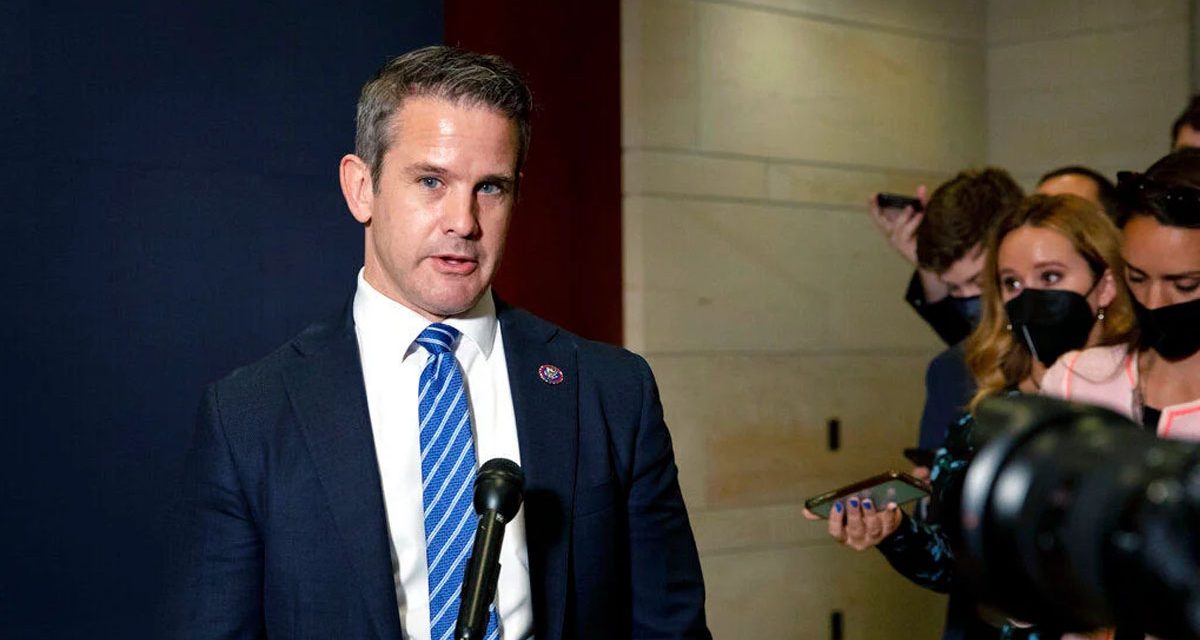
Former Representative Adam Kinzinger represented a suburban Chicago Congressional District that has reliably supported conservative Republican candidates. He was elected in 2010 as a conservative. Then along came Donald Trump, and Kinzinger became one of a hand full of elected Republicans who broke with the GOP over personal distain for the man.
Eventually, Kinzinger would abandon all his conservative principles to be a point man for the radical left. (I wonder how much of his conversion was driven by money – as appears also to be the case with former Congressman and radio talk show host Joe Walsh and former Republican National Chairman Michael Steele. But I digress.)
Kinzinger’s decision to join the highly politically biased kangaroo-style House Select Committee investigating the January 6 riot at the U.S. Capitol marked a defining moment—one that cemented his reputation as a Republican apostate and a traitor in the eyes of many GOP voters.
Kinzinger framed his participation on the committee as a matter of constitutional duty. His critics framed it as betrayal. Kinzinger completely abandoned his one-time conservative principles to become an advocate of left-wing ideology and policies. His “conversion” got him frequent spots on left-wing media outlets – including as a paid “contributor”.
Kinzinger did not seek re-election in 2022 — facing all but certain rejection by the hometown voters. It was a similar fate experienced by fellow January 6 Committee member Liz Cheney. Unlike Cheney, however, Kinzinger has avoided total political oblivion as a regular on MS NOW and CNN.
The newest chapter in Kinzinger’s public life involves a lawsuit filed by several of his former constituents. They argue that Kinzinger failed to represent their interests when he broke with Trump and joined the other team. He left the folks who elected him unrepresented,
Personally, I believe that the legal merits of the case are questionable since members of Congress are not legally obligated to mirror the views of their voters or keep their campaign promises. Still, the lawsuit is symbolically powerful. It reflects a broader belief among some voters that elected officials owe some measure of loyalty to the promises and policies upon which they were elected. The lawsuit itself provides a measure of retribution — even though it is likely to be dismissed.
But you have to love the concept – actually making elected officials legally responsible for the things they promise. In Kinzinger’s case, it is not just an occasional policy shift or broken promise. He became a full-time player for the other team – the one the voters in his district did not want to represent them.
The plaintiffs’ argument rests on the idea that Kinzinger’s actions were so far outside the expectations of a Republican representative that they constituted a kind of political malpractice or fraud. Whether or not a court agrees, the lawsuit underscores the deep emotional investment many voters now place in partisan alignment these days.
Since leaving office, Kinzinger has embraced a public role as a commentator, author, and constant critic of Trump and Republican policies. This has earned him the admiration of left-wing Democrats, but it has also intensified hostility from the faction of the Republican base that views him as a symbol of disloyalty.
The lawsuit, in this sense, is not just legal action. It is a cultural one. It represents the ongoing attempt to punish or delegitimize Republicans who broke ranks during the Trump era. Kinzinger, along with figures like Liz Cheney, has become a lightning rod for conservative voters.
The case raises important questions about the nature of representation. Are members of Congress morally, or even legally, obligated to reflect the majority opinion of their district? Or are they trustees, empowered to make independent judgments based on their understanding of the Constitution and national interest? Kinzinger clearly saw himself as the latter. His critics insist he should have acted as the former.
This tension is not new, but the intensity surrounding it has grown. The lawsuit highlights how political identity has become intertwined with personal identity for many Americans. When a representative breaks with the party, some voters experience it not as a policy disagreement but as a personal affront.
Kinzinger now faces a dual challenge — defending himself in a court of law while continuing to navigate a political landscape in which his name evokes strong reactions. The lawsuit may not succeed in court, but it succeeds in keeping Kinzinger at the center of a symbolic struggle over what it means to be a Republican—and what it means to dissent.
Kinzinger’s future will likely continue to involve public commentary, political analysis, and advocacy. But the lawsuit serves as a reminder that breaking with one’s party—especially in an era of intense polarization—comes with lasting consequences. Whether he views those consequences as a burden or a badge of honor is something only he can decide.
So, there ‘tis.



Check another one from the enemy list.
Slow news day?
Trying to divert from murderous Minnesota?