

















Will Belarus Enter the Ukraine War? Probably not.
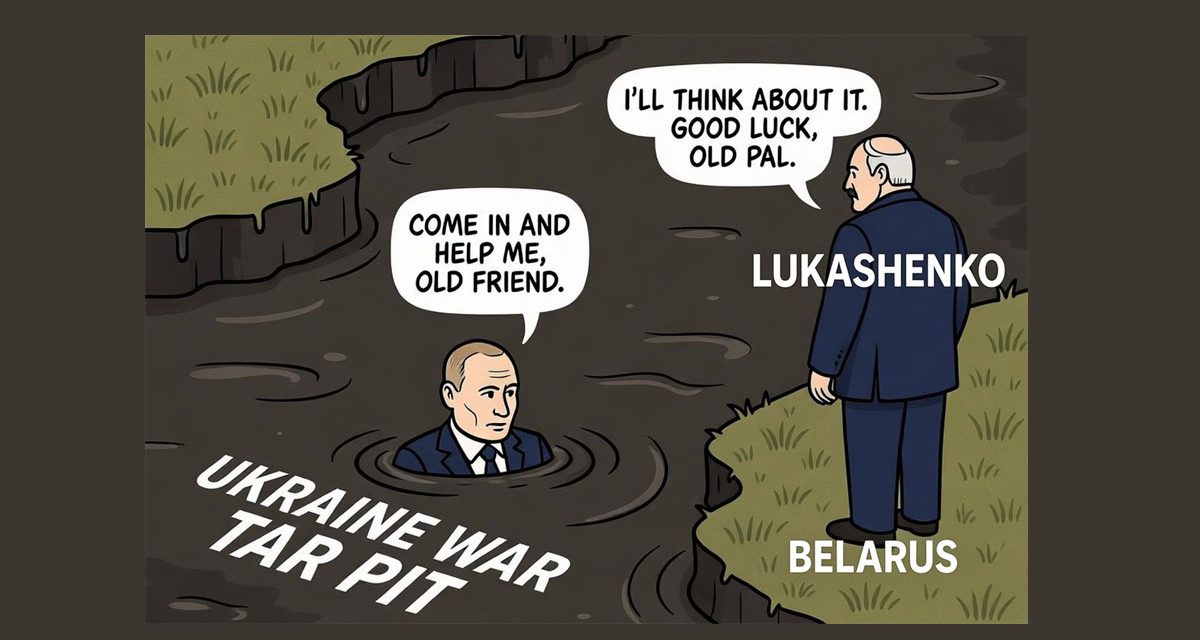
In the long-running drama of Vladimir Putin’s war against Ukraine, the question of Belarusian participation has lingered like an unwanted subplot. Putin has repeatedly sought to conscript his closest ally into direct combat or at least into a more aggressive supporting role. Yet Alexander Lukashenko has consistently stopped short of full commitment. Recent developments make deeper Belarusian involvement even less probable as Russia’s battlefield position weakens and the costs of entry rise for Minsk.
Putin’s efforts to pull Belarus into the fight date back to the opening phase of the full-scale invasion. In early 2022, Belarusian territory served as a staging ground for the initial thrust toward Kyiv. Russian forces massed there, and Belarus provided logistical support and infrastructure. Lukashenko permitted this use of his country but stopped well short of ordering Belarusian troops into sustained ground combat alongside Russian units.
Since that time, the Kremlin has pressed for more—additional troops, expanded basing, and active participation in operations that would extend the front westward or draw Ukrainian forces away from the east. Moscow has employed economic leverage, threats to cut financial lifelines, and joint military activities, including the deployment of tactical nuclear weapons to Belarusian soil and a series of nuclear exercises. Discussions between Lukashenko and Russian officials, often channeled through the Russian ambassador in Minsk, have included proposals to use Belarusian territory for drone operations or even potential moves against NATO neighbors.
Lukashenko has resisted these overtures with notable consistency. He has made clear that Belarus will enter the conflict only if directly attacked on its own territory. In recent statements, he has emphasized that his country has no intention of being drawn into the war in Ukraine and that there is no need for such involvement. He has acknowledged the risks and has gone so far as to state that battlefield victory appears unrealistic for either side, calling instead for compromise. These positions align with a broader pattern — peripheral assistance—such as hosting a limited number of Russian troops, facilitating some logistics, and recently increasing sales of gasoline and refined petroleum products to Russia amid Ukrainian strikes on Moscow’s energy infrastructure—while avoiding direct combat commitment.
The Belarusian leader has sound reasons for this restraint. Full entry would expose Belarus to Ukrainian retaliation of the kind Kyiv has already demonstrated deep inside Russia. Belarusian forces, largely untested in modern high-intensity conflict, would confront a Ukrainian military seasoned by years of fighting. The economic consequences would be severe — additional sanctions, disrupted trade, and the loss of any remaining Western engagement that Lukashenko has cultivated through prisoner releases and other gestures.
Public sentiment in Belarus has shown little enthusiasm for joining Russia’s war. Lukashenko, a survivor who has balanced dependence on Moscow with occasional outreach to the West, understands that turning Belarus into an active belligerent could threaten his own hold on power.
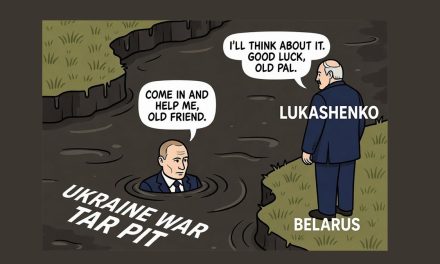
Recent reports reinforce the view that involvement has grown less likely. Ukrainian President Volodymyr Zelensky has issued a direct ultimatum regarding Russian drone relay stations operating from Belarusian territory in the Gomel and Brest regions. These installations have supported strikes on Ukrainian cities including Rivne, Zhytomyr, and Volyn. Zelensky gave Minsk one week to dismantle them or face Ukrainian action. This threat comes as Ukraine continues to target Russian rear areas and logistics, exposing vulnerabilities that have forced Russia to seek fuel supplies from Belarus.
At the same time, independent assessments show that Russia’s 2026 spring and summer offensive has produced only marginal gains in limited sectors while stalling or reversing in others. Territorial advances have slowed dramatically compared with prior periods, and Ukrainian forces have conducted successful strikes that disrupt Russian supply lines and air defenses.
Putin’s position has shifted from one of presumed rapid dominance to a grinding war of attrition marked by high casualties and logistical strain. Asking Lukashenko to commit Belarusian troops or infrastructure more deeply into such a contest resembles inviting a cautious neighbor to reinforce a faltering siege that shows no prospect of quick victory.
The Belarusian president has already extracted what benefits he can from the relationship—economic support, security guarantees against regime change—while keeping his distance from the front lines. The United States has pursued selective engagement with Minsk, including earlier sanctions relief on key exports and discussions tied to prisoner releases. This approach has given Lukashenko modest leverage and an alternative to total subservience to the Kremlin.
Sarcasm comes easily when watching Putin, the self-proclaimed master strategist who once envisioned a three-day operation, now lean on a reluctant partner whose military and economy could not sustain a major war effort. Lukashenko is no ideologue. He is a calculating authoritarian who has stayed in power for decades by reading the odds. Those odds currently favor continued limited cooperation—fuel sales, occasional infrastructure access, joint exercises that stop short of combat—over any dramatic escalation. Ukraine’s demonstrated ability to strike deep and Russia’s evident difficulties in converting battlefield pressure into decisive gains have narrowed the window for any Belarusian adventure.
Putin is like one of those ancient creatures trapped in the La Brea Tar Pit begging for fellow creatures to come in and help him. In the end, the answer to whether Belarus will enter the Ukraine war remains the same as it has been for most of the conflict — probably not. Lukashenko will continue to hedge, offering just enough to Moscow to avoid outright rupture while avoiding the disaster that full participation would bring to his country. Putin may keep pressing, but the wily survivor in Minsk has shown little inclination to trade his precarious independence for a seat at a table where the main course is a prolonged stalemate. The war will likely remain Russia’s burden to carry alone.
So, there ‘tis.





All-ass : Trump? I hope the next Congress holds any and all Executive Branch, Legislative Branch, or Judicial Branch to…
I don't think Israel's actions in Gaza are wrong. A heck of a lot more missiles have flown into Israel…
Dunger there’s nothing to hold Trump accountable for. Do you know why he should? Of course not you slimy turd
If Larry’s agin, it’s anti American. If he’s for, it’s locker room talk, it’s frisky language, and the like. Hasn’t…
Israelis in Congress? Talk about a red herring. I am pretty sure neither Greene or Carlson are Israeli or Jewish…