












What Does Trump “Federalizing Elections” Mean?
One of the latest panic‑inducing talking points circulating through the Trump‑resistance echo chamber is the claim that Donald Trump wants to “federalize elections.” According to them, Trump is plotting to seize control of the ballot box from the states and impose some sort of authoritarian voting regime. It is the kind of melodrama that keeps MS NOW producers employed. But like most narratives manufactured for partisan outrage, it collapses the moment you hold it up to the light.
Let us start with the Constitution—since critics have suddenly become strict constitutionalists. Article I, Section 4 states:
“The Times, Places and Manner of holding Elections for Senators and Representatives, shall be prescribed in each State by the Legislature thereof; but the Congress may at any time by Law make or alter such Regulations …”
That last clause is the part Democrats conveniently pretend does not exist. The Founders explicitly gave Congress the authority to “make or alter” election regulations for federal offices. The states generally run elections—but not with absolute, unchecked power. The Constitution never intended elections for federal office to be a free‑for‑all of 50 different systems with no federal standards whatsoever.
And that’s exactly what Trump and congressional Republicans are talking about — federal standards for federal elections, not some takeover of every precinct in America.
The proposed reforms are hardly radical. They include:
- Limiting voting to American citizens
- Setting a firm deadline for ballot counting
- Requiring paper ballots
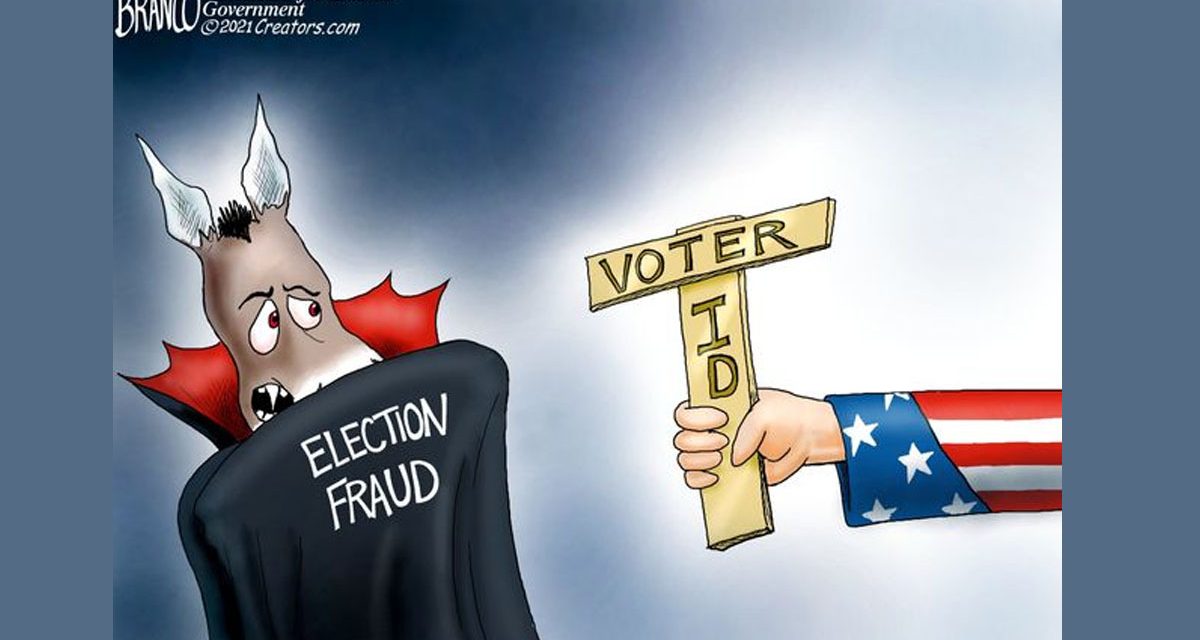
- Requiring official voter ID
- Establishing uniform rules for mail‑in ballots
- Strengthening chain‑of‑custody procedures
These are not fringe ideas. They are common‑sense measures designed to minimize fraud, tighten sloppy processes, and restore public confidence in elections. And here’s the part Democrats do not want to talk about — that the American people overwhelmingly support these reforms.
Polling Data Democrats Hope You Never See
A 2024 Gallup survey found that 81 percent of Americans support voter ID requirements, including:
- 95% of Republicans
- 83% of independents
- 69% of Democrats
A Harvard CAPS/Harris poll found that:
- 72% support limiting voting to U.S. citizens only
- 68% support requiring paper ballots
- 70% support signature verification for mail‑in ballots
- 64% oppose ballot harvesting
Even the left-leaning Pew Research survey reported that 79 percent of Americans believe voters should show a government‑issued ID to get a ballot.
These are not partisan fantasies. These are mainstream preferences. Yet Democrats oppose almost every one of these provisions. Their argument? That such reforms violate the Constitution. But that claim simply does not hold up.
The Myth of Absolute State Control
If states had absolute, exclusive authority over elections—as Democrats now pretend—then the federal government would have no power to:
- Set Election Day
- Enforce voting rights laws
- Regulate eligibility for federal office
- Intervene in discriminatory state election practices
- Oversee campaign finance
- Establish federal standards for absentee voting for military personnel
But it does all of these things.
History makes this even clearer. For decades, Southern Democrats used state election laws to block Black Americans from voting. They imposed poll taxes, literacy tests, and whites‑only primaries. And what ended those abuses? Federal intervention. Federal courts. Federal legislation. Federal enforcement.
The racist Democrat machines fought federal involvement by claiming absolute constitutional states’ rights. They lost. The federal government has always had a role in ensuring that elections, especially federal elections—are conducted legally, fairly, and constitutionally.
Historic Examples Democrats Pretend Never Happened
Federal involvement in elections is not new. It is not unprecedented. And it is certainly not unconstitutional.
Here are just a few examples:
1. The Enforcement Acts of 1870–1871
Passed by a Republican Congress to stop Democrat‑run states from suppressing Black voters. Federal marshals were deployed to protect polling places.
2. The Civil Rights Act of 1957
Created the Civil Rights Division of the DOJ, giving the federal government authority to intervene in discriminatory election practices.
3. The Voting Rights Act of 1965
Federal examiners and observers were sent into states with histories of election abuses. Entire state election systems were placed under federal oversight.
4. Federal Marshals in the 1960s
Deployed to protect Black voters in the South and enforce court‑ordered desegregation of polling places. They were also deployed to cities such as Chicago as poll watchers to prevent vote fraud.
5. DOJ Election Monitoring (1970s–Present)
The Department of Justice has routinely sent federal observers into cities with histories of election irregularities—almost always Democrat‑run cities such as Chicago, Detroit, Philadelphia, and St. Louis.
6. The Help America Vote Act (2002)
After the 2000 Florida recount, Congress established federal standards for voting machines, provisional ballots, and statewide voter registration databases.
So … the idea that Trump is proposing something unheard of – or is engaging in an authoritarian takeover of America’s elections — is simply false. The federal government has long intervened when states or localities failed to conduct honest elections. So, the idea that Trump is proposing something unprecedented or unconstitutional is dubious. The final determination may have to be made by the Supreme Court.
The Real Question
The real question is whether the federal government has a responsibility to ensure that elections for federal office are conducted in a legal, transparent, and trustworthy manner. And on that question, the Constitution, history, and public opinion all point in the same direction. The Supreme Court may ultimately weigh in on specific provisions, as it has many times before. (And I am betting Trump wins on this one). But the notion that Trump is plotting some authoritarian takeover of elections is a hyperbolic political narrative, not constitutional analysis.
Summary
Election integrity is not a partisan issue unless one party benefits from the lack of it. (And historically, we know which party that is). The American people want secure elections. They want voter ID. They want ballots counted promptly. They want citizenship requirements enforced. They want transparency.
Trump’s proposals don’t “federalize elections.” They standardize procedures consistent with the Constitution and the federal governments proper role. They restore confidence in a system that has been badly damaged by inconsistent rules, chaotic processes, partisan gamesmanship and … yes … even vote fraud.
If Democrats truly believed in democracy, they would welcome reforms that make elections more secure—not fight them at every turn.
So, there ‘tis.




“Gee Larry, you left off the good part from the Constitution: “…….except as to the Places of chusing Senators.” Quirky thing sometimes that Constitution. Must be a story behind that one. This is a heady topic I need to research, but some top-line thoughts. First, you noted the Constitution but left out the 200 years of SCOTUS decisions framing how we vote. The Federal Government has been setting rules and guideline benchmarks for years. So far, it’s worked quite well and I see no reason for change. From the beginning, Justice Story in the late 1700’s voiced the issues of many talking smack about Federalizing voting and Hamilton voicing the concern of many about States being in control. Think 1842 was when Congress put the first of many, “guidelines” in for elections.
Voting is a State’s Right. We diminish such rights at our peril. Larry used to support State’s Rights. In terms of voting, he does not. He whines that Dems are up in arms over Trump sending ICE to the polls, or worse. Yup. You betcha. We don’t want to see what happened in LA, Chicago, Minneapolis, all blue regions, extended to our polling places. I will not give up my right to mail my vote in (even though I drop mine off). I have been to polls when just MAGA arrived, in their yuge black crew cabs, darkened windows, festooned with MAGA stickers and symbols. That alone was intimidating, as they meant it to be. Like having a crow in a tree watching you as you mow the lawn. Call this Jim Crow. I’m safe. Nothing is gonna happen to this old white guy, my truck is redneck-ier than theirs, but they are creepier I do not need more creepy in my life if I can avoid it.
Larry says, calm down Democrats, this is only about the SAVE Act (even though he does not name it for some strange reason). Not necessarily. Trump has not mentioned the SAVE Act, that’s what people like Larry divine what he means when he said something else. Like all the different reasons we stormed VZ. This was kicked off when Trump said: “The Republicans should say, ‘We want to take over, we should take over the voting in at least — many — 15 places.’ The Republicans ought to nationalize the voting.” Inciteful as usual, and you say no reason to get all excited, it’s just a shower. You whine about Democrats with hair on fire, but you must realize that when Trump says “WE,” that we does not include us, more than half the nation. Fifteen places sure sounds blue to us, or purple swing states, it certainly can’t be where voter fraud has been determined. Because there is no rampant voter fraud proven in or out of court. Republicans should do it is most certainly intended as: them against us, and is clearly not bipartisan. And you say, once again, no there, there? Nothing to worry about. Just let the Felon King do what HE wants?
Larry, we have military in LA, DC, Chicago, and Minneapolis. We murdered two folks in MN; not even illegals. We shoot a citizen five times in Chicago, rip her from ER to detention, accuse her of terrorism-by-car, when ICE hit her. We are separating kids from parents again. We put the father of three patriot marines in jail. We have Congress folks in front of Grand Juries for sedition for a simple reading of the law. We have DOJ with a Democrat enemies hit list even attempting to indict a sub sandwich. And now we have border patrol with a top-secret military laser loaned from DOD shooting down four party balloons resulting in closure of a major airport as they tell us it’s cartel drones. No, I do not want these folks mucking with NJ elections, or any other state. And Spring is coming; Ice Out day is coming. There’s a 20-mile fissure from Cleveland to Canada on my beloved Erie, we will see the end of ice soon.
In March 2025, Trump’s EO began tried nationalizing voting by requiring proof of citizenship to register to vote, changed certification standards for voting machines, standardized the due date for mail ballots, and more. Most blocked in court but here’s the example of Trump nationalizing voting without consent of Congress; he didn’t even ask. Larry loves the policies. Screw State’s Rights, screw Congressional oversight and governance, let one man rule it all; Larry’s Felon King, the crook of crypto.
So, excuse my disbelief over your measured mindset of logical legalities to be addressed by Congress via the SAVE Act versus the delusions of a demented old man trying to roll his own laws from the Executive Office without talking to Congress at all. For the midterms you are already too late and anything you try to do for 2026 will be a clusterfuck implementation, operationally. But you don’t care because your real intent is less people voting which you believe favors MAGA.
Meanwhile, DOJ has asked most states to turn over their unredacted voter lists, which the department hopes to review for potential noncitizens. Yeah, sure, like that’s all they will do. I mean we are talking a DOJ that tracks Congress as they peruse the Epstein files. Illegally. They are suing 24 states, plus Washington, D.C., for noncompliance. Again, no Congressional input. IOW — the same people upset that we tracked WHO they called, not the call, but who they called has no issues with tracking all our voting data, who we are, what party you’re in, who we voted for, and what method we used to vote.
His mouthpiece said the fumbled mouth President really meant the SAVE ACT, sane, Congressional bill, but that is not what Trump has said and he’s had plenty of time to correct.
On top of Trump’s statements: Steve Bannon, a former Trump adviser and influential right-wing commentator, who repeated false claims that people living in the U.S. illegally vote in large numbers and said on his War Room podcast on Tuesday, “You’re damn right we’re gonna have ICE surround the polls come November.” Asked about Bannon’s comments, White House press secretary Karoline Leavitt said: “I can’t guarantee that an ICE agent won’t be around a polling location in November … but what I can tell you is I haven’t heard the president discuss any formal plans to put ICE outside of polling locations.” Now Leavitt is fumbled mouth covering for fumble mouth while Bannon is clear.
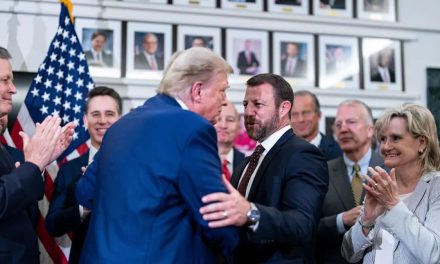
Trump later clarified: “I want to see elections be honest, and if a state can’t run an election, I think the people behind me should do something about it,” Mr. Trump said in the Oval Office, where Republican lawmakers from both chambers of Congress joined him at the signing of legislation to end the partial government shutdown. Again, he wants Republicans to take over elections though the Federal Government destroying a fundamental State’s Right. Larry wants to steal election control from the States and given it to the Fed, the very people being voted for. Can you say FOX in the henhouse?
Republican Rep. Jason Smith (R-Mo.) questioned why Immigration and Customs Enforcement (ICE) would be banned from polling places ahead of midterm elections. “Why should you ban ICE from being at polling places? Because illegals aren’t supposed to vote in this America,” Smith said during an appearance on CNBC’s “Squawk Box.” Now that’s Bannon and a representative saying what Trump won’t, out loud. These are Larry’s Republicans.
Last year, Trump announced he’s sending Federal “poll watchers” to NJ and CA polling places. We already had the home-spun version of this and it’s like going through a strike line as a scab. Not the most enjoyable thing in my life and certainly chills the joy voting used to have. IF ICE shows up, American voters will face the same risks as citizens of Minneapolis, Chicago, and LA have faced. Can’t say “I’m not mad at you, man” or stoop to help someone who has fallen; might be shot dead for domestic terrorism voting. And park very far away, you don’t want to be driving near these masked men with long guns.
No, Larry, this is big stuff, looking to void SCOTUS decisions and State’s Rights potentially with a militaristic flavor that only third-world authoritarian states have because your guy is a sore loser. Everything else, he made up.
Dunger that was quite the shit show. But don’t worry. Your comrades in your asshole party is proud of you. You represent the hammer and sickle well.
So, Carlos, given all that vomit you just spewed, you are saying you are of voter fraud? You want to leave in place the commie bastardization of what a fair and honest election should be? Everywhere you look under the current system there is rampant cheating, oddly enough always favoring the democrat party. C’mon, even somalia requires voter ID.
FRANKIE: show us the rampant cheating. Much less skewed to the Democrats.
I can show you that every time you win, it’s a landslide, it’s a mandate. Current statistics on the vote count, and current polling say you are delusional, a good thing cuz mid terms is a coming. Every time lose, we cheated, but you can’t prove it. Either you are stupid or we are mastermind criminals able to pull wool over idiots —- that’s you!!! If we do it all the time, how come you can’t catch us?
But we nailed you for a few felonies as you attempted to rig the 2016. We would have got you for 2020 too IF we hadn’t decided we won before our work was done. And then there’s you poster child for election fraud: George Santos. He makes Warren look like the Pope.
LD: thank you. Are you not entertained?
“Beam me up Scotty, there’s no intelligent life here.” :>) My God, you guys are one brick shy of a wall. You say a lot, prove nothing, and show what an idiot looks like.
1. I am not against voter ID.
2. I am not a communist: I am more capitalist than either of you put together.
3. I am a Democrat but probably not even in the majority in thinking.
Dunger you support people who want to take the country back to unconstitutional status. Our founding fathers knew what was right
Ham-On-Dung: That’s not true: I am suggesting the status quo versus your desire to destroy State’s Rights. And your paucity of knowledge about the Founders when there were some favoring federalizing the vote, and some favoring State’s Rights. As with many things, if not most things, the Founders favored State’s rights as the put into the Constitution. It’s in the Constitution dude. Larry even showed you the article. Do you need pictures?
BUSTED as in foot in mouth busted.
And really Dung Hammoff, can’t you improve on your boring twists of name? Ain’t you gots nothing better than that? How lame a name to blame shame on the Danger.
Federalizing the elections means honest and fair elections and ensuring non-citizens participating in the privilege afforded to legal citizens.
Manny: think about it. Why would any non-citizen want to take the risk of voting?
But you are advocating against State’s Rights. What’s next: Federal Education? National Gun Laws. Abolishment of State Governments?
All because someone lied to you so you would focus your hate on the undocumented, again, to divert your attention. Hate is good for authoritarians. Here’s NPR noting how stupid your fear is: *https://www.npr.org/2024/10/12/nx-s1-5147789/voting-election-2024-noncitizen-fact-check-trump* They don’t mince words: “Republicans have been repeating the false narrative that Democrats are purposefully letting migrants into the country so they will vote. There’s no evidence for the claim, which echoes a racist conspiracy theory known as the “great replacement.”
You have no evidence for your fear. You have no proof of what you are so, so, afraid of. But you do have fear. You think it’s happening. And you are afraid. So afraid of nothing the you want to spend our tax dollars fixing nothing.
But if you bring in the Federal Governments masked secret police who operate outside the like with long guns to our polling places, you risk what happened in LA, Chicago, and Minneapolis, you risk the very same pushback that made you run with your tail between your legs (might be good for you to have something tween you legs than the nothing you have now). And if you cancel the mail-in vote, you cancel voters like me and you will see the a different pushback from people cut out from voting.
It’s too late to do anything except stupid for the 2026 midterm, but stupid your side appears to be. Trump’s March EO to take over the vote mostly failed in court. IF the SAVE act fails in the Senate, and most likely will, Trump will throw another EO which will be stopped in court just wasting more tax dollars. And if you do pass a major voting law federalizing the elections for 2026, the result will be just another clusterfuck as you attempt to implement without enough time, resources, and even desire. Once again you will prove you boys are really good at the easy stuff to burn it down, but you really suck at getting things done and you waste a lot of taxpayer dollars in the attempt. ICE alone is spending us into a shithole we many not escape from.
When Trump left office last time, he gave us covid spending running up the US GOAT deficit. Biden caught that, brought it lower than Trump in year one, and then really smashed it in year two, growing in the next two. Trump’s deficit is a bit lower than Biden’s last year with was Biden’s worst of his three last years as he took his hand off the lever and tried to buy some votes. HOWEVER, Trump, as is his way, cheated and used taxation-without-representation tariff taxes to cover his bad spending with is higher than any Biden year. He also benefited from means testing revenues from Social Security and Medicare, another silent tax which with the tariffs brought $380B into the US general fund to blunt the deficit which was STILL almost as high as Biden’s worst non-covid deficit year, 2024. Trump spent more than the last five years only being beat by his covid year spending in 2020 and if you roll the fake-revenues tariff, ss, and medicare taxes, in, Trump 2.0’s first year deficit is worse than Biden’s last year, his worst non-covid year.
So, you are getting your “social” agenda and you are spending us into a shit hole to do it. You applaud ICE as they spend you into a rat hole. A magarat hole. You cut aid, agencies, and more and still spend us into the shitter. How does one even do that?
And now you want to spend more money, money we don’t have and have to borrow from folks like China, to federalize voting to fix a problem you can’t even find the evidence to prove. It’s mind boggling stupid, but somehow it makes you happy.