


















Supreme Court Got It Right on Independent Agencies and Presidential Powers
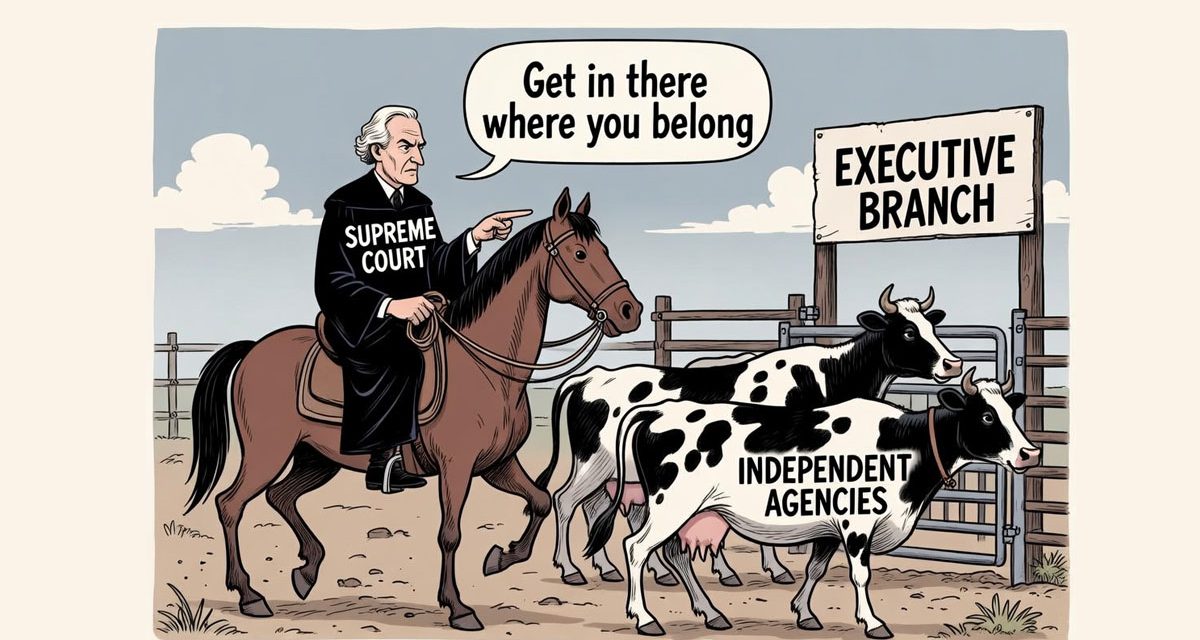
The Trump Derangement Syndrome crowd on the left is once again suffering a fit of apoplexy over yet another Supreme Court decision affirming presidential authority. Their constant belief is that anything that Trump does – or anything that benefits him – is not only wrong but is also an existential threat to the Republic. The recent court decision on the power of a president to fire leaders of so-called independent agencies is the latest example.
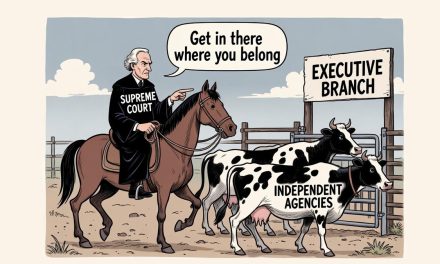
In this instance, the Court correctly upheld a President’s constitutional power to both appoint and remove the leadership of agencies within the Executive Branch – those entities that progressives insist on calling “independent” agencies.
There is relatively little dispute even on the left regarding a President’s right to nominate or appoint individuals to head regulatory agencies and commissions. The real objection arises when a President seeks to exercise the corollary power to fire those who fail to execute a President’s policies or who actively undermine the mandate given by the American voters. One suspects that the Democratic Party’s historical enthusiasm for expanding the reach and insulation of the administrative state has something to do with this selective outrage.
Before examining the specifics, it is essential to understand what “independent” truly signifies in this context. An agency that is independent of the Congress, the judiciary, and especially the President – the constitutional head of the Executive Branch – is not functionally autonomous in any virtuous sense. It is instead an entity governed by unelected officials who are accountable to no elected authority whatsoever. Such agencies are the creatures of the administrative state – entities led by unelected officials who operate with sweeping regulatory powers inside the vast federal bureaucracy. Though routinely described as “public servants,” far too many have assumed the role of masters. They issue rules that carry the force of law without the inconvenience of legislative process or electoral consequences.
For years, this writer has warned of the steady accretion of power by a insulated and entrenched bureaucracy operating as an unconstitutional and illegitimate fourth branch of government – and quite possibly the most powerful and least accountable branch in our constitutional system.
The proposition that significant portions of the government can function independently of elected leaders and beyond the corrective mechanism of elections is anathema to any meaningful conception of representative democracy. Unaccountable bureaucracies have historically served as the institutional foundation for autocratic rule, from ancient empires to modern totalitarian states.
The protections enjoyed by these bureaucrats exacerbate the problem. They are shielded by powerful union contracts and byzantine civil service laws that render removal for incompetence, insubordination, or policy disagreement extraordinarily difficult.
For the great majority of federal employees, civil service represents a lifetime career offering extraordinary job security. This system, originally designed to curb political patronage, has evolved into a nearly impregnable fortress that prioritizes the interests of the permanent government class over the public it ostensibly serves. The process for firing even the most egregious offender can take years and involve multiple layers of administrative appeal, effectively granting de facto lifetime tenure.
Federal workers are, by most objective measures, among the best compensated employees in the country. Their salaries, when combined with lavish benefit programs, paid leave, and retirement plans that dwarf those available in the private sector, place them in an enviable economic position. These are not beleaguered public servants scraping by on meager wages. They are a privileged cohort whose material well-being is secured by the very taxpayers whose lives they regulate, often with little regard for the economic consequences of their actions.
Because these officials are not elected, they remain largely impervious to shifts in public opinion or the application of public pressure. Elected officials must periodically submit their records to the judgment of voters. Bureaucrats do not. They endure from administration to administration, frequently advancing policy preferences that may have been rejected at the ballot box. This insulation transforms regulatory agencies into vehicles for the perpetuation of elite ideological projects rather than instruments of democratic governance.
The concept of independent agencies creates a constitutional anomaly. Powerful regulators function as part of the Executive Branch yet claim exemption from accountability to the elected head of that branch. This is not independence from politics in any principled sense. It is independence from democratic control. To suggest that Congress may create agencies within the Executive Branch that operate outside the President’s supervisory authority is to endorse a violation of the separation of powers. The legislative branch cannot legitimately seize executive functions by establishing fiefdoms that the President cannot direct or discipline. Such an arrangement inverts the constitutional design in which the President is responsible for the management of the Executive Branch.
History offers ample illustration of the dangers. The Consumer Financial Protection Bureau was deliberately structured with removal protections that allowed its leadership to pursue an aggressive regulatory agenda even when it diverged sharply from the priorities of the elected President. Efforts to reform entrenched agencies such as the Environmental Protection Agency or components of the Department of Justice have repeatedly collided with officials who cannot be readily removed despite clear policy disagreements. The practical result is a government that often continues on autopilot in directions opposed by the voters who elected a new chief executive.
There is also the issue of partisanship. As government workers, there is a natural tendency to favor the progressive version of an ever-expanding and unceasingly more powerful (and more costly) government. Bureaucrats lean to the left. This is the reason why Democrats in the federal bureaucracy outnumber Republicans two-to-one. And even Republican bureaucrats tend to lean left on matters of government expansion.
Some will inevitably evaluate the Supreme Court’s decision according to their approval or disapproval of President Trump. That is a profound mistake. Constitutional questions of this order must be decided on the basis of the document’s text, history, and structure – not on the transient popularity of any particular President.
The principle that the President must have the authority to ensure that the Executive Branch executes the President’s policies applies with equal force to every individual who occupies the office. To subordinate that principle to partisan sentiment is to place short-term political advantage above the enduring requirements of constitutional government.
The Court’s ruling represents a necessary corrective to the growth of an administrative state that has too often operated as a governing force unto itself. By restoring the President’s ability to hold agency leadership accountable, the Court reinforces the fundamental premise of our republic — that ultimate authority resides with the people, exercised through their elected representatives and, most directly in the executive sphere, through the President they choose. The alternative – a sprawling bureaucracy accountable to no one – is incompatible with self-government and invites the very concentration of unaccountable power that the Constitution was designed to prevent.
Kudos to the Supreme Court for imposing the Constitution on to the bureaucracy.
So, there ‘tis.



Ben Dunger says: "black folks can’t speak for themselves if they wander off the plantation" and wonders if he's racist?…
Split decision on this, plus the Kavanaugh off-ramp dissent means he voted against on the law and for by Congress…
Joyce Dunger: no thanks. Appreciate the offer, but you are not my type.
A pretty elegant proof that the Supreme Court is not in Trump's pocket, wouldn't you say?
Dunger it’s true that many brain dead people are democrats. So where does the racism come from? I didn’t post…