





















Trump’s Medicaid Work Requirements: Right Policy, Tough Execution
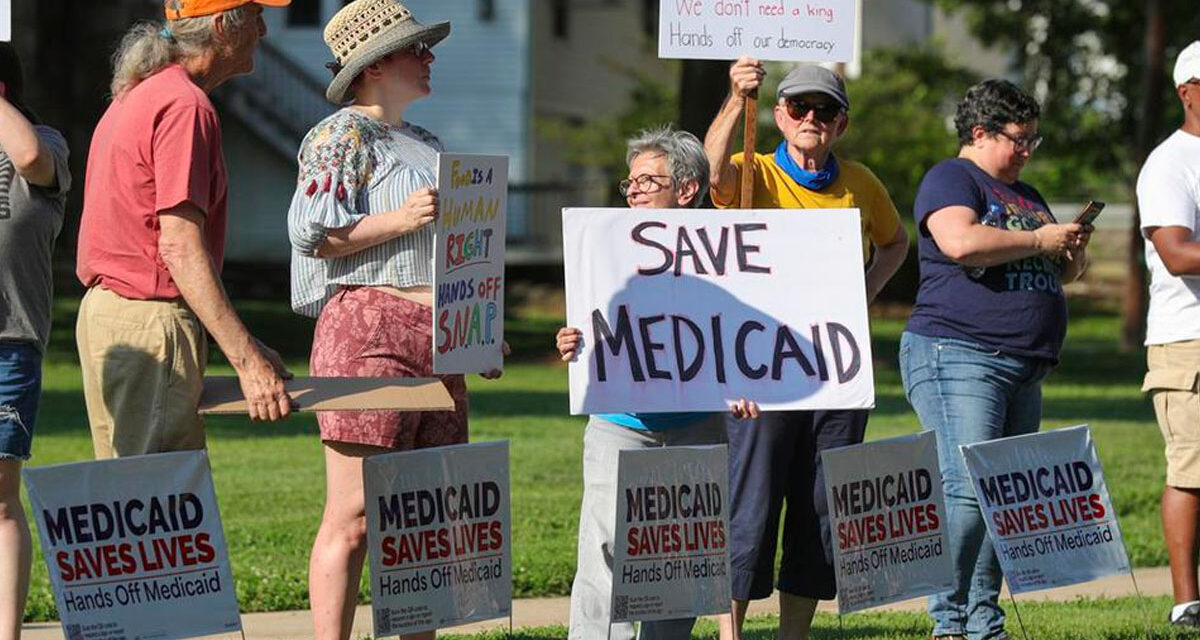
A controversial provision in President Donald Trump’s sweeping “One Big Beautiful Bill” has ignited fierce debate: mandatory work requirements for able-bodied Medicaid recipients. While critics call the policy a bureaucratic disaster in the making, supporters argue it’s a long-overdue reform rooted in personal responsibility and economic dignity. As the Senate takes up the bill, the stakes are high for millions of low-income Americans—and for the broader direction of welfare policy in the United States.
What the New Work Rules Would Require
Under the proposed federal rules, adults aged 19 to 64 who are receiving Medicaid through the Affordable Care Act’s expansion program would be required to complete at least 80 hours per month of work, job training, education, or volunteer service. Exemptions exist for pregnant women, parents of dependent children, and those with physical or mental disabilities.
The goal, according to Speaker Mike Johnson, is “common sense.” He said, “You find dignity in work, and the people that are not doing that, we’re going to try to get their attention.” For Johnson and many Republicans, Medicaid was never meant to be permanent support for able-bodied adults. “These programs were intended to be safety nets, not hammocks,” said Sen. Katie Britt of Alabama.
Rep. Nancy Mace put it even more bluntly: “If you’re an able-bodied worker, get a damn job.”
The Georgia Trial Run: A Warning Sign
Georgia is currently the only state enforcing work requirements for Medicaid, and the early results have raised red flags. Since the launch of its “Pathways to Coverage” program in July 2023, Georgia has spent close to $100 million, with over half going toward administrative costs. Out of nearly 250,000 eligible residents, only about 7,500 enrolled. That’s less than 5 percent participation.
The state’s own data shows that 64 percent of those eligible were already working, but many could not navigate the state’s digital verification system. Georgia has since reduced its verification frequency from monthly to annually, acknowledging the administrative burden.
Critics like Pamela Herd, a social policy expert at the University of Michigan, say Georgia’s experience is instructive. “The majority of people already meet the requirement or are exempt, but they’re going to get caught in paperwork. That’s not a policy success. That’s failure by design.”
What Happened in Arkansas and New Hampshire
Before Georgia, Arkansas tried work requirements between 2018 and 2019. The result: more than 18,000 low-income adults lost coverage in six months. A federal judge struck down the requirement, citing increased uninsurance rates with no evidence of higher employment. New Hampshire faced similar problems in 2019 and suspended its work rule before it could take full effect.
In both states, a significant number of enrollees lost coverage not because they failed to meet the requirements, but because they were confused about the process or couldn’t submit the correct paperwork in time.
California’s Potential Crisis
In California, where nearly 15 million people rely on Medi-Cal, state-specific projections are alarming. A report by the Urban Institute estimates that as many as 1.4 million Californians could lose coverage under the new federal work rules. Many of these people work in the informal economy as gardeners, nannies, and housekeepers—jobs without pay stubs or HR departments to verify hours.
Diana Alfaro, a health navigator in Los Angeles, said, “They’re already doing the work. But try getting a letter from someone who pays you in cash or has no fixed hours. It’s not realistic.”
Critics argue that the policy amounts to a bureaucratic trap. “You might say you’re combating fraud,” said Katherine Hempstead of the Robert Wood Johnson Foundation, “but the way you’re going to save money is by people accidentally losing coverage. That’s not a good way to run social insurance.”
Supporters of the bill argue that the work requirement is both a moral imperative and a fiscal necessity. The Congressional Budget Office estimates that the rule could save $344 billion over 10 years, largely by reducing Medicaid enrollment. That money, Republicans say, helps offset the cost of Trump’s renewed tax cuts and brings long-term sustainability to welfare programs.
Rep. David Valadao of California, a Republican who represents a heavily Medicaid-dependent district, said, “For those who are able-bodied with no dependents and choose not to make that effort, yeah, you’re probably going to be affected by this. But the average working American thinks that’s fair.”
Trump’s Philosophy: Work as a Pathway to Dignity
For Trump, this reform fits into a broader worldview that sees work not only as an economic necessity but as a source of personal value. His administration’s position is clear: people capable of working should be encouraged, even pushed, to work. It’s not about cruelty, they argue, but about breaking cycles of dependency.
Sen. Bill Cassidy of Louisiana summed up that philosophy well: “Safety nets should bounce you to your feet. They shouldn’t be like flypaper in which you stick and can never get off.”
Critics warn that the Medicaid work requirements could throw millions off health coverage due to technicalities, not laziness. They point to failed experiments in Arkansas and Georgia, and looming dangers in places like California. Still, supporters maintain that encouraging work is a moral and economic imperative—and Trump’s policy reflects that belief.
While the policy may stumble in execution, its intent is grounded in a simple principle: for those who can work, work is the best path forward. As the Senate debates the bill, that idea—however controversial—remains at the heart of Trump’s vision for welfare reform.




That which is right, is not always easy, that which is easy, is not always right.
And that which is left can never be right and that which is right is not always right. So pass or flunk, either way you’re sunk, so smoke n toke, cause it’s all a joke.
Burma Shave.
Cut, slash, burn, destroy. Hi ho, Hi ho, it’s off to save the nation I go. I cut I cut, it really sucks, I cut wherever I can. Fuck transparency, fuck meritocracy, fuck democracy, I cut, I cut, no Congressional input, I cut whatever I can. Get em up, Epstein them out, raaaaaw hiiiiiide.
To fake a rational rationale for Medicaid, Daniel parses the Medicaid cuts to focus on a single element in a program that has five major elements in a disaster of a policy in its entirety. The beauty is that we might not see the damage as Trump targets the unwashed, the unseen, the poor, the destitute. The five elements/cost savings are:
Work Requirements/$326B in savings
Eligibility Rule Changes/$126B
Provider Tax Limits/$191B
State Directed Payments/$149B
Eligibility Redeterminations/$63B
Thus the work requirement cost savings are about 1/3 of the total cuts and the largest perceived savings. And they really aren’t even savings, but a hurdle people on Medicaid must clear. Or do without. How are the savings really achieved? By denying Medicaid to those unable to work, those taking care of others, perhaps those trying to get training/education to escape poverty, . Trump and company say the work is for dignity; it’s part time or 50% of full time. If it was for dignity, they would be working already. According to KFF, the cuts are 15% to Medicaid in total. For 15%, he’s putting those unable to work on the street.
KFF estimates that 44% of Medicaid recipients work full time, 20% part time. But, 12% don’t work to care for loved one at home. Fuck em. About 10% have disability or health issues stopping them from working. Screw em. 7% are in school. Heck with em. And 8% are either retired, looking for work, or other. Who cares, cut em. Your savings is by denying them Medicaid, not profiting from their work efforts. He taxes that with his tariff sales tax that screws the poor more than the rich.
Medicaid provides health coverage to our poorest citizens. Trump’s own CBO estimates the cuts, including the “forced-to-work” restriction will cause 11.8M to lose health coverage, many of them covered via the ACA, tossing them to the ER for more expensive coverage with less positive results. That’s your savings, tossing 12 million off health care coverage. It is the most regressive cut to US health benefits ever. Trump is setting the record for removing support to our most vulnerable with no alternatives. Where will they go for health care coverage: the ER. The more expensive ER coverage will be covered by US health insurance policy owners —- i.e. the rest of us in higher premiums and more congestion at ER facilities. And they will wait until they are very, very, sick, again raising the overall costs of healthcare. Some health care facilities in lower income and rural areas will close, based on past experiences. According to Berkley Public Health: “States that have previously passed such work requirements have seen many people lose insurance, though often because the bureaucracy made it too difficult to prove that they were actually complying and so should have been Medicaid eligible. Another population at high risk is immigrants, for example, most on humanitarian visas will now be barred from Medicaid.”
Of course, the beauty of these cuts is that they, for the most part, don’t affect older folks and others above the poverty line. They mostly affect the unseen, the poor, the destitute. They attempt remove the emotional pull at the heartstrings by branding it as “the dignity of work.” “Most working-age Medicaid enrollees who don’t receive disability benefits already work or are looking for work, or are unable to do so because they have a disability, attend school, or care for a family member, according to KFF, a health information nonprofit that includes KFF Health News.” According to NPR: “State experiments with work requirements have been plagued with administrative issues, such as eligible enrollees’ losing coverage over paperwork problems, and budget overruns. Georgia’s work requirement, which officially launched in July 2023, has cost more than $90 million, with only $26 million of that spent on health benefits, according to the Georgia Budget & Policy Institute, a nonpartisan research organization.”
What Daniel does not say about the bill, and the work requirement in the bill, is that it affects those on the ACA outside of Medicaid: “For those with Obamacare plans, the new legislation will make it harder to enroll and to retain their coverage. ACA marketplace policyholders will be required to update their income, immigration status, and other information each year, rather than be allowed to automatically reenroll — something more than 10 million people did this year. They’ll also have less time to enroll; the bill shortens the annual open enrollment period by about a month.” So, many currently on the ACA will lose coverage over a bureaucratic nightmare of Trump’s own making. The ACA, which has resulted in the most Americans in history with health care insurance, will finally be the failure that Trump has always wanted based on his policy actions. He offers no alternative for these 12 million for health care beyond the ER. Where’s the dignity in all that, Daniel?