




















The U.S and Israel Launch Massive Strikes on Iran

A major military confrontation between the United States, Israel, and Iran erupted early Saturday when U.S. and Israeli forces launched a sweeping pre dawn bombing campaign across Iranian territory. The joint operation, called Operation Epic Fury, targeted Iran’s leadership, military infrastructure, missile systems, and nuclear related facilities in what officials described as the opening phase of a broader campaign that could reshape the Middle East.
Explosions rocked Tehran and other major cities as air defenses attempted to respond. Traffic clogged highways as civilians fled urban areas amid fears of additional strikes. Israeli officials said approximately 500 targets had already been hit since the operation began.
President Donald Trump framed the campaign as a necessary step to eliminate a long standing threat. He said the operation was designed to ensure Americans would never face the danger of a nuclear armed Iran. In a direct appeal to the Iranian people, Trump urged them to overthrow their government, saying, “It will be yours to take,” and adding, “This will be probably your only chance for generations.”
The operation followed weeks of rising tension and a monthlong U.S. military buildup in the region that came after protests inside Iran earlier this year. Trump had previously pledged to support demonstrators who challenged the regime.
Forces Arrayed Against Iran
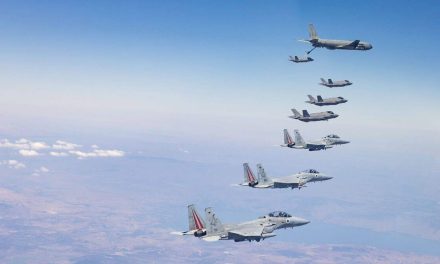
Israel played a central role in the opening attacks. The Israeli Air Force launched what it described as the largest military flyover in its history. Approximately 200 fighter jets carried out coordinated strikes across Iran, targeting missile launchers, air defense systems, and military infrastructure.
The military power assembled against Iran was substantial and carefully positioned. At the center of U.S. force projection were two aircraft carrier strike groups, the USS Abraham Lincoln and the USS Gerald R. Ford. These carriers function as mobile air bases, capable of launching waves of strike aircraft while being protected by missile defense systems and escort ships.
More than a dozen additional U.S. warships were deployed across the region, including guided missile destroyers capable of launching Tomahawk cruise missiles. The distributed positioning of these forces meant that American military assets could operate from multiple directions simultaneously, reducing vulnerability to Iranian retaliation.
The U.S. Air Force also deployed dozens of advanced aircraft to regional bases in Jordan, Israel, and Saudi Arabia. These included F 35 stealth fighters, F 22 air superiority fighters, F 15 and F 16 strike aircraft, as well as specialized platforms like the E 3 Sentry airborne warning aircraft and the E 11A battlefield communications node.
Israeli officials said the operation involved “accurate planning and high quality intelligence” and emphasized that the synchronized use of hundreds of aircraft was designed to achieve air superiority quickly. According to the Israeli military, the massive flyover “thwarted numerous threats to the IAF’s fighter jets and to Israeli civilians.”
Targeting Iran’s Leadership
One of the most dramatic aspects of the operation was the direct targeting of Iran’s senior leadership. Sites linked to Supreme Leader Ayatollah Ali Khamenei were struck, and Iranian leadership figures, including the president, were reportedly targets of the campaign.
Iranian officials later stated that Khamenei had not been in Tehran during the attacks and had been moved to a secure location. Iran’s foreign minister said both Khamenei and President Masoud Pezeshkian were still alive “as far as I know.”
The decision to strike leadership targets suggests the campaign may go beyond degrading military capabilities and could be aimed at destabilizing the regime itself. Trump described the operation as the beginning of a campaign that would “devastate Iran’s military, dismantle its nuclear program and ultimately bring about regime change.”
Iran’s Retaliation Across Israel and the Gulf
Iran responded quickly with a large scale missile and drone campaign that extended far beyond Israel. Dozens of missiles were launched at Israeli territory, with approximately 40 reportedly landing in the country.
But unlike previous conflicts, Iran dramatically expanded its retaliation by targeting Arab countries that host U.S. military bases. Missiles and drones were launched toward Bahrain, Qatar, Kuwait, Jordan, Saudi Arabia, and the United Arab Emirates. Iranian strikes also hit near the U.S. Navy’s Fifth Fleet headquarters in Bahrain, though no casualties were reported.
The widening of the conflict into Gulf states marked a dangerous escalation. It created the risk that additional countries could be pulled into direct confrontation.
U.S. defenses intercepted multiple incoming missiles, and regional air defense systems also prevented many impacts. However, damage was reported at some military sites, including facilities in Bahrain.
Iran also targeted shipping routes by threatening activity near the Strait of Hormuz, one of the world’s most important energy chokepoints. Concerns grew that Iran might attempt to disrupt global oil supplies.
Arab States React Strongly to Iranian Strikes
The retaliation against Arab countries triggered immediate and forceful responses from governments across the Gulf region. Many nations condemned Iran rather than criticizing the U.S. Israeli operation.
Qatar stated that it reserves its “full right” to defend itself after what it described as Iranian aggression against its territory. Its Defense Ministry said air defense systems had “successfully thwarted a number of attacks targeting the country’s territory.”
Saudi Arabia issued a strong warning, saying it affirmed “its full solidarity with and unwavering support for the brotherly countries” affected by Iranian strikes. The Saudi government also warned of “grave consequences resulting from the continued violation of states’ sovereignty and the principles of international law.”
The United Arab Emirates reported that it had been “subjected to a blatant attack involving Iranian ballistic missiles,” adding that its air defense systems intercepted several incoming weapons. Authorities said falling debris caused one civilian death and material damage. The UAE called the attack “a dangerous escalation and a cowardly act that threatens the safety of civilians and undermines stability,” and said it “reserves its full right to respond.”
Jordan also condemned the strikes. The country’s foreign minister said King Abdullah II “condemns the attack on the territories of Jordan, and any attacks on Arab countries,” expressing solidarity with nations targeted by Iran.
Lebanon’s foreign ministry similarly condemned Iran’s actions, stating that it “strongly condemns the Iranian attacks” and rejects any violation of sovereignty.
These responses suggest Iran’s decision to strike Gulf states may have backfired diplomatically by strengthening regional alignment against Tehran.
International Reaction: Support, Concern, and Opposition
Global reaction to the strikes has been deeply divided.
Several countries openly supported the United States and Israel. Canada said, “Canada supports the United States acting to prevent Iran from obtaining a nuclear weapon,” describing Iran as “the principal source of instability and terror throughout the Middle East.”
Australia also endorsed the operation. Prime Minister Anthony Albanese wrote that “Australia stands with the brave people of Iran in their struggle against oppression,” while confirming support for U.S. action to prevent Iran from obtaining nuclear weapons.
The United Kingdom emphasized that Iran “must never be allowed to develop a nuclear weapon,” while coordinating closely with European partners.
Ukraine strongly supported the U.S. decision. President Volodymyr Zelenskyy said, “It is important that the United States is acting decisively. Whenever there is American resolve, global criminals weaken,” linking Iran to Russia’s war against Ukraine through drone supplies.
Some countries took a more cautious position. France warned that the conflict carried “grave consequences for international peace and security” and called for an emergency United Nations Security Council meeting. European leaders urged renewed negotiations while also condemning Iran’s missile attacks.
Other governments openly opposed the strikes. Spain rejected what it called “unilateral military action,” saying it contributed to “a more uncertain and hostile international order.” China said it was “highly concerned” and called for an immediate halt to military operations, emphasizing that Iran’s sovereignty should be respected.
Pakistan condemned the attacks and called for diplomacy, while Oman criticized the U.S. Israeli operation as a violation of international law and urged a ceasefire.
Russia issued one of the harshest responses. Senior official Dmitry Medvedev said, “All negotiations with Iran are a cover operation,” sharply criticizing Western intentions.
Economic and Strategic Risks
The conflict quickly produced global economic concerns. Tankers began diverting away from the Strait of Hormuz, through which roughly 20 percent of the world’s oil supply moves each day. Oil prices rose as traders feared disruption.
Even without direct attacks on shipping, the threat alone demonstrated Iran’s ability to create global economic shock.
Officials indicated that several days of intensive strikes are planned. Experts believe the duration will depend heavily on Iran’s military resilience and its willingness to escalate further.
The targeting of leadership sites and the scale of the operation suggest that regime change is at least a possible objective. Trump described the campaign as one that could ultimately bring about the fall of the current government.
However, Iran has signaled it will continue fighting. Officials in Tehran said the country would defend itself against any attack.
Internal unrest inside Iran may play a major role in the outcome. Earlier protests included chants supporting opposition figure Reza Pahlavi, the son of the former shah. Demonstrators shouted “Long live the Shah” and “Pahlavi will return,” reflecting dissatisfaction with the current regime.
Trump’s direct appeal to Iranians indicates that Washington may hope military pressure combined with internal opposition could destabilize the government.
Whether that happens remains uncertain. Much depends on the survival of Iran’s leadership, the cohesion of its military forces, and the willingness of the population to challenge the regime during wartime conditions.
What is clear is that the confrontation has entered one of the most dangerous phases in decades of tension between Iran, Israel, and the United States, with the potential to reshape the geopolitical landscape of the Middle East.
PBP Editor: The question remains as to what will replace the government of Iran when it falls. You cannot leave a power vacuum since it will likely be filled with the most evil and powerful person remaining.
But we are betting that there is a succession plan that Trump has in mind.



Making it a PBP February Funnies Trifecta, and even funnier than female genitalia or the frequency of the f-word, Ernest…
Larry often picks a fight while blaming the other guys for starting it. That's not just my conclusion. One wonders…
ICE should kick you out too. There’s nothing wrong with kicking illegal wetbacks out of here.
Larry, You do love your bullshit don't you-tastes great, makes you strong, right? No, the democrats did not want to…
AOC is a national embarrassment and should not speak for the US ever again. Democrats should change their party to…