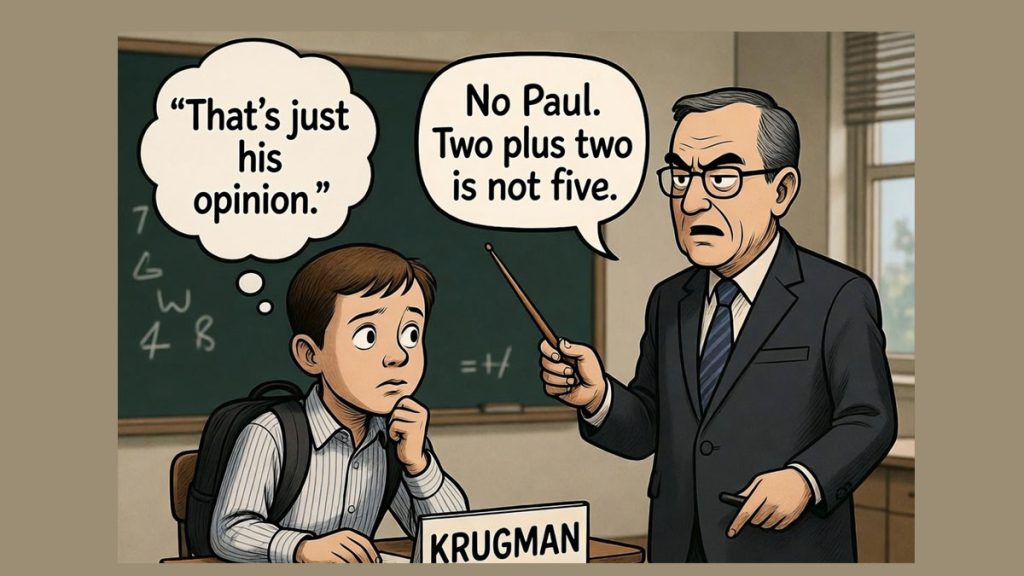
<p class="wp-block-paragraph">Left-wing economist Paul Krugman has once again emerged from the shadows to warn the American people that President Trump’s imposition of a 50 percent tariff on certain Canadian goods represents a “terrible mistake” — the very sort of blunder that he alleges plunged America into the Great Depression of the 1930s.</p>


<p class="wp-block-paragraph">One might find such pronouncements terrifying if not for the inconvenient truth that Krugman, despite his Nobel Prize in Economics, possesses one of the most consistently unreliable crystal balls in the profession. His analysis remains captive to left-wing political ideology, where predictions often amount to little more than wishful thinking dressed up as scholarly insight.</p>


<p class="wp-block-paragraph">There was a time when Krugman stood as one of the prominent economic figures in America. He enjoyed a twice-weekly column in the New York Times for some 25 years — a platform that amplified his voice across the nation. Yet even that perch could not shield him from the consequences of his own record. The Times eventually dropped him — though Krugman insists the departure represented his personal decision. He decided to retire. That claim fails the most basic litmus test of credibility since he now produces regular commentaries on Substack. If the move truly stemmed from voluntary retirement rather than editorial fatigue or irreconcilable differences, one wonders why the urgency to maintain such a prolific output elsewhere.</p>


<p class="wp-block-paragraph">Krugman’s history of inaccurate positions and overt political bias stretches back years and provides ample reason for skepticism. He famously predicted that the growth of the Internet would slow drastically — a forecast that aged about as well as milk left on a windowsill during a heat wave.</p>


<p class="wp-block-paragraph">Following the 2016 election of Donald Trump, he warned of a global recession “with no end in sight” — a dire prophecy he reiterated throughout the Trump years even as the economy boomed with strong job growth and low unemployment. Time and again, Krugman has sounded alarms about impending doom under conservative policies only to watch reality deliver the opposite.</p>


<p class="wp-block-paragraph">His warnings on inflation from quantitative easing post-2008, the survival of the euro, and post-Brexit economic collapse similarly missed the mark. It seems that whenever left-wing narratives demand panic, Krugman stands ready with charts and certitude, only for events to expose the ideology driving the ink. He is the economic version of former Vice President Al Gore, who predicted Draconian climate catastrophes that never happened.</p>


<p class="wp-block-paragraph">In the current case, Krugman dismisses Trump’s explanation that the tariffs respond to unfair trade practices by Canada. Instead, he offers the improbable notion that the measures arise from all that smoke drifting across the border from Canadian wildfires — a theory one might charitably describe as creative.</p>


<p class="wp-block-paragraph">Whatever the motivation, Krugman declares the tariffs “almost surely illegal.” (“Almost surely? That is the kind of precision that we have come to expect from folks who live in ivy-covered towers. But I digress.) One imagines Krugman peering into his econometric models and emerging with probabilistic legalese that constitutional lawyers and federal courts might find presumptuous. He possesses no special qualification to render such judicial pronouncements. Those determinations belong to experts in law and Supreme Court justices, not economists wielding political agendas.</p>


<p class="wp-block-paragraph">While this writer generally opposes tariffs on principle<strong>,</strong> they are occasionally necessary as a temporary means to correct imbalances or address illegal or unfair trade practices. In such cases, they protect American workers without triggering catastrophe — a reality Krugman’s partisan lens refuses to acknowledge. His reflexive opposition to Trump policies fits a familiar pattern — economic analysis subordinated to partisan warfare.</p>


<p class="wp-block-paragraph">(By way of clarification, this writer does believe that Trump goes too far in imposing tariffs – and for many of the wrong reasons. Conversely, this writer does not agree with Krugman in terms of the dire consequences he forecasts. And so far, this writer has been right and Krugman has been wrong.)</p>


<p class="wp-block-paragraph">Americans have grown weary of these recycled doomsday scenarios from voices like Krugman. The Nobel Prize, once a mark of intellectual rigor, now serves more as a reminder that even decorated economists can prioritize ideology over evidence. President Trump’s approach prioritizes fairness and reciprocity in trade, rejecting the naive assumptions of globalist orthodoxy that have disadvantaged American industries for decades.</p>


<p class="wp-block-paragraph">As the economy continues to demonstrate resilience, one expects Krugman to pivot seamlessly to the next apocalyptic forecast. His Substack audience may applaud the consistency of his worldview, but the rest of the nation has learned to view such predictions with the skepticism they richly deserve. In the arena of economic commentary, Paul Krugman remains the gift that keeps on giving — primarily to those who appreciate the humor in watching failed prophecies accumulate like unpaid tariffs on Canadian lumber.</p>


<p class="wp-block-paragraph">So, there ‘tis.</p>


<p class="wp-block-paragraph"></p>

Krugman: Trump’s Tariffs Pushing the United States into Another Great Depression?