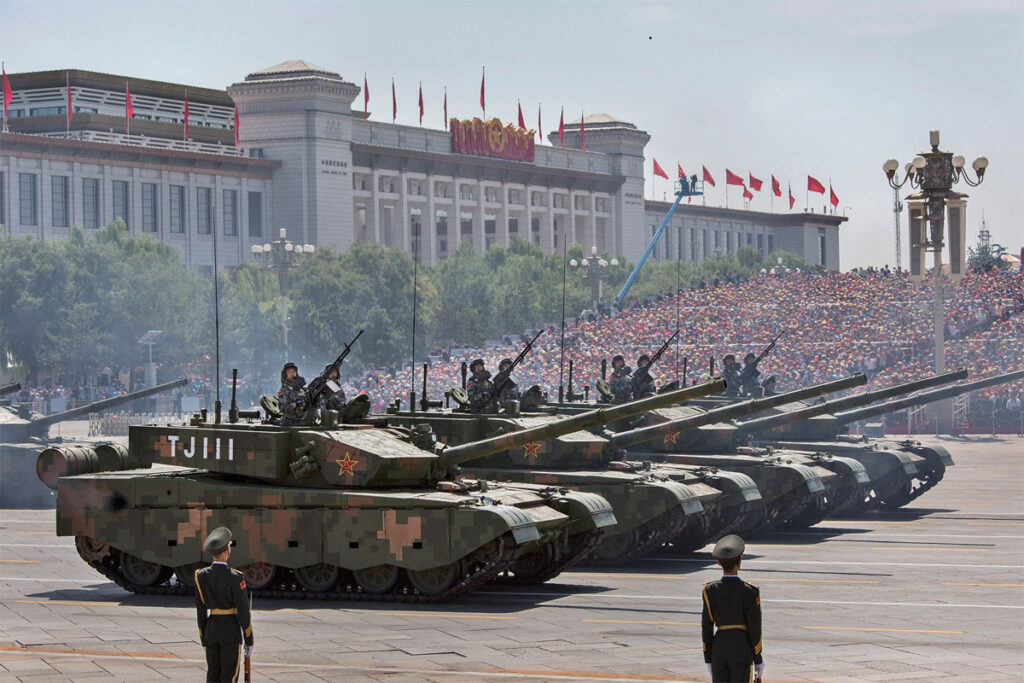
<p>When the Chinese Communist Party leadership gathered in Beijing for its quinquennial congress last October, the media spotlight was firmly on President Xi Jinping securing a precedent-shattering third term as China’s unchallenged leader. However, overlooked by many at the time was the rise of a new group of political leaders in the top echelons of power whose background diverges from the usual careers in provincial government or Communist Party administration. Instead, they all have deep experience in China’s military-industrial complex.</p>


<p>Their swift advancement is part of Xi’s efforts to reinvigorate China’s long-running project of “military-civil fusion,” a policy that seeks to harness new technologies from the private sector for the benefit of the country’s rapidly modernizing military.</p>


<p>More than a third of the Communist Party’s 205-member Central Committee now have a background in science, technology, engineering, and mathematics, according to a report by MacroPolo, a think-tank of the Paulson Institute in Chicago. That is a 35 percent increase from the previous committee appointed five years before.</p>


<p>Xi&#8217;s belief in the successful combination of party-state control and private sector activities in China’s military-industrial sector is highlighted by the unprecedented promotion of individuals with military-industrial engineering backgrounds in Chinese politics. This rapid rise of technocrats with expertise in defense and technology is spectacular, even in comparison with the general trend of a rising class of technocrats in the post-Mao era.</p>


<p>The implications of this development could be profound, as China&#8217;s potential adversaries in the West, already alarmed by the expansion of Chinese military capabilities, fear that the pace and breadth of military technology breakthroughs will accelerate. Xi&#8217;s recent appearance in front of leaders of the People’s Liberation Army, dressed in a dark green Mao suit, emphasized the need for China&#8217;s self-reliance and collaborative innovation in science and technology to establish its dominance on the world stage.</p>


<p>However, despite China&#8217;s immense control over its private enterprises and the presence of state-owned enterprises and universities conducting defense-focused research and development, the country&#8217;s defense industry remains poorly operated and has largely failed to reform. The military has been slow to adapt to private sector forces, and defense sector state-owned enterprises struggle to strike a balance between making money and supporting policy goals.</p>


<p>China&#8217;s military-civil fusion policy has faced challenges in integrating private sector technology and innovation with the military. The military has shown a lack of trust in private groups, which has narrowed the scope of what the private sector can offer. Conflicting laws and regulations, legal risks, and concerns about intellectual property rights further complicate cooperation between the private sector and the military.</p>


<p>The US government sees China&#8217;s military-civil fusion policy as a strategy to develop the most cutting-edge military in the world by acquiring and diverting advanced technologies, including through theft. The US defense community has expressed concerns that Chinese companies are obtaining overseas technologies and expertise that can later be used by the military. The US has imposed export controls and sanctions to counter this perceived technology transfer.</p>


<p>Xi&#8217;s personal leadership and increased spending in the military-civil fusion policy reflect a significant shift in China&#8217;s approach to address its security concerns. The policy is expanding into various domains of competition, including cyber, finance, space, and maritime sectors. Political support and funding have been provided to firms involved in military-civil fusion projects, resulting in the establishment of numerous demonstration bases and institutions dedicated to military-focused research and development.</p>


<p>China&#8217;s improved technology has positioned its defense companies to ramp up weapons exports and fill the void left by Russia and Ukraine in certain developing countries. Beijing&#8217;s focus on national security is understandable given rising military tensions with the US, but there are differing views on how Xi balances security with other domestic concerns. </p>


<p>While Beijing believes that domestic development of technology and a strong military-industrial complex are essential for its national security and global influence, critics argue that the focus on military-civil fusion may divert resources and attention away from pressing domestic issues such as economic inequality, social welfare, and environmental sustainability.</p>


<p>Xi Jinping&#8217;s dream of a Chinese military-industrial complex is a key component of his broader vision for China&#8217;s rise as a global superpower. By promoting technocrats with military-industrial expertise and implementing the military-civil fusion policy, China aims to harness private sector innovation and technology to bolster its military capabilities. However, challenges remain in effectively integrating the private sector with the military and addressing concerns about technology transfer and intellectual property rights. The implications of China&#8217;s military modernization efforts and its growing defense industry are closely watched by its adversaries and have far-reaching geopolitical implications.</p>

Xi Jinping’s Dream of a Chinese Military-Industrial Complex