<p class="wp-block-paragraph"><strong><em>This is another in a series of Black History Month commentaries offered as part of an oft requested dialogue on race. ; It deals with facts, events and perspectives that Democrats and the political left strive to keep out of their version of a “dialogue.” ;</em></strong></p>


<p class="wp-block-paragraph">There are many politicians who contributed to the plight of Black Americans for the 160 years since the end of the Civil War and the Emancipation Proclamation. ; One man, however, stands out for being the most significant architect of the <em>de facto</em> racist system that has maintained racial segregation and oppression by supplanting constitutional rights with welfare dependency. ; ;</p>


<p class="wp-block-paragraph">While the modern American people are not a racist culture, the last vestige of institutional <em>de facto</em> racism still exists. It is easy to find. One merely has to look at where Black Americans are still segregated into communities in which there is a lack of quality education, jobs, safe housing, poor healthcare, public safety, well maintained streets and parks, effective police enforcement and public mobility. In place of those, there is a high rate of generational welfare dependency that traps millions of Black citizens on a barely survivable economic plantation. </p>


<p class="wp-block-paragraph">That describes the historic conditions in America’s major cities – virtually all of which are –and have been – in the virtually exclusive one-party control of the Democratic Party for generations. It explains why virtually all the major race-based protests, demonstrations and riots have occurred in those same cities – triggered by the oppressive effects of systemic or institutional <em>de facto</em> racist policies and practices.</p>


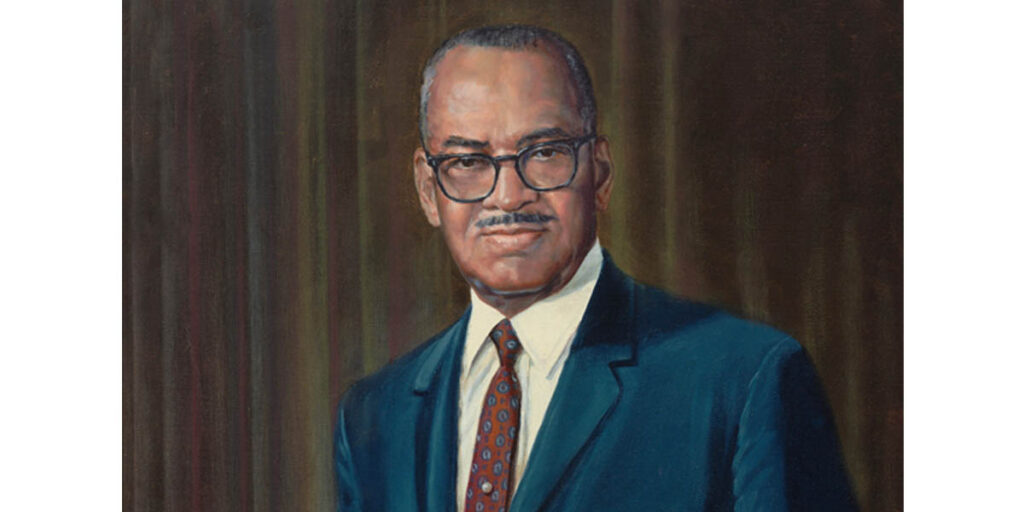
<p class="wp-block-paragraph">To see the genesis of urban institutional racism, one needs to look to Chicago in the 1930s – and a man named William Dawson. ; He played a major role in enslaving millions of Black folks over several generations in segregated impoverished welfare-dependent communities – the economic plantations, as they are appropriately dubbed.</p>


<p class="wp-block-paragraph">Here is the excerpt from the book.</p>


<p class="wp-block-paragraph"><strong>The Chicago Machine and William Dawson</strong></p>


<p class="wp-block-paragraph">It was in Chicago that the Latin term <em>de facto</em> was first routinely applied as a modifier in describing a special form of institutional racism. ; <em>De facto</em> racism has been more enduring because it is not as obvious as the <em>de jure</em> segregation of the solid Democrat South. ; It is not as easily addressed by the courts.</p>


<p class="wp-block-paragraph">The Chicago Democrats did not invent the votes-for-benefits concept. ; That was already the <em>modus operandi </em>of New York’s Tammany Hall since the Eighteenth Century. ; The difference was that the Tammany organization, and its imitators, used privately sourced rewards in return for votes, such things as food, coal and, of course, money. ; It also might include jobs, obtaining building permits or “fixing” traffic citations. ; The Chicago model shifted the “bribes” to taxpayer financed benefits.</p>


<p class="wp-block-paragraph">The strategy to control the vote through welfare did not occur organically by cultural evolution. ; It was a scheme perfected and implemented by the Chicago Democrat Machine. ; It was the cynical genius of a man named William Dawson.</p>


<p class="wp-block-paragraph">Dawson began his political career as a Black Republican in 1930, just as Blacks were switching over to the Democratic Party. ; He was elected alderman from Chicago’s Second Ward in 1932 – a ward with a large Black population. ;</p>


<p class="wp-block-paragraph">At the time, the white Democrat Committeeman of the Second Ward was Joseph Kittinger. ; Following the Democrat’s older strategy, Kittinger doled out jobs and favors to the Ward’s white minority – basically ignoring or discouraging the Negro vote. ; The Black community, however, was gaining in numbers and influence, and they demanded that Chicago Mayor Ed Kelly remove Kittinger for a Black ward boss. ; Which he did.</p>


<p class="wp-block-paragraph">In Kittinger’s place, Kelly persuaded Republican Dawson to switch parties in return for controlling patronage in the Second Ward. ; As the new ward boss, Dawson developed an ingenious means to control the Negro vote in the all-Black segregated communities. ; He literally abandoned the fight for constitutionally grounded civil rights for a new faux “civil right” – access and dependency on welfare.</p>


<p class="wp-block-paragraph">While Negroes gave Roosevelt overwhelming support in 1932, that loyalty seemed to be weakening in the late 1930s. ; As late as 1939, the allegiance of the Black vote to the Democratic Party was still fragile and the Republican Party was gaining as a competitive political force. ; ; The majority of Blacks were registered as Republicans until 1948.</p>


<p class="wp-block-paragraph"><strong>The Black Sub-Machine</strong></p>


<p class="wp-block-paragraph">Dawson’s influence grew beyond the Second Ward. ; He became the go-to man for Chicago’s entire Black population. ; He was the boss of what some called “the sub-machine.” ; An online website associated with Chicago public television station WTTW stated:</p>


<p class="wp-block-paragraph"><em>Dawson proved adept at organizing the increasing number of Black Democrats on the South Side and soon consolidated his political power. He effectively used patronage and precinct workers to develop a strong voting bloc that generally gave local, state, and national Democratic candidates impressive majority votes. Dawson would eventually control as many as five wards, forming the city&#8217;s first Black political machine.</em></p>


<p class="wp-block-paragraph">Based on his rhetoric more than his actions, Dawson became a hero to the Black community. ; Like the house slaves of the early Nineteenth Century, however, Dawson’s loyalty was to the white Democrat bosses in City Hall.</p>


<p class="wp-block-paragraph">According to Christopher Manning in “William L. Dawson and the Limits of Black Electoral Leadership.”</p>


<p class="wp-block-paragraph"><em>“Dawson was also leader of the African American ‘sub-machine’ within the Cook County Democratic Organization. In the predominantly African American wards, Dawson was able to act </em><em>as his own political boss, handing out patronage and punishing rivals just as leaders of the larger machine, such as Richard J. Daley, did. However, Dawson&#8217;s machine had to continually support the regular machine in order to retain its own clout.</em></p>


<p class="wp-block-paragraph"><em>He chose to work on city politics from this stance, rather than to conduct open civil rights challenges, and </em><em>did not support the work of Dr. Martin Luther King, Jr. ;in Chicago in the 1960s.”</em><strong><em></em></strong></p>


<p class="wp-block-paragraph">By 1957, Black leaders, such as Martin Luther King, were pushing back against both <em>de jure</em> racism in the South and the <em>de facto</em> racism in the major cities. With more aggressive civil rights activism on the rise, <em>The Chicago Defender,</em> a Black publication, said that Dawson as a civil rights leader was &#8220;non-committal, evasive, and seldom takes an outspoken stand on anything.”</p>


<p class="wp-block-paragraph"><strong>The Dawson Strategy Goes National</strong></p>


<p class="wp-block-paragraph">Dawson’s welfare-for-votes was so effective in recruiting and retaining Blacks for the Democratic Party in Chicago that he attracted national attention, including the eye of the President. ; FDR saw the value in the Dawson welfare-for-votes strategy. ;</p>


<p class="wp-block-paragraph">Dawson was elected to Congress and was named Assistant Chairman of the Democratic National Committee. ; His specific responsibility at the DNC was to spread the welfare-for-votes concept to Black voters in other cities.</p>


<p class="wp-block-paragraph">Black leaders, like Dawson, became part of the established Democrat political machine. ; In New York City’s Harlem, Congressmen William Clayton Powell took on the Dawson role under Big Jim Pemberton. ; The importance of Dawson, Pemberton and Powell to the Democratic Party was chronicled in a major feature article in <em>Life Magazine</em> in 1944.</p>


<p class="wp-block-paragraph">(End of excerpt)</p>


<p class="wp-block-paragraph">As has been the case in the past, the current Black History Month fails to cover all the historical facts of Black history in America –especially the post-Civil War history, which is skewed by political bias in academia, entertainment and the news media. ; Much of history recounts the horrors of racial oppression without identifying who was, and is, responsible for the conditions under which millions of Black folks live today. ; It is not a natural outcome. ; The conditions of life in America’s segregated cities are not the result of Black character traits – as some contend. ; It is the willful maintenance of institutionalized oppression for political benefit.</p>


<p class="wp-block-paragraph">Democrats – for obvious reasons – and the left in general do not want a dialogue on race that covers ALL the facts. ; They want only a propagandized version of Black history. ;</p>


<p class="wp-block-paragraph">As I have said in the past, Black History Month should be cut back to two weeks, because the American people – Black and White – are only getting half the historic story.</p>


<p class="wp-block-paragraph">So, there ‘tis.</p>

William Dawson and the creation of the economic plantation