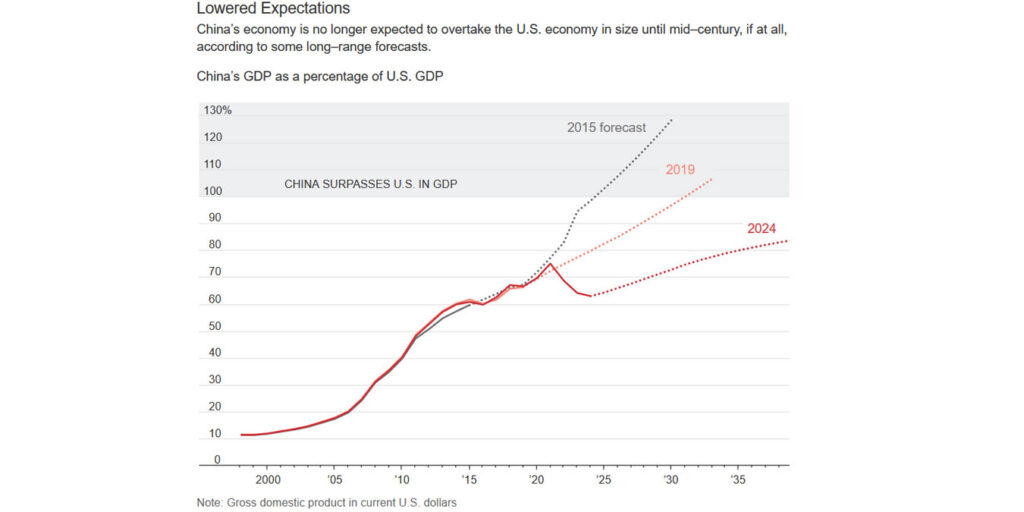
<p class="wp-block-paragraph">For decades, economists and policymakers predicted that China&#8217;s rapid economic growth would allow it to surpass the United States as the world&#8217;s largest economy. Once seen as an inevitable outcome, this forecast now appears uncertain. Structural issues within China&#8217;s socialist economy, totalitarian demographic challenges, and the aftermath of a catastrophic real estate bust have slowed its momentum. Today, experts suggest that China may not overtake the U.S. in GDP until at least 2050—if it ever does.</p>


<h3 class="wp-block-heading" id="h-the-shifting-forecasts">The Shifting Forecasts</h3>


<p class="wp-block-paragraph">In 2019, projections suggested that China&#8217;s economy would eclipse the U.S. by 2030. However, recent developments have significantly altered those forecasts. The U.S. economy remains resilient, bolstered by innovation, strong consumer spending, and a robust service sector. Meanwhile, China&#8217;s economic engine has stumbled, dragged down by overbuilding, mounting debt, and a shrinking workforce &#8211; all of which, incidentally, caused by their socialist totalitarian government.</p>


<p class="wp-block-paragraph">According to the Centre for Economics and Business Research, China might not surpass the U.S. economy until mid-century, if at all. Some experts, including former U.S. Treasury Secretary Lawrence Summers, even argue that China may never take the top spot. &#8220;I think there is a real possibility that something similar would happen with respect to China,&#8221; Summers said, drawing parallels between China&#8217;s current situation and past overestimations of Japan and Russia.</p>


<p class="wp-block-paragraph">Instead, its economic trajectory could mirror Japan&#8217;s experience in the 1990s, where rapid growth gave way to stagnation. As Anne Stevenson-Yang, co-founder of J Capital Research, bluntly put it, &#8220;Erratic and irresponsible policies, excessive Communist Party control, and undelivered promises of reform have created a dead-end Chinese economy of weak domestic consumer demand and slowing growth.&#8221;</p>


<h3 class="wp-block-heading" id="h-the-real-estate-crisis-a-18-trillion-implosion">The Real Estate Crisis: A $18 Trillion Implosion</h3>


<p class="wp-block-paragraph">At the heart of China&#8217;s economic struggles lies its real estate sector. Once a cornerstone of growth, the property market has crumbled under the weight of excessive borrowing and speculative investment. Since 2021, the property meltdown has erased an estimated $18 trillion in household wealth—a figure larger than the losses seen in the U.S. during the 2008 financial crisis.</p>


<p class="wp-block-paragraph">Millions of unfinished or vacant apartment units dot China&#8217;s cities, symbolizing the fallout from unchecked development. Despite government efforts to stabilize the sector with stimulus measures and policy shifts, consumer confidence remains weak. Households, having seen their wealth evaporate, are reluctant to spend, further stalling economic recovery.</p>


<p class="wp-block-paragraph">This real estate collapse is deeply tied to government policies. For years, China&#8217;s socialist economic model encouraged overbuilding, as state-backed developers pursued growth targets rather than market demand. At the same time, local governments became reliant on land sales to finance their budgets, creating a vicious cycle of debt and construction.</p>


<h3 class="wp-block-heading" id="h-the-one-child-policy-and-its-aftermath">The One-Child Policy and Its Aftermath</h3>


<p class="wp-block-paragraph">China&#8217;s one-child policy, a totalitarian demographic experiment enforced from 1980 to 2015, has had devastating long-term consequences for its economy. While the policy succeeded in slowing population growth, it also created an imbalance in the age structure of the population.</p>


<p class="wp-block-paragraph">Today, China faces a demographic time bomb. The country&#8217;s working-age population is shrinking, while its elderly population is expanding rapidly. By 2035, one in four Chinese citizens will be over 65. This demographic shift means fewer workers to drive economic growth and more strain on social welfare systems.</p>


<p class="wp-block-paragraph">&#8220;Historically, no country has managed to achieve 4% growth in the subsequent 12 years after the elderly made up 15% of the population,&#8221; noted Fu-Xian Yi, a demographer at the University of Wisconsin–Madison.</p>


<p class="wp-block-paragraph">The one-child policy also resulted in a gender imbalance, with far more men than women in the population. This imbalance contributes to social instability and reduces birth rates, further exacerbating the demographic crisis.</p>


<h3 class="wp-block-heading" id="h-manufacturing-and-overcapacity">Manufacturing and Overcapacity</h3>


<p class="wp-block-paragraph">China&#8217;s manufacturing prowess remains a core strength, dominating industries such as electric vehicles and renewable energy. However, manufacturing has also become a source of economic imbalance. Excess industrial capacity has led to falling prices for Chinese goods and increased reliance on exports. This has sparked trade tensions with the U.S., Europe, and emerging markets like India and Brazil.</p>


<p class="wp-block-paragraph">While China&#8217;s factory floors remain productive, the country&#8217;s dependence on manufacturing exposes it to global market volatility and trade barriers. According to economist Mark Williams, &#8220;A lot of people for a long time have overestimated the competence of China’s leadership and have been shocked by the missteps with Covid and the property sector.&#8221;</p>


<h3 class="wp-block-heading" id="h-is-china-the-next-japan">Is China the Next Japan?</h3>


<p class="wp-block-paragraph">Parallels between China and Japan&#8217;s economic trajectories are hard to ignore. Japan&#8217;s bubble economy of the 1980s burst spectacularly in the early 1990s, leading to a prolonged period of stagnation. Many economists worry that China could face a similar fate due to its real estate crash, high debt levels, and an aging population.</p>


<p class="wp-block-paragraph">However, China does have some advantages over Japan. Its population is much larger, urbanization is ongoing, and sectors like technology and green energy offer growth potential. But whether these factors can offset its structural weaknesses remains uncertain.</p>


<p class="wp-block-paragraph">Justin Yifu Lin, former Chief Economist at the World Bank, remains optimistic. He argues that China&#8217;s larger population means the country&#8217;s economy will eventually outpace the U.S., saying, &#8220;As long as Beijing maintains internal stability and external peace, the Chinese economy will soon overtake the U.S.&#8221;</p>


<h3 class="wp-block-heading" id="h-u-s-resilience-vs-china-s-uncertainty">U.S. Resilience vs. China&#8217;s Uncertainty</h3>


<p class="wp-block-paragraph">While China&#8217;s economic slowdown continues, the U.S. economy remains a global powerhouse. The United States benefits from high productivity, a dynamic private sector, and the dollar&#8217;s status as the world&#8217;s reserve currency. Despite political polarization and economic challenges, the U.S. economy has proven remarkably adaptable.</p>


<p class="wp-block-paragraph">Looking ahead, the Congressional Budget Office projects moderate but steady growth for the U.S., averaging around 2% annually over the next decade. In contrast, China&#8217;s growth rate is expected to slow to around 3% by the early 2030s.</p>


<p class="wp-block-paragraph">For China to have any chance of overtaking the U.S., it must address its core challenges: stimulate domestic consumption, reduce reliance on debt-driven growth, and reform its aging social welfare system. However, these changes require significant political and economic reforms—steps that China&#8217;s leadership appears reluctant to take.</p>


<p class="wp-block-paragraph">Ultimately, GDP rankings tell only part of the story. Even if China surpasses the U.S. in raw economic size, the U.S. will likely remain far wealthier on a per capita basis. Additionally, America&#8217;s global influence, driven by financial markets, innovation, and cultural exports, will continue to shape the world economy.</p>


<p class="wp-block-paragraph">The race between China and the U.S. is no longer about who will become the largest economy, but rather about who can build a more sustainable, resilient, and innovative economic model for the future.</p>


<p class="wp-block-paragraph">In the words of economist Andy Rothman, &#8220;Looking at the Chinese economy and the U.S. economy as a zero-sum game isn&#8217;t accurate. Both economies can thrive, but only if each country addresses its own unique challenges.&#8221;</p>


<p class="wp-block-paragraph"><strong>PBP Editor:</strong> China was cheating. They began building housing at a massive rate on borrowed money, and it became a major addition to their GDP, and a wealth placeholder &#8211; typical socialist thinking. But that has collapsed. They built their manufacturing base on the subsidized flooding of foreign markets and stolen technology. The West is getting wise, and manufacturing is beginning to move out.</p>

Will China Ever Surpass the U.S. Economy?