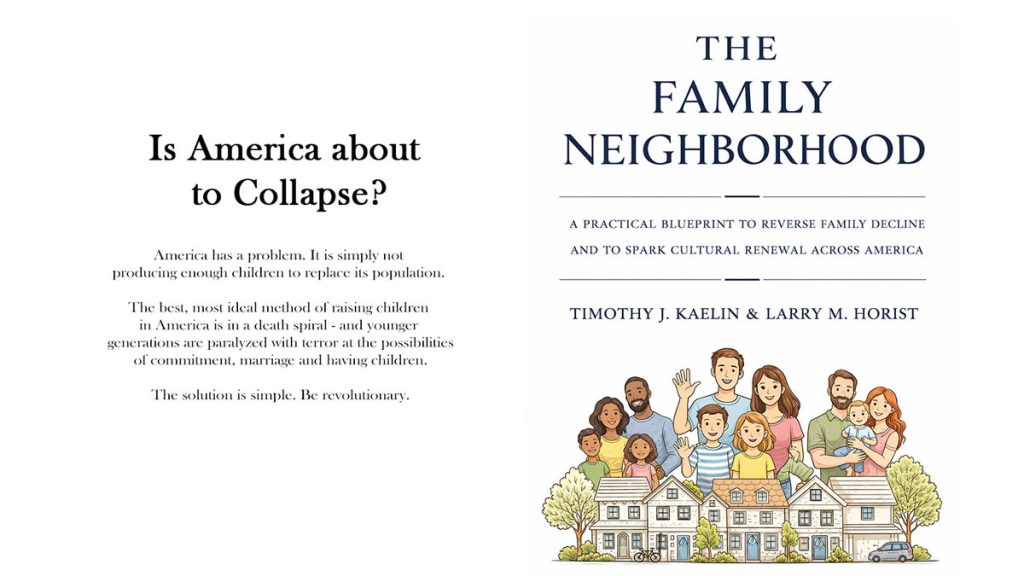
<p class="wp-block-paragraph"><em>This article is adapted from <strong><a href="https://www.amazon.com/Family-Neighborhood-practical-blueprint-cultural/dp/B0GT9BYVRF/">The Family Neighborhood: A Practical Blueprint to Reverse Family Decline and Spark Cultural Renewal Across America </a></strong>by Timothy J. Kaelin and Larry P. Horist. The book explores the growing collapse of family formation in America, why it matters to the nation’s future, and bold proposals to make marriage, parenting, and family life more achievable again. <a href="https://www.amazon.com/Family-Neighborhood-practical-blueprint-cultural/dp/B0GT9BYVRF/">Available now on Amazon for $17.95</a>.</em></p>


<p class="wp-block-paragraph">Young Americans are not rejecting marriage so much as becoming terrified of it.</p>


<p class="wp-block-paragraph">That distinction matters.</p>


<p class="wp-block-paragraph">Spend enough time speaking with people in their twenties and thirties and a striking pattern emerges. Many still want love. Many still imagine themselves having children someday. Many still hope for a stable home and meaningful relationships. Yet when conversations turn to marriage, commitment, or family, optimism often gives way to anxiety.</p>


<p class="wp-block-paragraph">Marriage feels risky.</p>


<p class="wp-block-paragraph">Children feel overwhelming.</p>


<p class="wp-block-paragraph">Commitment feels dangerous.</p>


<p class="wp-block-paragraph">What previous generations viewed as a natural progression into adulthood increasingly feels to younger Americans like stepping toward a cliff edge in the dark.</p>


<p class="wp-block-paragraph">The numbers suggest something profound has changed.</p>


<p class="wp-block-paragraph">In the 1980s, roughly <strong>68 percent of Americans between ages 20 and 34 were married</strong>. Today, that figure has fallen to <strong>well below 40 percent</strong>. In 1970, nearly <strong>70 percent of adults between ages 25 and 49 lived with a spouse and at least one child</strong>. By 2021, that number had collapsed to roughly <strong>37 percent</strong>.</p>


<p class="wp-block-paragraph">This is not a lifestyle trend.</p>


<p class="wp-block-paragraph">It is a cultural shift.</p>


<p class="wp-block-paragraph">And fear appears to sit near the center of it.</p>


<p class="wp-block-paragraph">Many young adults grew up watching marriages fail in real time. Divorce became common enough that millions absorbed instability as normal. Some remember bitter custody battles, financial hardship, emotional chaos, or years of uncertainty after parents separated.</p>


<p class="wp-block-paragraph">For a generation raised amid family instability, marriage often no longer looks like safety.</p>


<p class="wp-block-paragraph">It looks like risk.</p>


<p class="wp-block-paragraph">Many are quietly terrified of repeating what they witnessed growing up.</p>


<p class="wp-block-paragraph">Researchers have found that children who experience divorce or unstable family environments are substantially more likely to struggle with intimacy and stable relationships in adulthood. Family instability often reproduces itself psychologically. A child raised doubting permanence may grow into an adult terrified of trusting it.</p>


<p class="wp-block-paragraph">This hesitation is not merely emotional. Economics compounds the anxiety.</p>


<p class="wp-block-paragraph">Young couples today face financial realities that often feel crushing. Housing prices have surged. Childcare in many cities rivals a second mortgage payment. Student debt lingers for years. Stable employment feels less predictable than it once did.</p>


<p class="wp-block-paragraph">The cost of raising one child to age 18 now exceeds roughly <strong>$300,000 for middle-class families</strong>, excluding college.</p>


<p class="wp-block-paragraph">Young adults see this and quietly panic.</p>


<p class="wp-block-paragraph">Previous generations often married younger, bought homes sooner, and built families on incomes that seem almost impossible to replicate today. Many younger Americans compare their circumstances to those of their parents and feel defeated before they even begin.</p>


<p class="wp-block-paragraph">Marriage gets postponed.</p>


<p class="wp-block-paragraph">Children get postponed.</p>


<p class="wp-block-paragraph">Life itself gets postponed.</p>


<p class="wp-block-paragraph">The average age of first marriage now hovers around <strong>30 years old</strong>, far later than previous generations, while nearly <strong>four in ten adults under age 50 say they are unlikely ever to have children</strong>.</p>


<p class="wp-block-paragraph">People tell themselves they are waiting until they feel financially secure.</p>


<p class="wp-block-paragraph">But financial security increasingly arrives later in life, if it arrives at all.</p>


<p class="wp-block-paragraph">And by the time many feel “ready,” solitude has become comfortable, fertility windows narrow, and emotional habits harden.</p>


<p class="wp-block-paragraph">Yet economics alone cannot explain what is happening.</p>


<p class="wp-block-paragraph">Culture matters too.</p>


<p class="wp-block-paragraph">Modern culture sends profoundly mixed messages about family life. Television, movies, and social media frequently portray marriage as confinement, parenthood as endless exhaustion, and domestic life as stressful monotony.</p>


<p class="wp-block-paragraph">Freedom is marketed.</p>


<p class="wp-block-paragraph">Permanence is questioned.</p>


<p class="wp-block-paragraph">Family life is often framed less as aspiration and more as sacrifice.</p>


<p class="wp-block-paragraph">Children are increasingly discussed in financial terms: expensive, limiting, burdensome.</p>


<p class="wp-block-paragraph">For many younger Americans, marriage no longer feels like the beginning of adulthood.</p>


<p class="wp-block-paragraph">It feels like the end of freedom.</p>


<p class="wp-block-paragraph">And underneath it all sits something even more troubling: loneliness.</p>


<p class="wp-block-paragraph">America’s support systems have quietly eroded. Grandparents live farther away. Churches are weaker than they once were. Neighborhoods are less connected. Friendships themselves are thinning.</p>


<p class="wp-block-paragraph">In 1985, Americans reported an average of nearly <strong>three close confidants</strong>. By the early 2000s, that number had fallen dramatically, while roughly <strong>one-quarter of Americans reported having no close confidants at all</strong>.</p>


<p class="wp-block-paragraph">Previous generations had villages, whether formal or informal.</p>


<p class="wp-block-paragraph">Grandparents babysat.</p>


<p class="wp-block-paragraph">Neighbors stepped in.</p>


<p class="wp-block-paragraph">Churches organized activities.</p>


<p class="wp-block-paragraph">Parents traded favors.</p>


<p class="wp-block-paragraph">Today many young adults look at parenthood and feel genuinely terrified because they believe they will have to survive it alone.</p>


<p class="wp-block-paragraph">The fear is rational.</p>


<p class="wp-block-paragraph">A young couple sees exhausted parents drowning in childcare costs, logistics, emotional strain, and social isolation and quietly asks:</p>


<p class="wp-block-paragraph">Why would we sign up for this?</p>


<p class="wp-block-paragraph">What older generations sometimes dismiss as selfishness or immaturity often looks more like fear.</p>


<p class="wp-block-paragraph">Fear of divorce.</p>


<p class="wp-block-paragraph">Fear of failure.</p>


<p class="wp-block-paragraph">Fear of poverty.</p>


<p class="wp-block-paragraph">Fear of emotional pain.</p>


<p class="wp-block-paragraph">Fear of instability.</p>


<p class="wp-block-paragraph">Fear of bringing children into a world they no longer trust.</p>


<p class="wp-block-paragraph">And once fear becomes cultural, it reproduces itself.</p>


<p class="wp-block-paragraph">The consequences are already visible.</p>


<p class="wp-block-paragraph">Fewer marriages.</p>


<p class="wp-block-paragraph">Fewer births.</p>


<p class="wp-block-paragraph">More loneliness.</p>


<p class="wp-block-paragraph">More anxiety.</p>


<p class="wp-block-paragraph">America’s fertility rate has now fallen to roughly <strong>1.6 births per woman</strong>, far below the <strong>2.1 needed simply to replace the population</strong>.</p>


<p class="wp-block-paragraph">A nation that becomes terrified of marriage slowly becomes terrified of the future itself.</p>


<p class="wp-block-paragraph">The uncomfortable truth is that lectures about “family values” accomplish little if the conditions surrounding marriage and parenthood remain frightening.</p>


<p class="wp-block-paragraph">People do not move toward what terrifies them.</p>


<p class="wp-block-paragraph">If America wants stronger families, it must stop asking why younger generations hesitate and begin asking a harder question:</p>


<p class="wp-block-paragraph">Why have we built a culture, economy, and social structure that leaves so many young people terrified of marriage in the first place?</p>


<p class="wp-block-paragraph"><em>This article is adapted from <strong><a href="https://www.amazon.com/Family-Neighborhood-practical-blueprint-cultural/dp/B0GT9BYVRF/">The Family Neighborhood: A Practical Blueprint to Reverse Family Decline and Spark Cultural Renewal Across America </a></strong>by Timothy J. Kaelin and Larry P. Horist. The book explores the growing collapse of family formation in America, why it matters to the nation’s future, and bold proposals to make marriage, parenting, and family life more achievable again. <a href="https://www.amazon.com/Family-Neighborhood-practical-blueprint-cultural/dp/B0GT9BYVRF/">Available now on Amazon for $17.95</a>.</em></p>


<p class="wp-block-paragraph"></p>

Why Young Americans Are Terrified of Marriage