<p class="wp-block-paragraph">One of the major focuses of my consulting business was education<strong>.</strong> I was a senior consultant to two of the largest and most troubled school systems in America during a brief period of reform—Chicago and Detroit. I was on the strategic team for two major strikes. Other clients included Friedman School Choice Foundation and the Chicago’s Teacher Academy. ; I was also a board member of Chicago’s School for the Performing Arts.  ;As a parent, I was deeply involved in school policy issues at the local level.</p>


<p class="wp-block-paragraph">I have long considered the failures in the public school systems as among the greatest immoralities in public policy. Failing schools—especially those serving minorities in the segregated communities of America’s major Democrat-run cities—have destroyed the career potential and dreams of millions of young Black and Hispanic students &#8211; and sadly destroyed too many lives. It has also deprived America of the benefit of what those millions of students could have contributed to society. Reliance on generational welfare poverty and oppression is directly related to school quality.</p>


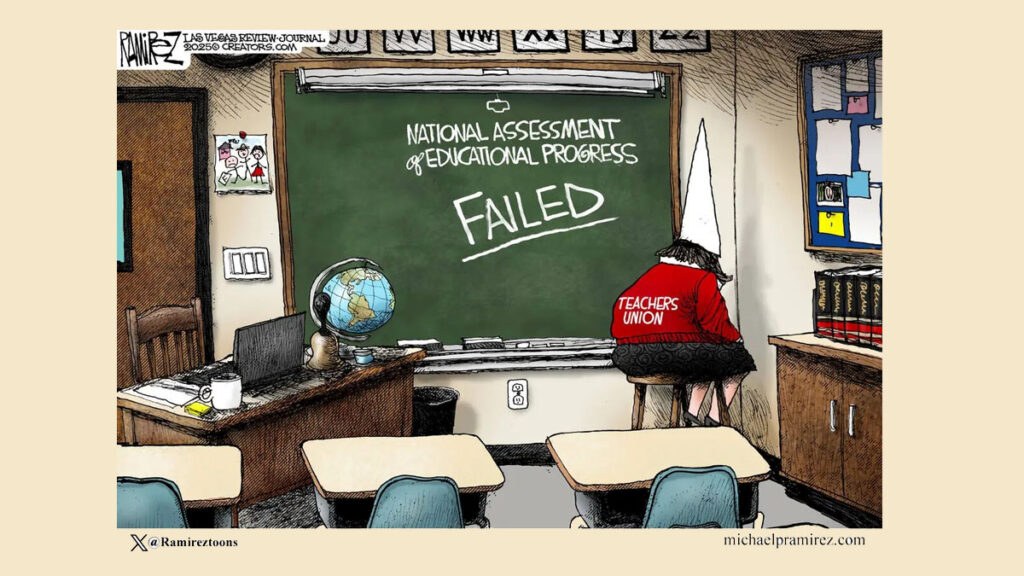
<p class="wp-block-paragraph">I have also long believed the long-term decline in public education outcomes—and the resistance to meaningful reforms—has been due to the politics and policies of the school unions. They are not educational institutions, but rather politically partisan membership clubs. The primary function of the unions is to have as many dues-paying members as possible and to use that money for personal enrichment and political power.</p>


<p class="wp-block-paragraph">To better understand why we should eliminate school unions, let us look at some facts.</p>


<p class="wp-block-paragraph">Teachers’ unions were once formed to protect educators from unfair labor practices and to advocate for better working conditions. But over the decades, the two largest unions—the National Education Association (NEA) and the American Federation of Teachers (AFT)—have evolved into powerful political machines. Their influence now extends far beyond the classroom. They are major funders of the Democratic Party and wield massive influence through their huge pension programs. ; Rather than working to improve classroom outcomes, the NEA and AFT actually undermine positive reforms—directly or by ambivalence.</p>


<p class="wp-block-paragraph">Despite their failures, union officials are well compensated. NEA President Becky Pringle has a compensation package of $480,000 per year—8.5 times the median teacher salary. Randi Weingarten of the AFT earns $565,000 per year—9 times the median teacher salary. These figures do not include a number of indirect nonmonetary benefits. Also, the lucrative pensions enjoyed by union officials are often paid by taxpayers—not union funds.</p>


<p class="wp-block-paragraph"><strong>Politicization of the NEA and AFT</strong></p>


<p class="wp-block-paragraph">The NEA and AFT have become deeply entangled in partisan politics. In recent years, both unions have taken aggressive stances on national issues that have little to do with education. Their political activity is overwhelmingly one-sided. In the 2024 election cycle, 98.96 percent of NEA contributions went to Democrats, while 99.9 percent of AFT contributions did the same. This lopsided spending suggests that the unions are not representing the diverse political views of their members or the public but are advancing a partisan agenda that primarily serves the political and financial interests of union leaders and the local political establishment.</p>


<p class="wp-block-paragraph"><strong>Ties to Democratic Political Machines</strong></p>


<p class="wp-block-paragraph">The NEA and AFT have long-standing ties to Democrat political machines in major cities. Their influence in urban politics has helped elect progressive candidates who, in turn, support union-friendly policies. In cities like Chicago, New York, and Los Angeles, unions have become kingmakers, funneling millions into campaigns and lobbying efforts. In return, the political leaders work on behalf of union interests.</p>


<p class="wp-block-paragraph">For generations, these same cities have suffered from chronic educational failure. Inner-city schools remain overcrowded, and plagued by low graduation rates. Despite their political clout, the unions have done little to address institutional racism and segregation in urban districts. Instead of fighting for reform, they often resist accountability measures and protect underperforming educators. (I have seen that many times in contract negotiations.)</p>


<p class="wp-block-paragraph"><strong>The NEA</strong></p>


<p class="wp-block-paragraph">NEA&#8217;s Pringle has openly embraced an adversarial partisan political role. At the 2025 NEA convention, she declared that educators were “ready to engage with school boards, town halls, state legislatures, and even Congress” to advocate for their union’s politically partisan interests.  ;Ponder that. Pringle’s vision of the union’s role is to fight against Congress, state legislatures, and even local school boards – those the people elect.</p>


<p class="wp-block-paragraph">The NEA 2025 convention revealed just how far the union has drifted from its educational mooring. Delegates passed a resolution pledging to “defend democracy against Trump’s embrace of fascism”—and to use the term “fascism” in NEA materials to describe his policies.</p>


<p class="wp-block-paragraph">The NEA has also taken an official stand in opposition to the activities of Immigration and Customs Enforcement (ICE)—preferring to allow dangerous criminals to remain in American communities. Criminals who often prey on children. ; They have accused ICE of targeting student leaders.</p>


<p class="wp-block-paragraph">The resolution was not only politically charged but also riddled with errors. The word “fascism” was ironically misspelled twice as “facism,” prompting widespread and well-deserved ridicule. Critics argued that the union, which claims to represent educators, could not even spell the ideology it was condemning.</p>


<p class="wp-block-paragraph">The NEA’s ties to the radical wing of the Democratic Party were seen in another controversial move. The union recently voted to cut ties with the Anti-Defamation League (ADL), a civil rights organization known for combating antisemitism. The union accused the ADL of conflating criticism of Israel with antisemitism and claimed that the group was pushing a “radical, antisemitic agenda” on students. The resolution bans the use of ADL literature and speakers in school events. The ADL responded forcefully, calling the NEA’s actions “profoundly disturbing” and warning that the decision would further isolate Jewish educators.</p>


<p class="wp-block-paragraph">They even changed the language from “deportation” to “kidnapping.”</p>


<p class="wp-block-paragraph"><strong>The AFT</strong></p>


<p class="wp-block-paragraph">AFT President Randi Weingarten has similarly used her platform to push for progressive causes, from climate activism to gender ideology. She has become so politically toxic that some Democrat leaders have called for the Party to break ties with her. She was forced to resign her position on the Democratic National Committee. A position on the DNC? ; How partisan can you get?</p>


<p class="wp-block-paragraph">Ben Austin, a former campaign aide for Kamala Harris and founding director of Education Civil Rights Now, published an op-ed urging Democrats to “break up with Weingarten.” He pointed to her following Biden’s school closure policies—which essentially “erased two decades of learning progress” and alienated working-class voters. Austin blames her for “gaslighting Democrats” into opposing school choice and described her partisan leadership as “tragic for American children.”</p>


<p class="wp-block-paragraph"><strong>More Money, Poorer Results</strong></p>


<p class="wp-block-paragraph">Despite their massive increases in school funding, the NEA and AFT have failed to deliver meaningful improvements in public education. Since the rise of unionization in the 1960s and 1970s, educational performance has stagnated or declined. According to research, unionized districts tend to spend more on salaries and benefits but fail to outperform non-unionized school systems.</p>


<p class="wp-block-paragraph">Studies show that low-achieving and high-achieving students perform worse in unionized districts. While the cost of education continues to rise, the return on investment—in terms of student performance—stagnates in better districts and declines in low-income minority communities.</p>


<p class="wp-block-paragraph"><strong>Children Last</strong></p>


<p class="wp-block-paragraph">One of the mantras of educators is “Children First.” In fact, in labor negotiations the children’s needs come last—if considered at all. Both in my experience negotiating union contracts and from extensive research, I can safely attest that I have never found school unions proposing or supporting any contract provisions that benefited the classroom or the students that did not benefit the union &#8212; either increasing the number of teachers (dues-paying members) in systems with excessive deadwood; shortening teacher work schedules in hours or days; or increasing teacher pay and benefits at the expense of what I call “the children’s budget.”</p>


<p class="wp-block-paragraph">In several cases—thanks to support from the local political establishment—unions won pay and benefit concessions that absorbed more than 100 percent of all new money coming into the school district. This necessitated cuts in “the children’s budget” that impacted directly on the classroom—cuts in school maintenance, supplies, and even elimination of some traditional subjects, such as music and art.</p>


<p class="wp-block-paragraph">Unions vigorously protect bad teachers &#8212; essentially preventing dismissal of those failing to provide quality education in the classroom and other negative personnel issues. As a means of protecting their failures, unions work against standard testing of students and also teacher testing.</p>


<p class="wp-block-paragraph">Unions are also the primary force against school choice, programs that would enable parents to remove their children from failing and dangerous schools and get them into schools where they can receive quality education. Union policies warehouse students in failing minority schools—denying them an education that can lead to college or productive careers. This is especially true of schools in segregated minority communities. School choice would not end the public school system, since it largely impacts schools that fail to meet the primary mission: to educate children.</p>


<p class="wp-block-paragraph"><strong>Fighting Back</strong></p>


<p class="wp-block-paragraph">The good news is that there is a growing political constituency for effective education reforms. School choice is part of it—and the Trump administration has advanced that cause in his Big Beautiful Bill. Parent Associations are taking more interest and more control over educational quality. Congressman Mark Harris (R-NC) and Senator Marsha Blackburn (R-TN) have introduced the National Education Association Repeal Act, which would revoke the NEA&#8217;s federal charter.</p>


<p class="wp-block-paragraph"><strong>A Broken System</strong></p>


<p class="wp-block-paragraph">The original purpose of teachers’ unions was to protect educators and improve schools. But today, the NEA and AFT function more like partisan advocacy groups driven by self-interest than a professional education organization. Their actions, whether it’s labeling political opponents as fascists, severing ties with civil rights groups, or funneling millions into one-sided campaigns—have undermined their credibility and effectiveness.</p>


<p class="wp-block-paragraph">Public education is too important to hold hostage by political agendas. If unions cannot return to their core mission of supporting teachers AND students, then it is time to consider eliminating them altogether. The future of our schools—and our children—are too important to be allowed to fail in the future as they have failed in the past.</p>


<p class="wp-block-paragraph">So, there ‘tis.</p>

Why school unions have to be eliminated