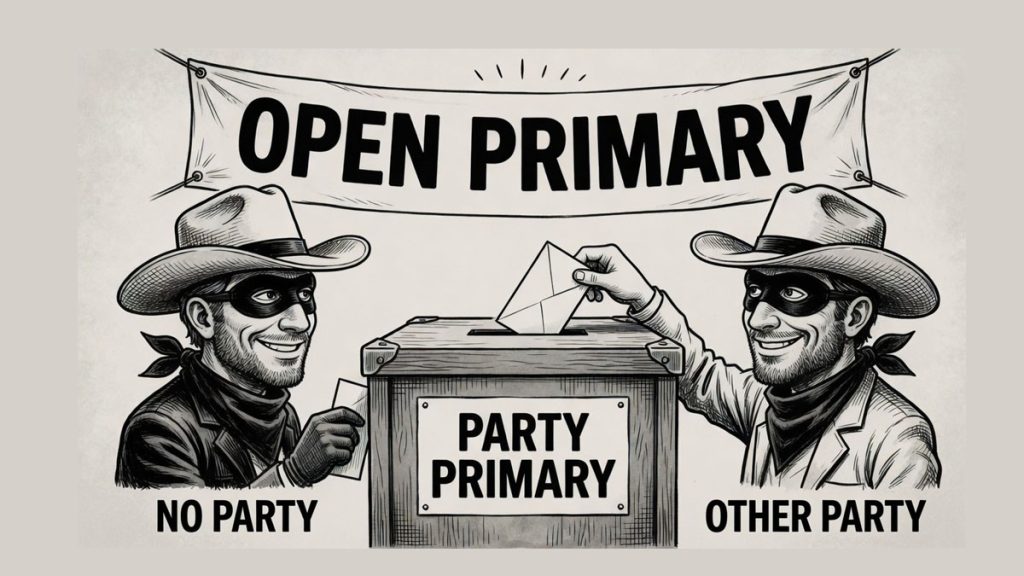
<p class="wp-block-paragraph">In a recent program, CNN host Michael Smerconish expressed his advocacy for open primaries, often called “jungle” primaries. His commitment runs deep. In addition to promoting the idea on his show, Smerconish participates in a lawsuit in Pennsylvania aimed at imposing a jungle primary system on the Keystone State, modeled after the one in California. (One has to wonder why any sane American would look to California for policy guidance. But I digress.)</p>


<p class="wp-block-paragraph">For those unfamiliar with the jungle primary system, it operates in a straightforward yet deeply flawed manner. Every voter, regardless of party affiliation or independent status, receives the same ballot. Republican, Democrat, and independent candidates all compete together. If no candidate secures more than 50 percent of the vote, the top two finishers advance to a runoff. In deeply red or blue states or localities, the top two candidates generally come from the same dominant party. This outcome effectively disenfranchises voters from the minority party and independent citizens alike.</p>


<p class="wp-block-paragraph">The system virtually eliminates any realistic path for third-party or independent candidacies to succeed. Proponents tout it as a reform that broadens participation. In reality, it undermines the very foundations of representative democracy by diluting the voices of organized political minorities and forcing a false consensus that favors the majority.</p>


<p class="wp-block-paragraph">Open primaries prove particularly detrimental to Black candidates and Black voters. Unless a jurisdiction boasts a Black majority &#8212; or a very substantial Black minority &#8212; black candidates face steep odds in prevailing. History provides a stark illustration. In 1995, Chicago Mayor Richard M. Daley had the state legislature change the Windy City’s elections from partisan to open primaries specifically to prevent a Black candidate from succeeding – as Harold Washington had done in 1983. The explicit purpose was to block a viable Black candidate from capturing the mayoralty. This maneuver succeeded in preserving the White political machine for the next decade. The same dynamic occurred in the 2026 California primary election, in which there were no viable Black candidates.</p>


<p class="wp-block-paragraph">This is no isolated incident. Open primaries strip away critical protections for minority viewpoints within the electorate. In states where one party dominates, minority party voters discover that the runoff features two candidates from the opposing party.</p>


<p class="wp-block-paragraph">The mechanism does not empower independents. Instead, it compels them to choose among candidates of the two major parties, often selecting the lesser of two evils from parties with which they feel no genuine alignment. Independents may influence which major party candidate advances, but they rarely see independent candidates advance.</p>


<p class="wp-block-paragraph">Politics remains an inherently binary process. Issues cluster around the opposing poles of a philosophical continuum &#8212; liberal and conservative. The two major parties, imperfect as they are, embody these competing visions. Voters align, however loosely, with one pole or the other – and that includes the so-called independents.</p>


<p class="wp-block-paragraph">The American system differs markedly from parliamentary systems, such as the British model, where coalition governments and issue-specific voting produce different dynamics. In the American context, jungle primaries erode the clarity that partisan primaries provide. They blur distinctions and reward candidates who appeal to the broadest, often most moderate or lowest-common-denominator, coalition rather than those who articulate principled positions.</p>


<p class="wp-block-paragraph">Advocates argue that because taxpayers fund primaries, all citizens should participate without restriction. This claim collapses under minimal scrutiny. Taxpayers support countless public services from which they derive no direct benefit. Childless adults pay for schools. Nondrivers finance roads. Law-abiding citizens underwrite prisons. Public funding does not grant every individual an unrestricted claim on every process. Primaries serve as internal mechanisms for parties to select standard-bearers who best represent their philosophies. The system provides opportunities for independent candidates to get on the ballot. The desire to vote in party primaries is driven largely by the historic failure of independent parties and candidacies.</p>


<p class="wp-block-paragraph">Opening partisan primaries to all comers transforms parties into mere administrative conveniences rather than vehicles for distinct ideological expression.</p>


<p class="wp-block-paragraph">The consequences extend beyond mere inconvenience. Jungle primaries accelerate the tyranny of the majority. In most instances, Jungle primaries produce runoffs featuring two candidates from the same party – leaving General Election voters disenfranchised. Similar patterns emerge elsewhere. Minority parties lose their ability to field competitive candidates. Third parties, already fragile, face even steeper barriers. The result is not greater democracy but a duopoly that entrenches power in whichever party holds numerical superiority in a given jurisdiction. Minority parties have no chance unless a large number of candidates form the opposing party enter the race and divide the vote – and that is more the exception than the rule.</p>


<p class="wp-block-paragraph">Partisan primaries, whatever their shortcomings, preserve space for ideological competition and minority party vitality. They compel parties to engage their bases and refine their platforms. Jungle primaries, by contrast, invite crossover mischief, strategic voting designed to weaken opponents rather than strengthen one’s own principles, and the elevation of bland consensus figures over conviction politicians.</p>


<p class="wp-block-paragraph">Americans should reject this seductive but dangerous proposal. Pennsylvania voters and citizens across the nation must recognize the jungle primary for what it is &#8212; a reform that promises inclusion but delivers dilution &#8212; which claims to empower independents but actually marginalizes them, and that weakens the minority protections required in a healthy republic. True electoral integrity demands clear partisan distinctions, not a blurred Tweedle-Dee/Tweedle Dum contest between fungible candidates.</p>


<p class="wp-block-paragraph">The Founding Fathers designed a system of checks and balances, including mechanisms to protect minority rights against unchecked majoritarianism. Open primaries erode one such safeguard. Citizens should defend partisan primaries with vigilance. The alternative is a political landscape in which the loudest or most numerous voices silence all others under the guise of reform. That path leads not to better governance but to the steady erosion of the representative republic that has served this nation well for 250 years.</p>


<p class="wp-block-paragraph">Ultimately, the push for open primaries represents another example of seductive but misguided reform that prioritizes abstract notions of fairness over the practical mechanics that sustain a functioning republic. Conservatives, in particular, must remain vigilant against these efforts that erode the ability of minority viewpoints—whether ideological, racial, or regional—to compete effectively. The American experiment thrives not on forced consensus but on vigorous competition between distinct visions of governance. Preserving partisan primaries is essential to maintaining that vital distinction.</p>


<p class="wp-block-paragraph">So, there ‘tis.</p>


<p class="wp-block-paragraph"></p>

Why Open Primaries is a Bad Idea