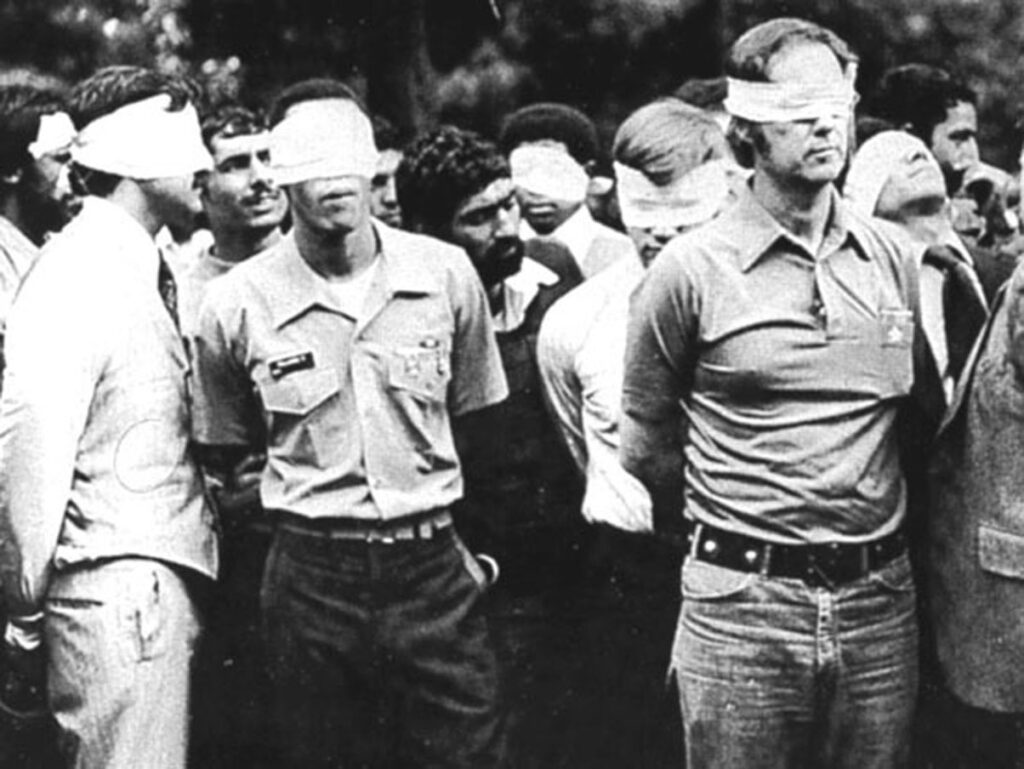
<p>There was a time when American policy prohibited the providing of financial benefits for the release of American hostages. It was predicated on the belief that paying ransoms of any sort would only encourage the taking of more American hostages by enemy regimes. A second consideration was the problem of providing adversarial rogue governments with more money to pursue terrorism.</p>
<p>That policy changed in the last days of the Carter administration. While 52 American hostages were released by Iran on the first day of the Reagan administration, the deal was negotiated and agreed to by Carter. The timing of the release was believed to be a slap in the face at Carter – or a means for the Ayatollahs to ingratiate themselves with Reagan. If they expected leniency from Reagan, they were badly mistaken.</p>
<p>Carter had made at least one military effort to free the hostages who had been languishing in Iranian custody for 144 days. After that he agreed to have Algiers serve as an arbitrator. The final 1980 deal looked a lot like the deal President Biden made with the current Iranian leadership. After months of secret negotiation, Iran and the United States signed what were called the Algiers Accords.</p>
<p>In return for the release of the hostages, the United States canceled all claims it had against Iran, released $7.9 billion in Iranian assets frozen after the fall of the Shah and pledged not to interfere in the internal affairs of Iran. Iran relinquished all claims against the United States.</p>
<p>Whether it was a courtesy afforded to his predecessor or not wanting to be associated with such a bad deal, Reagan sent Carter to meet with the returning hostage in Germany.</p>
<p>Make no mistake about it, the $7.9 billion that was provided to the Iran regime in 1980 was used to fund terrorism that killed tens of thousands of people – including thousands of American soldiers and civilians.</p>
<p>In 2016, President Obama agreed to exchange seven Iranian prisoners for four Americans. The deal was controversial because the Iranians were identified as terrorists. The United States dropped charges and international arrest warrants against 14 other Irani officials.</p>
<p>In addition, the United States flew $700 million dollars in cash to Iran as the downpayment on $1.7 billion dollar to be paid later. The Obama administration denied that the payment was ransom but that the money was simply “leverage” for the release. (Wordsmithing Washington-style).</p>
<p>In a one-for-one deal, the Biden administration traded basketball star Britney Griner for Viktor Bout, a notorious arms dealer for Russian President Putin. It caused considerable controversy because it was not an equal trade by any measure. It also left behind Paul Whelan, who had been in a Russian prison for a much longer time – and still is. There were reasonable questions as to whether political correctness played a role since Griner is a gay black woman.</p>
<p>Like earlier deals, Biden’s current agreement was a prisoner exchange with a large sum of money for Iran. (When we exchange prisoners, why doesn’t the United States get a bunch of money?) Five Americans are being released in return for five Iranians. Ironically, two of the Irani prisoners have chosen to remain in America. Why were they part of an exchange?</p>
<p>In terms of money, $6 billion of frozen assets being held by South Korea as part of the western sanctions against the terrorist state will be given to Iran. The deal stipulated that the money could only be used for “humanitarian purposes.” Iranian officials, however, said that they will spend the money as they please. And what pleases them is killing Americans and Jews.</p>
<p>The problem is whether America can trust the Iranians to keep that part of the bargain or not. Probably not. Even if they do spend that money for humanitarian needs, it would be an offset that would make $6 billion available for anything, including funding terrorist groups in the Middle East and elsewhere.</p>
<p>It should not be considered incidental that not long after the United States pays ransoms for hostages, nations who make hostage-taking part of their official policy – especially Russia, Iran and North Korea – will grab another person. We can fully expect – based on the success of their strategy – that innocent Americans will be held hostage by hostile nations in return for big bucks.</p>
<p>Of course, we want our fellow Americans returned home healthy and happy. Not like 22-year-old Otto Warmbier, who was held by North Korea until he was terminally ill. But we should not ignore that unknown future hostage and all the lives that will be lost to American financed acts of terrorism and war.</p>
<p>The White House and the State Department can use euphemisms and spin to try to deflect from one simple truth. The money exchanged for hostages is ransom … period. It will be used against Americans and our allies. As difficult as it is, it is never a good policy to pay ransom. It encourages hostage taking. Who will be next?</p>
<p>So, there ‘tis.</p>

Who will be the next American hostage?