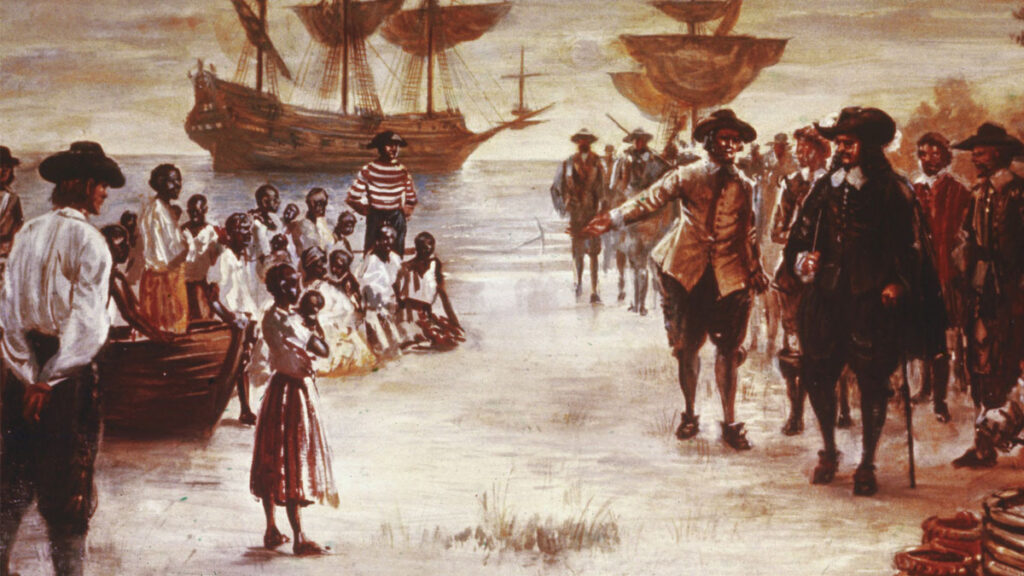
<p class="wp-block-paragraph">I pose the headline question for a reason. ; It is to correct the common belief that it was in the year 1619 in what is now Hampton, Virginia that the first African slaves arrived in the on what would become American soil. ; President Biden was recently in Angola, Africa to memorialize that date &#8212; and the first shipment of slaves sailing out of that nation for the American colonies. ;</p>


<p class="wp-block-paragraph">There are three things wrong with that memorial celebration. ; That is not the date the first slaves arrived in the Americas – or on the North American continent that would later become the United States. ; Virginia was not the first location where slaves arrived. ; And they did not uniquely originate from Angola.</p>


<p class="wp-block-paragraph">The first slaves arrived on the North American continent almost 100 years earlier &#8212; in 1526. ; They arrived in what is now South Carolina. ; They were brought to what was then the Spanish colony of San Miguel de Gualdape. ;</p>


<p class="wp-block-paragraph">Angola was only one of several locations providing slaves – and not a significant source for the Spanish. Slaves were obtained from a much larger region of Africa that now encompasses Senegal, Zambia, Congo, the Democratic Republic of the Congo (formerly Zaire) and other locations.</p>


<p class="wp-block-paragraph">In preparing for my book,<strong> <a href="https://www.amazon.com/Who-Put-Blacks-That-PLACE/dp/1964251117">“Who Put Blacks in That PLACE. </a></strong><a href="https://www.amazon.com/Who-Put-Blacks-That-PLACE/dp/1964251117">The long sad history of the Democratic party’s oppression of Black Americans &#8230; to this day,”</a> I researched the Black experience in North America from the time of the FIRST arrival of slaves to today. I was familiar with the initial arrival in 1526. </p>


<p class="wp-block-paragraph">That is why I winced when Biden celebrated the date as 1619 as the first shipment of slaves to North America. ; I suspect he got his misinformation from the recent “Project 1619” produced by Nikole Hannah-Jones, a writer for <em>The New York Times Magazine</em>.</p>


<p class="wp-block-paragraph">There is a reason why Hannah-Jones got the date wrong. ; Not a good one, in my judgment, but a reason. ; She was not writing about the first slaves to set foot on what would become the United States – although that is the perception most folks have thanks to Project 1619. Hannah-Jones was tracing the Black experience from the first to arrive AT AN ENGLISH COLONY. ; The highly controversial Project 1619 left out almost one hundred years of Black history – including a number of noteworthy events. ;</p>


<p class="wp-block-paragraph">The first slave uprising in North America occurred shortly after the slaves arrived in 1526. The recently arrived slaves set fire to their homes and escaped to integrate with Native American tribes – a practice that would occur in other areas in later years. ; It explains why so many Black Americans today have Native American in their DNA.</p>


<p class="wp-block-paragraph">I never understood why 1619 took historic precedence over the actual date when slaves were brought to what is now the United States. ; And why an English colony was more meaningful than the Spanish colony. ; Seems to me that the actual FIRST is the most significant date. ; And why write off 100 years of Black history?</p>


<p class="wp-block-paragraph">In fact, African slavery was flourishing throughout South America and the Caribbean before they arrived in the English colony of Virgina in 1619. Slaves had first arrived in Brazil in 1533. And the vast majority of slaves arriving in the New World in 1619 went to South America and the Caribbean.</p>


<p class="wp-block-paragraph">In trying to figure out the reason why Hannah-Jones and the academic world see greater significance with 1619 than 1526, I can only assume that there is an undercurrent of anti-Anglo-ism. It makes the bad guys the White Europeans—and distracts attention from the role of the Spanish. In today’s culture, Latinos are considered to be people of color by the left-wing establishment (even though a majority of Latinos consider themselves to be – and are – White). Perhaps there is another explanation for cherry picking 1619, but I have no idea what it might be.</p>


<p class="wp-block-paragraph">We may have travelled too far down this rabbit hole. But the intentional misdating of the arrival of the first slaves in what is now the United States raises questions. ; It only add to the controversy that surrounds Project 1619 in its entirety.</p>


<p class="wp-block-paragraph">So, there ‘tis.</p>

When did slaves first arrive in North American? And no, it was not 1619