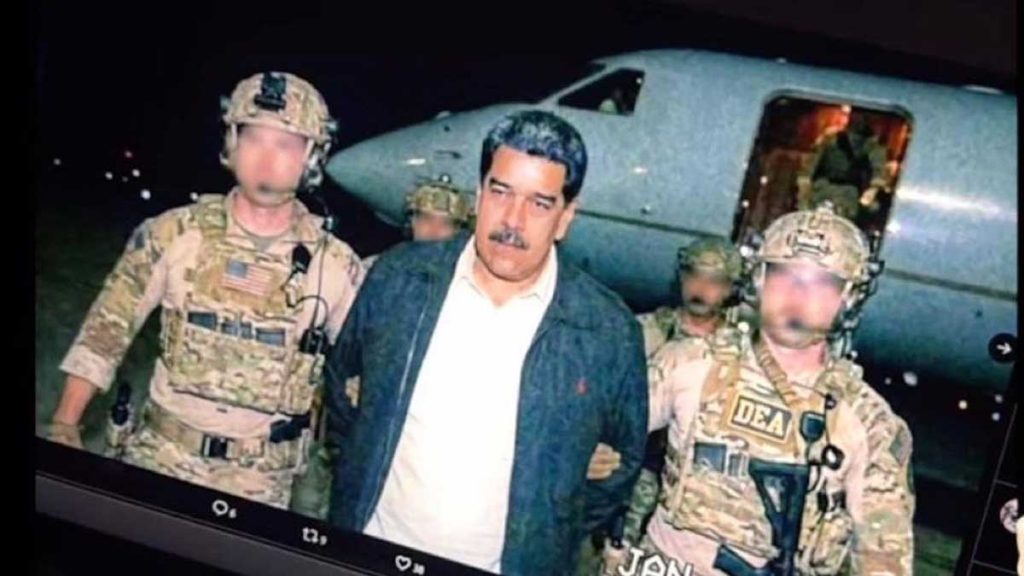
<p class="wp-block-paragraph">For years, Venezuelans have lived under Nicolás Maduro’s rule, watching their country collapse while he clung to power through fraudulent elections and brute force. Now that era has been shaken to its core. After a large scale United States strike on Caracas, Maduro has been captured and is on his way to New York to face drugs and weapons charges in Manhattan federal court, according to President Donald Trump. Maduro is reportedly aboard the USS Iwo Jima, no longer a powerful president, but a prisoner heading into the heart of the U.S. justice system.</p>


<p class="wp-block-paragraph">For millions of Venezuelans at home and abroad, this moment feels like justice finally starting to catch up with a man they see as a tyrant who fixed elections and destroyed a country rich in oil and talent.</p>


<h4 class="wp-block-heading">Who Nicolás Maduro Is and How He Held Onto Power</h4>


<p class="wp-block-paragraph">Nicolás Maduro Moros is a Venezuelan citizen who once presented himself as the rightful successor to Hugo Chávez. According to the new U.S. indictment, he is now described as the “de facto but illegitimate ruler of the country,” a man who remained in power “despite losses in recent elections.”</p>


<p class="wp-block-paragraph">Maduro’s political career stretches back decades. He held a seat in Venezuela’s National Assembly from about 2000 to 2006. He then served as Minister of Foreign Affairs from about 2006 to 2013, and briefly as Vice President in 2013. After Chávez died, Maduro took over the presidency and began to tighten his grip on power, even as the economy collapsed and the streets filled with anger and hunger.</p>


<p class="wp-block-paragraph">The indictment notes that in 2018, Maduro “declared victory in a disputed and internationally condemned presidential election.” Then, in 2019, Venezuela’s National Assembly invoked the constitution and declared that Maduro “had usurped power and was not the legitimate President of Venezuela.” More than 50 countries, including the United States, refused to recognize him as head of state. Still, he remained in office.</p>


<p class="wp-block-paragraph">In 2024, another election was held and again, the international community broadly criticized the vote. The indictment states that Maduro “declared himself the winner despite widespread condemnation.” In the eyes of many Venezuelans, this confirmed what they already believed. Their elections had become tools of a dictator who would not leave office willingly.</p>


<h4 class="wp-block-heading">A Government Turned Into a Drug Machine</h4>


<p class="wp-block-paragraph">The new indictment from the U.S. Department of Justice does not describe Maduro as just a corrupt politician. It portrays him as the central figure in a narco state. Prosecutors say that for more than 25 years, Venezuelan leaders “have abused their positions of public trust and corrupted once-legitimate institutions to import tons of cocaine into the United States.”</p>


<p class="wp-block-paragraph">Maduro, they say, is “at the forefront of that corruption” and has “partnered with his co-conspirators to use his illegally obtained authority and the institutions he corroded to transport thousands of tons of cocaine to the United States.” The document claims that “since his early days in Venezuelan government, Maduro Moros has tarnished every public office he has held.”</p>


<p class="wp-block-paragraph">As a member of the National Assembly, he allegedly moved “loads of cocaine under the protection of Venezuelan law enforcement.” As Foreign Minister, he “provided Venezuelan diplomatic passports to drug traffickers” and helped give “diplomatic cover for planes used by money launderers to repatriate drug proceeds from Mexico to Venezuela.” Later, as President, he “allows cocaine fueled corruption to flourish for his own benefit, for the benefit of members of his ruling regime, and for the benefit of his family members.”</p>


<p class="wp-block-paragraph">The result, according to prosecutors, is a government that has used its power to protect drug trafficking instead of fighting it. The indictment states that Maduro now sits “atop a corrupt, illegitimate government that, for decades, has leveraged government power to protect and promote illegal activity, including drug trafficking.” That trafficking has “enriched and entrenched Venezuela’s political and military elite” and concentrated power and wealth in the hands of his wife, the “purported First Lady” Cilia Flores de Maduro, his son Nicolás Ernesto Maduro Guerra, known as “Nicolasito” or “The Prince,” and other top officials.</p>


<h4 class="wp-block-heading">State Sponsored Gangs and a Reign of Fear</h4>


<p class="wp-block-paragraph">The Justice Department also accuses Maduro and his family of building violent enforcement networks to protect their drug empire. The indictment says Maduro and Flores ran “state sponsored gangs” to “facilitate and protect their drug trafficking operation.” These gangs were not just thugs for hire. Prosecutors say they were used to order “kidnappings, beatings, and murders” against people who owed money or interfered with trafficking.</p>


<p class="wp-block-paragraph">Prosecutors describe a cycle in which cocaine traffickers could pay a portion of their profits to Maduro and other politicians in exchange for law enforcement cover and logistical support. Those politicians then used the money to “maintain and augment their political power.” As the drug cartels grew, so did Maduro’s profits.</p>


<p class="wp-block-paragraph">According to the indictment, this system “lines the pockets of Venezuelan officials and their families while also benefiting violent narco terrorists who operate with impunity on Venezuelan soil and who help produce, protect, and transport tons of cocaine to the United States.”</p>


<h4 class="wp-block-heading">Partners in Narco Terror: FARC, ELN, Sinaloa, Zetas, and Tren de Aragua</h4>


<p class="wp-block-paragraph">Maduro’s regime is also accused of partnering with some of the most dangerous organizations in the hemisphere. Since about 1999, Venezuelan officials including Maduro, Diosdado Cabello, and Ramón Rodríguez Chacín have allegedly worked with narco terrorist groups and cartels such as the FARC, the ELN, the Sinaloa Cartel, the Zetas, and Venezuela’s Tren de Aragua, led by Héctor “Niño Guerrero.”</p>


<p class="wp-block-paragraph">The FARC, founded in 1964, became “one of the largest producers of cocaine in the world” and used that revenue to fund weapons and terrorist attacks. The ELN, another Colombian group, has long sought to overthrow Colombia’s democratic government and has financed its operations by exporting “tons of cocaine annually to the United States and elsewhere.” The Sinaloa Cartel, led for many years by Joaquin “El Chapo” Guzmán and Ismael “El Mayo” Zambada, grew into “the largest drug trafficking organization in the world,” maintaining its power through a “sophisticated and heavily armed security apparatus” that kills police, civilians, and rivals who enter its territory.</p>


<p class="wp-block-paragraph">The indictment sums up this network plainly. “Maduro Moros and his co-conspirators have, for decades, partnered with some of the most violent and prolific drug traffickers and narco terrorists in the world, and relied on corrupt officials throughout the region, to distribute tons of cocaine to the United States.”</p>


<h4 class="wp-block-heading">How Delta Force Brought Maduro Down</h4>


<p class="wp-block-paragraph">The capture of Nicolás Maduro was carried out by one of the most secretive and capable units in the U.S. military. An elite U.S. Army special operations unit known as Delta Force led the raid that seized Maduro and his wife, according to sources.</p>


<p class="wp-block-paragraph">Delta Force is one of the United States military’s premier special missions units. It specializes in counterterrorism, hostage rescue, direct action, and special reconnaissance, often focusing on high value targets. Created in 1977 and placed directly under the Joint Special Operations Command, Delta Force is made up of eight operational “sabre squadrons” and is based at Fort Bragg in North Carolina.</p>


<p class="wp-block-paragraph">Although most information about Delta Force is highly classified, it is known that the unit has been involved in some of the most complex and dangerous operations in U.S. history. It helped respond to the 1993 helicopter shoot down in Somalia, an event later dramatized in the film “Black Hawk Down.” It also participated in Operation Just Cause in Panama, which led to the capture of dictator Manuel Noriega in December 1989. Trump administration officials have cited that Panama operation as a precedent for the mission to capture Maduro.</p>


<p class="wp-block-paragraph">In this new raid, Maduro and Cilia Flores were “dragged from their bedroom by elite U.S. forces,” according to CNN sources. President Trump told Fox News that some Americans were injured when a helicopter was hit during the mission, a sign of how dangerous the operation was.</p>


<p class="wp-block-paragraph">On the ground in Caracas, CNN teams witnessed explosions and reported that parts of the city were without electricity. Footage showed empty roads and long lines outside pharmacies and grocery stores as people tried to get basic supplies while their government’s leader was being taken away.</p>


<h4 class="wp-block-heading">Who Is the Legitimate President Now</h4>


<p class="wp-block-paragraph">The U.S. will take control of Venezuela during the transition, Trump has said he wants to make sure that bad elements do not grab control. Opposition leader María Corina Machado, a Nobel Peace Prize laureate, has made it clear that she believes the legitimate President is Edmundo González Urrutia.</p>


<p class="wp-block-paragraph">In a letter posted on X and addressed to the people of Venezuela, Machado wrote, “Nicolás Maduro from today faces international justice for the atrocious crimes committed against Venezuelans and against citizens of many other nations.” She said that “given his refusal to accept a negotiated solution, the government of the United States has fulfilled its promise to enforce the law.”</p>


<p class="wp-block-paragraph">Machado declared, “The time has come for popular sovereignty and national sovereignty to rule in our country.” She promised that “we are going to restore order, free political prisoners, build an exceptional country, and bring our children back home.”</p>


<p class="wp-block-paragraph">She also stated that González had been elected as the legitimate president in the 2024 election, but that Maduro took office in January the next year despite “widespread international criticism of the election as fraudulent.” In her view, “He must immediately assume his constitutional mandate and be recognized as commander in chief of the national armed forces by all the officers and soldiers who make up its ranks.”</p>


<p class="wp-block-paragraph">González shared her message and added, “Venezuelans, these are decisive hours, know that we are ready for the great operation of the reconstruction of our nation.”</p>


<h4 class="wp-block-heading">A Country on the Move: Nearly Eight Million Forced to Leave</h4>


<p class="wp-block-paragraph">Maduro’s rule has not only damaged institutions and the economy. It has pushed millions of people out of their homeland. Over the past decade, Venezuela has suffered one of the largest migration crises in modern history. According to data from United Nations agencies cited in the text, more than 7.7 million Venezuelans have left the country since 2014. Other estimates place the figure at around 7.8 million to nearly 8 million Venezuelans now living abroad.</p>


<p class="wp-block-paragraph">That means roughly 25 to 27 percent of Venezuela’s population has gone abroad. In practical terms, it means families crossing bridges into Colombia on foot, holding their children’s hands while they line up for shelter or vaccinations. One Venezuelan who fled with his family said, “I’ll return when Maduro goes,” capturing the feeling of many who see one man’s rule as the barrier between them and their homeland.</p>


<p class="wp-block-paragraph">Years ago, humanitarian workers described how from January to June in one year, 650 people came to a shelter run by the Scalabrini International Migration organization. By August alone, 850 people arrived, a sign that “things are only getting worse.” Franklin Díaz, who runs the shelter, said, “The action of the authorities is fundamental, they are the ones who manage the resources,” pointing directly to Maduro’s government.</p>


<p class="wp-block-paragraph">Colombia introduced “border mobility cards” that allow Venezuelans to cross even without passports. More than 700,000 people applied for these cards. Still, many found themselves sleeping in streets, trapped by the collapse of the bolívar. As one report noted, triple digit inflation meant “their savings in Venezuelan bolivares are worthless once converted into Colombian pesos.” Families curled up on sidewalks and roundabouts under signs that said “I love Cúcuta,” not as tourists, but as refugees.</p>


<p class="wp-block-paragraph">Now, with Maduro in custody, millions of exiles are watching closely, many of them part of the 7.7 to nearly 8 million who left during the worst years of his rule.</p>


<h4 class="wp-block-heading">Voices from Caracas and the Diaspora</h4>


<p class="wp-block-paragraph">Inside Caracas, the reactions to Maduro’s capture are mixed but intense. Motorcycle rider Ronald Galuee told Reuters, “There should be a positive change for all Venezuelans,” and said that “now is the time for transition in this country.” He expressed a cautious hope, explaining, “Now we have to wait for these people (government officials) to speak out and see what they have to say. Everything should happen now and we should get out of this situation.”</p>


<p class="wp-block-paragraph">Merchant Juan Carlos Rincon said, “We are in God’s hands, because God is the one who is in control of everything. Only He knows what may happen in Venezuela.” He also voiced a deep wish shared by many: “We want to be at peace, move forward, and for Venezuela to have, like any other country, the right to choose its own destiny and its own leaders.”</p>


<p class="wp-block-paragraph">Not everyone in Caracas supports the U.S. operation. Baker Franklin Jimenez argued that the United States should not have captured Maduro, saying “this will create an even worse conflict than the one we have now.” Referring to the bombings, he said that as the authorities have called for, “we all have to go out into the streets to defend our homeland, to defend ourselves.”</p>


<p class="wp-block-paragraph">Outside Venezuela, however, many Venezuelans are openly celebrating. In Doral, Florida, and Santiago, Chile, crowds gathered after the U.S. confirmed Maduro’s capture. People danced, chanted, and sang the national anthem. Outside the El Arepazo restaurant in Doral, Venezuelans waved their national flag and held signs that read “Make Venezuela Great Again.”</p>


<p class="wp-block-paragraph">One Venezuelan community member, Kirvin Suarez, told Reuters, “Today, justice is being served. Justice is being served for all the Venezuelans who left our country to demonstrate who we are. We are fighters, we entrepreneurs, we are good people but we want to return to our country and rebuild, move forward and continue being that force that we have always been. Long live Venezuela.”</p>


<p class="wp-block-paragraph">Another Venezuelan abroad said, “This is the start of the end of the dictatorship of Venezuela.” Daniel Victorio added, “I am obviously very happy about everything that has happened,” and thanked President Donald Trump.</p>


<h4 class="wp-block-heading">A Tyrant Falls, and Venezuela Looks Toward Tomorrow</h4>


<p class="wp-block-paragraph">Nicolás Maduro spent years fixing elections, crushing opponents, and turning Venezuelan institutions into tools of a sprawling cocaine empire. He stood atop a system where “state sponsored gangs,” corrupt officials, and violent narco terrorists worked together while ordinary people faced empty shelves and worthless money.</p>


<p class="wp-block-paragraph">Now, that same man is in custody, heading to face charges of narco terrorism, conspiracy to import cocaine, possession of machine guns, and more. For Venezuelans who have suffered hunger, exile, and humiliation, his capture feels like the first crack in a wall that once seemed impossible to break.</p>


<p class="wp-block-paragraph">The road ahead is still uncertain. As one analyst warned, simply removing Maduro is “not enough” to guarantee that the democratic opposition takes power, because his inner circle is already trying to preserve its influence and avoid prosecution. But there is no question that something historic has happened.</p>


<p class="wp-block-paragraph">A ruler who stayed in office through rigged elections and cocaine fueled corruption has finally been pulled from his bedroom by foreign soldiers and placed on a ship bound for court. In Caracas, in Cúcuta, in Doral, and in every city where Venezuelans have been forced to start over, people are watching and hoping that this moment will truly be the beginning of the end of Maduro’s regime, and the start of a new chapter where they can finally celebrate not only his capture, but the return of their freedom.</p>

Venezuela’s Long Night Breaks: Maduro Captured, Narco Regime Expose