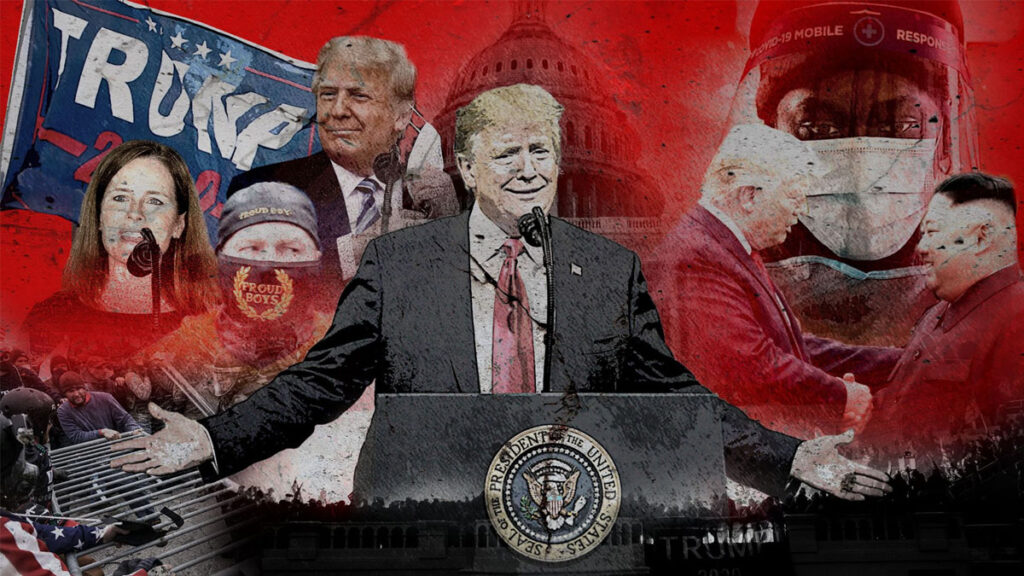
<p class="wp-block-paragraph">President Trump’s “Liberation Day” speech on April 2, 2025, was more than just another announcement from the Rose Garden. It marked a major turning point in U.S. economic policy. Trump laid out a bold new vision, declaring that years of being taken advantage of by foreign countries were over. His administration would impose sweeping new tariffs on imported goods, aiming to bring manufacturing back to American soil. The announcement triggered a wave of global financial turbulence, but the administration insists that this disruption is part of the plan.</p>


<p class="wp-block-paragraph">Markets have tumbled, bond yields have fallen, and China has hit back with sweeping retaliatory measures. While investors are shaken, Trump and his team believe that some chaos is necessary to fix what they see as a broken system.</p>


<h4 class="wp-block-heading">Wall Street’s Worst Week in Years</h4>


<p class="wp-block-paragraph">The markets reacted immediately. On April 4, the Dow Jones Industrial Average dropped by 2,231 points, the Nasdaq slid 5.8 percent, and the S&;P 500 fell by 6 percent. The two-day selloff wiped out an estimated $6.6 trillion in market value. According to Dow Jones Market Data, tech giants like Apple, Amazon, and Nvidia—often referred to as the &#8220;Magnificent 7&#8243;—lost a combined $1.55 trillion. Apple alone saw $443.5 billion in value disappear.</p>


<p class="wp-block-paragraph">It was one of the worst weeks for Wall Street since the financial crisis of 2008. As the <em>Wall Street Journal</em> reported, “The tech-heavy index fell more than 5% on both Thursday and Friday, a back-to-back drubbing that has only happened four other times in the index’s history.”</p>


<p class="wp-block-paragraph">Yet, Trump appeared unfazed. Speaking on social media, he said, “China played it wrong. They panicked—the one thing they cannot afford to do!” He also called it a “great time to get rich,” suggesting that the market panic might present buying opportunities for those who believe in his long-term plan.</p>


<h4 class="wp-block-heading">A Bond Rally for the Wrong Reasons</h4>


<p class="wp-block-paragraph">While stocks fell, U.S. government bonds rallied sharply. Investors rushed into Treasurys, pushing the yield on the 10-year note below 4 percent, down from around 4.8 percent in January. This drop in yield is significant because it reflects a growing belief among investors that the economy is headed for slower growth or even a recession.</p>


<p class="wp-block-paragraph">Treasury Secretary Scott Bessent had long spoken of the importance of reducing bond yields to lower borrowing costs for the government, businesses, and consumers. He believed that lower yields would come as a result of reduced deficits and greater domestic energy production. But as <em>The Wall Street Journal</em> explained, “That is hardly what’s happening now.”</p>


<p class="wp-block-paragraph">Instead, the bond rally was driven by fear. “This week’s bond rally, in fact, has been particularly noteworthy because it has happened even though investors are worried that Trump’s policies could lead to higher inflation and a larger budget deficit,” wrote financial reporter Sam Goldfarb.</p>


<p class="wp-block-paragraph">White House trade adviser Peter Navarro tried to paint the bond rally as a positive sign, saying on CNBC, “Mortgage rates are going to come down. That is going to have a nice bounce for our housing sector.” Still, some investors are skeptical. Leah Traub, a fixed-income manager at Lord Abbett, pointed out, “The current economic threat is completely made by policy. Therefore, it can at least be mitigated by policy.”</p>


<h4 class="wp-block-heading">China’s Broadside: A 34 Percent Tariff on All U.S. Goods</h4>


<p class="wp-block-paragraph">Beijing did not stay quiet. In response to Trump’s sweeping new tariffs, China announced it would impose a 34 percent tariff on <em>all</em> U.S. imports starting April 10. This marked the first time that China responded to a U.S. trade move with a blanket tariff.</p>


<p class="wp-block-paragraph">“This is an aggressive, escalatory response that makes a near-term deal to end the trade war between the two superpowers highly unlikely,” wrote economist Leah Fahy at Capital Economics.</p>


<p class="wp-block-paragraph">China also restricted the export of rare-earth minerals, launched investigations into American firms like DuPont, and blacklisted more than two dozen U.S. companies. Among those targeted was the Coalition for a Prosperous America, a group that actually supports Trump’s tariffs. This shows that China is willing to hit both allies and critics alike in its fight to protect its interests.</p>


<p class="wp-block-paragraph">A former editor of China’s state-run <em>Global Times</em>, Hu Xijin, wrote on social media, “Time will show how wrong and foolish it is for Washington to detonate this tariff nuclear bomb.”</p>


<p class="wp-block-paragraph">Still, Trump stood firm, believing that China’s retaliation proves the effectiveness of his approach. As he wrote on Truth Social, “The one thing they cannot afford to do!”</p>


<h4 class="wp-block-heading">The Bigger Vision: Reviving American Industry</h4>


<p class="wp-block-paragraph">Trump’s economic vision is rooted in a deep belief that America must restore its industrial strength. During his Liberation Day speech, he painted a picture of a once-thriving country that had been hollowed out by bad trade deals and cheap imports. “Empty, dead sites, factories that are falling down…will be knocked down, and they’re going to have brand new factories built in their place,” he said.</p>


<p class="wp-block-paragraph">His advisors describe this approach as economic therapy. Trump believes that the U.S. economy, despite its recent growth and low unemployment, has serious long-term problems. To him, the strong numbers are masking deeper weaknesses caused by offshoring and dependency on foreign supply chains.</p>


<p class="wp-block-paragraph">Stephen Miran, chairman of Trump’s Council of Economic Advisers, said the plan goes far beyond tariffs. “We’re making a lot more stuff in America—high-tech manufacturing, security goods, autos, a lot more stuff across the industrial spectrum,” he explained. Miran believes that cutting taxes, reducing regulations, and closing loopholes in trade will help rebuild the manufacturing base and strengthen American families.</p>


<p class="wp-block-paragraph">“If you create good jobs for people,” Miran said, “they have an easier time forming a family, getting married, having kids, finding housing, affording the costs of raising children.”</p>


<h4 class="wp-block-heading">A Strategy Based on Disruption</h4>


<p class="wp-block-paragraph">The Trump administration is aware that this transformation will not be smooth. Even Trump himself admitted earlier this year, “Will there be some pain? Yes, maybe (and maybe not!). But we will make America great again, and it will all be worth the price that must be paid.”</p>


<p class="wp-block-paragraph">At a recent Republican fundraiser, Vice President JD Vance told donors that Trump is willing to accept short-term suffering in order to realign global trade and bring production back to U.S. soil. “He’s making policy decisions with his gut,” Vance reportedly said, referencing a meeting he had with Ford Motor Company’s executive chairman.</p>


<p class="wp-block-paragraph">This approach reflects Trump’s long-standing view of trade. As far back as the 1980s, he argued that the U.S. was being taken advantage of. “We let Japan come in and dump everything into our markets. It’s not free trade,” he said in a 1988 interview. “If you ever go to Japan right now and try to sell something, forget about it.”</p>


<p class="wp-block-paragraph">To Trump, tariffs are not just an economic tool, they are a way to restore fairness and national pride. His critics say this strategy could cause a recession. Others say it might raise prices and reduce efficiency. But Trump’s supporters argue that it is about playing the long game.</p>


<h4 class="wp-block-heading">The Road Ahead</h4>


<p class="wp-block-paragraph">Despite the pain in financial markets and the uncertainty in global trade, the administration believes that the country is headed toward a stronger, more self-reliant future. “The patient lived, and is healing,” Trump wrote in a recent post. “The prognosis is that the patient will be far stronger, bigger, better, and more resilient than ever before.”</p>


<p class="wp-block-paragraph">In the short term, markets may continue to shake, inflation could rise, and some industries might struggle. But the White House sees this as a necessary step. As Kush Desai, a spokesperson for the administration, said, “The U.S.’s decline isn’t inevitable, but a choice rooted in bad policies that put the country last.”</p>


<p class="wp-block-paragraph">Whether Trump’s vision succeeds or falters, one thing is certain: the rules of global trade have changed, and America is not playing by the old ones anymore.</p>

Trump’s ‘Liberation Day’ Tariffs – Pushing through the Chaos