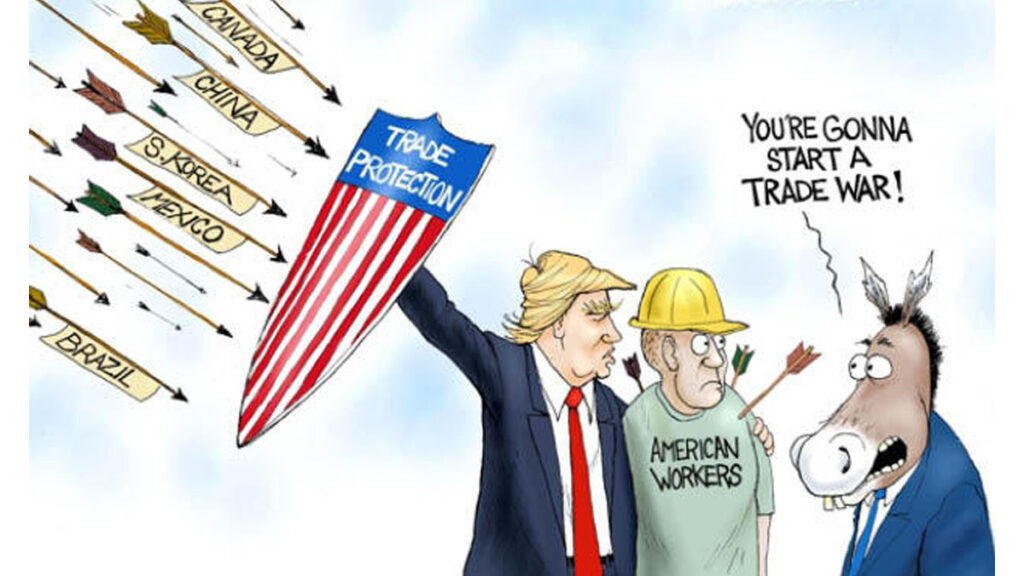
<p class="wp-block-paragraph">As a conservative, I am not a fan of tariffs. But unfortunately, they are a necessary tool to push back against foreign tariffs and unfair trade practices. In fact, they are essentially the only tool – or weapon, if you like.</p>


<p class="wp-block-paragraph">Trump is not wrong when he says that foreign trade policies have been grossly unfair to the United States. In fact, virtually all the top Democrats raising fuss over the Trump tariffs have been on record complaining about the trade imbalances. Among those favoring tariffs in the past to combat unfair trade practices are President Obama and Senate Minority Leader Chuck Schumer, but they never did anything about it. California Democrat Congressman Mike Garcia recently said he favors tariffs in some cases – although not Trump&#8217;s. The Democratic National Chairman stated, “we are not against tariffs” even as he criticized Trump’s tariffs. Democrats are being hypocritical and duplicitous on the issue.</p>


<p class="wp-block-paragraph">The are two features of the current tariff controversy that are not widely reported.</p>


<p class="wp-block-paragraph">They say that Trump is starting a “trade war.” ; Doesn’t that more aptly apply to those who have been putting high tariffs on American goods in the past – and using other trade tricks to ban American products? ; It seems those nations started the trade wars even though the United States did not respond in a timely fashion.</p>


<p class="wp-block-paragraph">We have also heard a LOT about how damaging tariffs are to the nation that imposes them. ; According to Democrats, American tariffs will raise prices &#8230; cause a recession or stagflation &#8230; increase unemployment &#8230; destroy business &#8230; and essentially crash the economy. ; So &#8230; why aren’t tariffs so damaging to all those other countries that have imposed them? ; Just asking.</p>


<p class="wp-block-paragraph">Tariffs have been part of the American experience since the founding of the Republic. ; President Washington used tariffs as a means of raising money for the fledgling nation. Treasury Secretary Alexander Hamilton saw the benefits in tariffs. ; In addition to raising revenue, Hamilton saw import duties as a means of protecting domestic businesses from foreign competition.</p>


<p class="wp-block-paragraph">Later in the 19<sup>th</sup> Century, the nation split on questions of tariffs – with the north favoring them to protect its industrial base and the south opposing them because they harmed international markets for cotton and other agricultural commodities – and the south was more reliant on imports.</p>


<p class="wp-block-paragraph">In the 20<sup>th</sup> Century, America passed the Smoot-Hawley Tariff Act of 1930. The primary purpose was to raise revenues to offset the growing depression. It failed when other nations responded with tariffs – setting off a damaging trade war.</p>


<p class="wp-block-paragraph">Trump has embraced tariffs as a revenue source and as a protection – and expansion – of the American industrial and agricultural base. ; He also sees them as a gauntlet to be cast down to trigger negotiation on a wide variety of issues – including illegal immigration and drug trafficking.</p>


<p class="wp-block-paragraph">What has been disconcerting to the obsessive Trump haters has been the breadth and boldness of his tariffs. ; He is not fighting this battle incrementally. ; He is using reciprocal tariffs &#8230;. retaliatory tariffs &#8230; and punitive tariffs &#8230; all at once. ; And he is not diplomatic in his assessment of the other nations.</p>


<p class="wp-block-paragraph">He often said that he would be happy to reduce his tariffs &#8212; and even eliminate them &#8212; if other nations would do the same. He is using tariffs and the threat of tariffs to drive nations to the bargaining table.</p>


<p class="wp-block-paragraph">Tariffs are a complex business. ; Every country is unique in terms of their tariff policies and their product mix – between what they need to import and what they want to export.</p>


<p class="wp-block-paragraph">Let us take coffee as an example. We import a LOT of coffee from Colombia because we are not a coffee-producing nation. We have no coffee industry to protect nor any ability to develop one. Same with chocolate, bananas and other tropical commodities. Trump’s tariff on Colombia seems to be more of a negotiating tool on other issues, such as immigration and drugs.</p>


<p class="wp-block-paragraph">Tariffs on steel and computer chips make more sense as a means of protecting American industries essential to national security. ; We are a steel and computer chip importing country – leaving critical industries exposed to the vicissitudes of international conflict. ; ; Tiawan produces up to 80 percent of our computer chips. ; What happens if Beijing invades the island province? ; Trump tariffs on China in his first term successfully reduced steel imports from the Middle Kingdom from 8 percent to 1.8 percent.</p>


<p class="wp-block-paragraph">Then there is the issue of cost increases on the American consumer. ; While tariffs do tend to increase prices, the impact on consumers will vary from product to product &#8230;  ;on what businesses absorb of the tariff cost &#8230; and how individual consumers adjust their purchases. ; A person does not have to purchase foreign goods with high tariffs. ; Cheaper domestic goods will compensate for tariffs.</p>


<p class="wp-block-paragraph">Some of the concern over the tariffs is legitimate – some not. ; Trump is not going for measured changes in global trade. ; He is going for a total disruption and realignment. ; Like major surgery, it results in some pain, some uncertainty and a recovery period.</p>


<p class="wp-block-paragraph">Trump’s critics say he does not have a long terms plan &#8230; he is unpredictable &#8230; ; he is chaotic. ; Well Duh! ; He makes field calls based on how other nations respond. ; He imposes harsh tariffs. ; When other nations begin to respond positively, he pulls back – putting the threat in the background. ; He backs off when he sees progress.</p>


<p class="wp-block-paragraph">Trump’s 90-day pause can be seen as a response to the stock and bond markets. ; But also, the positive response he got from a large number of nations. ; He paused the tariffs on nations that did not retaliate – essentially checkmating retaliation. ; Some 75 nations have opened the door to negotiations. ; Pausing the tariffs on those nations makes a lot of sense.</p>


<p class="wp-block-paragraph">Trump’s adversaries are not responding to his tariffs in an intelligent or consistent manner but responding as the myopic resistance movement – engaging in fearmongering &#8230; hysteria &#8230; disinformation &#8230; and outright lies. ; They still believe that their road to political success rests on the demonization of Trump and his supporters &#8212; and the ruination of his presidency. ;</p>


<p class="wp-block-paragraph">It is very early in Trump’s second terms. ; All of today’s hysterical fearmongering over the stock market &#8230; the cost of goods &#8230; unemployment &#8230; the government bureaucracy &#8230; mass deportations &#8230; will drift in the rearview mirror in the months and years to come.</p>


<p class="wp-block-paragraph">His evergreen critics seem to have forgotten that he is just now nearing the end of his first 100 days. That means he has approximately 1360 days to go. ; Trump is playing multiple chess games while the Democrats are playing Blind Man’s Bluff.</p>


<p class="wp-block-paragraph">So, there ‘tis.</p>

Trump tariffs: Tariff-ic or Tariff-ying?