











Trump Hosts Latin America Summit: Attack Cartels and Counter China

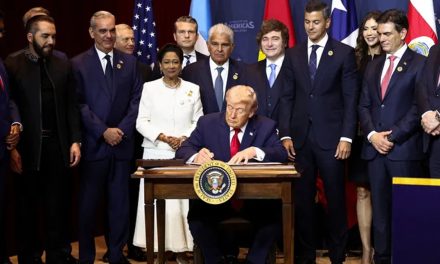
President Donald Trump gathered leaders from across Latin America this weekend for the inaugural “Shield of the Americas” summit, an event designed to strengthen security cooperation in the Western Hemisphere and push back against growing foreign influence in the region.
The meeting took place at Trump National Doral Miami, where a group of like minded governments met with the U.S. president to discuss organized crime, regional security and economic cooperation. The summit came at a time when the Trump administration is juggling several global crises, including the war with Iran, but the president used the gathering to emphasize that the Western Hemisphere remains a priority for U.S. foreign policy.
Trump said the United States and its regional partners must work together to confront violent drug cartels and transnational criminal networks that threaten stability throughout the Americas.
“The only way to defeat these enemies is by unleashing the power of our militaries,” Trump said. “We have to use our military. You have to use your military.”
Leaders from Across the Hemisphere Attend
Leaders from Argentina, Bolivia, Chile, Costa Rica, the Dominican Republic, Ecuador, El Salvador, Guyana, Honduras, Panama, Paraguay and Trinidad and Tobago attended the summit.
The meeting represented an effort to bring together governments that are generally aligned with Washington’s political outlook. Notably absent were some of the region’s largest powers, including Brazil and Mexico, as well as Colombia, which has historically been a key partner in U.S. anti narcotics operations.
The gathering also followed the collapse of a broader regional meeting known as the Summit of the Americas, which had been postponed amid political disagreements over which countries should be invited.
The “Shield of the Americas” concept emerged as an alternative framework built around cooperation among countries that share similar views on security and governance.
Trump Pushes Military Action Against Cartels
At the center of the summit was Trump’s call for a more aggressive campaign against drug trafficking organizations.
Trump argued that cartel networks have grown so powerful that they now threaten the national security of multiple countries in the region. He urged leaders to consider using their military forces to dismantle those organizations.
Citing the international coalition that defeated the Islamic State group in the Middle East, Trump said a similar approach could be used against organized crime.
“We must now do the same thing to eradicate the cartels at home,” he said.
According to Reuters, Trump framed the summit as the launch of a new coalition aimed at confronting cartel networks across the region. At one point he suggested that the United States could use missiles against cartel leaders if partner countries requested it.
The administration has already taken steps that signal a more forceful approach in Latin America. In January, U.S. forces captured Venezuelan President Nicolás Maduro in an operation tied to drug conspiracy charges. The move dramatically altered the political landscape in Venezuela and threatened Chinese interests tied to the country’s oil industry.
A Broader Security Strategy
Trump’s summit was part of a wider effort to increase American influence and security cooperation throughout the Western Hemisphere.
The administration’s national security strategy argues that the United States must prevent foreign powers from controlling strategic assets or gaining military footholds in the region. It also highlights concerns about infrastructure projects and other investments that could give outside powers greater leverage.
Supporters of the administration say the summit represents a necessary step toward defending the region from both criminal organizations and geopolitical rivals.
“President Trump is right to focus on defending the Western Hemisphere from China,” said Representative John Moolenaar, a Michigan Republican who chairs the House Select Committee on the Chinese Communist Party. “President Trump has made it clear we stand with our friends in the region against China’s efforts to undermine America’s interests.”
The Economic Dimension
While the summit focused heavily on security issues, economic cooperation is also central to the administration’s regional strategy.
Over the past two decades China has become a dominant economic partner for many Latin American countries, investing heavily in infrastructure, trade and development financing. Between 2014 and 2023 China provided roughly $153 billion in loans and grants to countries in Latin America and the Caribbean, compared with about $50.7 billion from the United States, according to AidData.
Analysts say that economic engagement will be critical if Washington hopes to strengthen its relationships in the region.
Francisco Urdinez of Chile’s Pontifical Catholic University said governments will expect real incentives if the United States wants closer political alignment.
“What they’re really hoping is that Washington backs up the political alignment with tangible economic benefits,” he said.
Trump has already offered such incentives to some governments. For example, the administration approved a $20 billion currency swap for Argentina and increased the amount of Argentine beef that can be exported to the United States.
Regional Leaders Respond
Some leaders in the region have signaled support for closer cooperation with Washington.
Ecuador’s president Daniel Noboa said joint security operations between Ecuadorian and U.S. forces targeting organized crime groups were only the beginning of deeper collaboration.
This week, security forces from both countries carried out operations in Ecuador’s Amazon region against the Colombian armed group Comandos de la Frontera.
Noboa said the joint fight against drug traffickers “is only the beginning.”
Others remain more skeptical about Washington’s intentions.
Cuban President Miguel Díaz Canel criticized the summit as “small, reactionary, and neocolonial,” accusing the United States of pressuring governments to accept American military force as a solution to internal problems.
Trump also made clear that his administration intends to take a tougher stance toward Cuba in the future. Speaking at the summit, he suggested that the island’s communist leadership could face major changes once the current conflict with Iran ends.
“Great change will soon be coming to Cuba,” Trump said. “They’re very much at the end of the line.”


Having worked as a DoD civilian during government shutdowns, I can tell you that whether or not one agrees with…
Joe, I am sure it is, and you are.
my pleasure
Larry, what you say is true-highly doubtful that Paxton would win a general election. However , it has been shown…
Me post be blocked. Too bad, shot this one down in flames. A crash n burn special. I guess extreme…