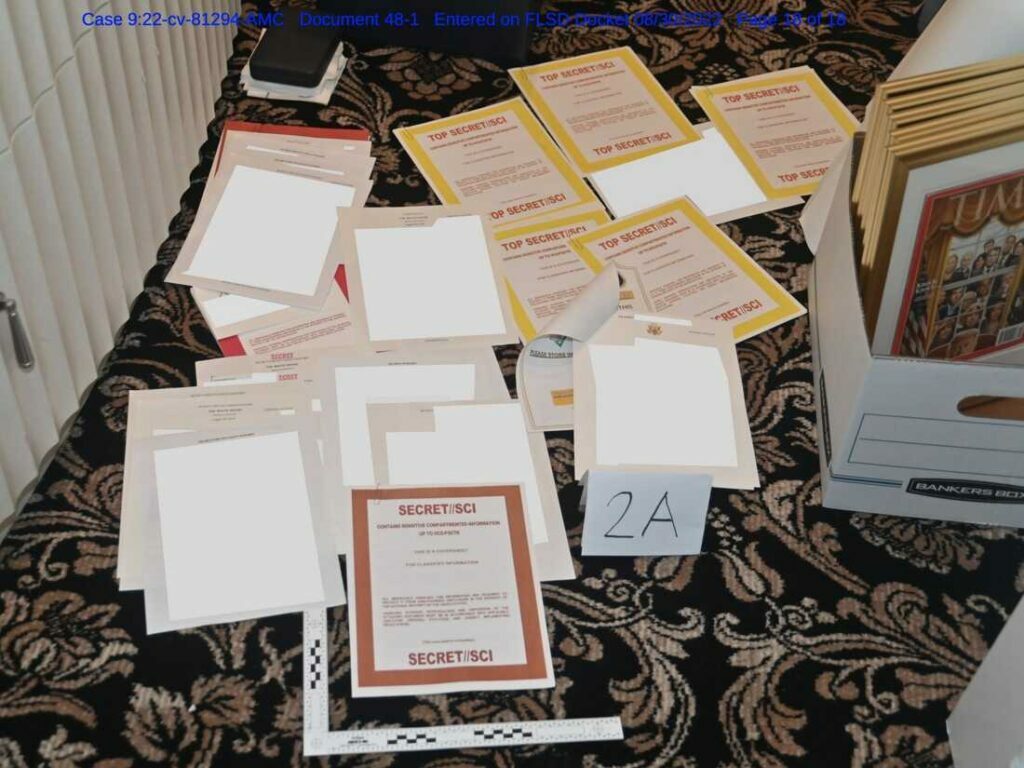
<p class="wp-block-paragraph">There is a need for a disclaimer since some readers take the view that unless you condemn President Trump on every issue in every way, you are a MAGA cultist (their term). ; They generally misrepresent my opinions by creating a straw man Larry Horist as their counterpoint. ; Any time a person tries to be factual and objective, one side or the other goes on the attack. ; Soooo. ; Allow me to reiterate my position on this one issue – the government records stored at Mar-a-Lago. ; And there are two distinct issues even though the constant Trump/Republican/conservative critics tend to merge the issues. ; ;</p>


<h2 class="wp-block-heading" id="h-classified-documents-is-they-is-or-is-they-ain-t"><strong>Classified documents – Is they is, or is they ain’t</strong></h2>


<p class="wp-block-paragraph">On the question of possessing documents that are or were classified, the jury (actually the Supreme Court) is out on this matter.  ; Trump says he has declassified all the documents in his possession. ; There is no doubt that he has the constitutional power to do so.</p>


<p class="wp-block-paragraph">Critics say that there is no evidence – no compliance to an official process – to establish what he has or has not declassified. ; They are correct – but not in the way they think. ; There IS no official process prescribed in the Constitution by which a President may exercise the power over classification. There is no “way” by which it must be done. ; There is no requirement that a President must inform anyone of his actions.</p>


<p class="wp-block-paragraph">Trump says he did declassify them. ; He even suggests that the act of removing them from the White House was an automatic declassification.</p>


<p class="wp-block-paragraph">Procedurally, none of that sounds right. ; I think most folks would agree that that is NOT how it should work. ; But that does not mean that it IS how it works. ; There is nothing to establish that Trump’s opinion is wrong.  ; It is a grey area – constitutionally unclarified. ; That is why I recommended a constitutional amendment to correct the situation. ; Short of that, the Supreme Court would have to at least “interpret” the meaning of the Constitution in this regard.</p>


<p class="wp-block-paragraph">There is a nuance, however. ; (Isn’t there always?) ; Records do not have to be classified to be illegally misused. ; If government information is provided to an enemy to the detriment of the United States, it is still a prosecutorial crime – whether the information is classified or not. ; There is no indication that Trump would do such a thing despite the irrational speculation of the more extreme Trump-haters. Too much grey area. ; ;</p>


<p class="wp-block-paragraph">All this means is that the issues of the classification of the documents taken to Mar-a-Lago pose no serious threat to Trump. ; Just a needed reform of the procedure to resolve the debate over the presidential power and declassification procedure. ;</p>


<h2 class="wp-block-heading"><strong>Possession of the documents – is they his, or is they ain’t</strong></h2>


<p class="wp-block-paragraph">Setting aside the classification issue, did Trump have a right to remove all those boxes of documents from the White House and bring them to his residence at Mar-a-Lago? ; That is a lot easier to answer. ; No! ; The 1978 Presidential Records Act is as clear as anything ever gets in government and law. ; All those documents are the property of the state – the people. ; They do not belong to Trump … period.</p>


<p class="wp-block-paragraph">Lawyers, judges and constitutional scholars on all sides of the political divide seem to agree on that point. ; Only Trump has claimed that the documents are his. ; Even his own lawyers dealing with the controversies are not proffering his argument of ownership – or control. ; They have not made that case publicly or in any court filings. ; They do plead that perhaps some documents are protected by client privilege or Executive Privilege – or are clearly personal items. ; Those few cases will be determined by the so-called “Master” if the Justice Department’s appeal of the appointment fails.</p>


<p class="wp-block-paragraph">From the very onset, I have expressed my own curiosity as to why Trump would have taken all those documents – and resisted returning them to the National Archives. ; Why would he have spent months resisting and deceiving the DOJ? ; I cannot even speculate a good answer.</p>


<p class="wp-block-paragraph">If you read the 1978 Act, it is difficult to see how Trump did not beak the law. ; Although the left-wing media pumps it up as if it is the worst crime against America since Pearl Harbor, it actually is not among the more serious crimes. ; It has been worsened somewhat by the long refusal to return the documents – but still a major deal.</p>


<h2 class="wp-block-heading"><strong>Where does it end?</strong></h2>


<p class="wp-block-paragraph">The current question is what Attorney General Merritt Garland will do about it. ; Will he indict Trump and put him on trial? ; Probably not. ; Even many of those Trump-hating former prosecutors seen on television predict that there will be no indictment in this case. ; The documents will eventually be returned and that will be the end of the issue.</p>


<p class="wp-block-paragraph">Why no indictment? ; Let me use the same reason as the Trump critics. ; The “crime” is not serious enough to put a former President of the United States on trial and potentially in jail. ; The DOJ could look at it as a civil crime and request the courts impose a fine. ; And probably not even that. ;</p>


<p class="wp-block-paragraph">There is one other point. ; Prosecutors do not like to lose cases in court. ; If it is unusually burdensome to criminally indict a former President, imagine how difficult it would be to convince 12 jurors to put a President behind bars. ; That is also going to be a consideration in anything that comes out of the January 6th investigation – or any of the others.</p>


<p class="wp-block-paragraph">Those who believe – or hope – that Trump is one short putt away from the hoosegow may be in for a major disappointment. ; There is a huge difference between convicting in the court-of-public-opinion and in a court-of-law.</p>


<p class="wp-block-paragraph">So, there ’tis.</p>

Trump documents case is unique