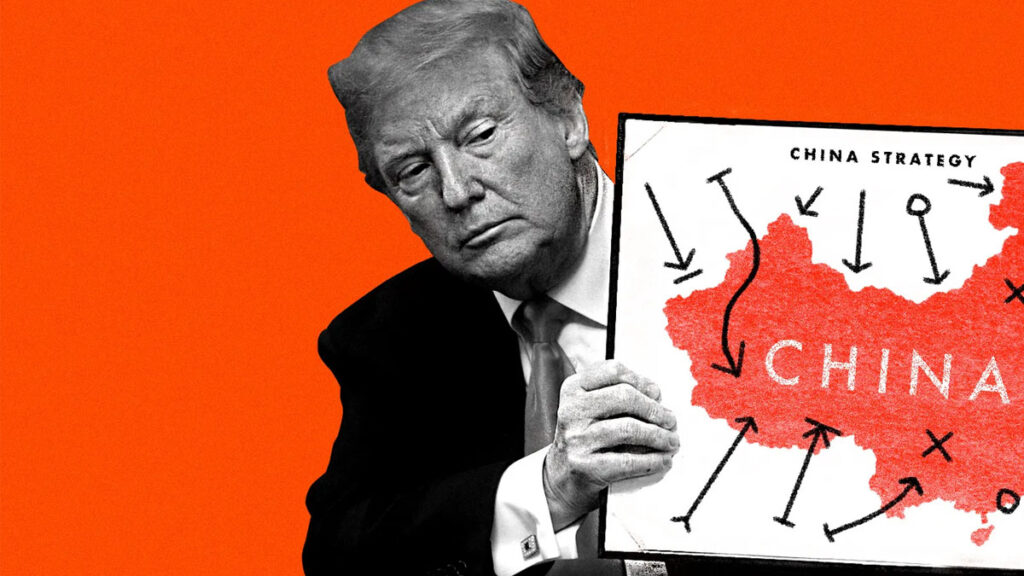
<p class="wp-block-paragraph">As the United States approaches another presidential election, questions arise about the potential policies and priorities of a second Donald Trump administration. With his track record of bold moves and sweeping changes, Trump’s return to the White House could bring a more aggressive approach toward China, escalating the economic and strategic rivalry between the two global powers. Known for his hardline stance on trade and economic issues with China, Trump has signaled that, if elected, he would take an even tougher stand on Beijing, with tariffs, export controls, and military posturing on the table.</p>


<h3 class="wp-block-heading" id="h-trump-s-background-with-china-the-tariff-man-strikes">Trump’s Background with China: The “Tariff Man” Strikes</h3>


<p class="wp-block-paragraph">During his first term, Trump’s relationship with China was defined by his desire to change what he saw as an unfair economic relationship. He introduced tariffs on Chinese imports worth over $250 billion, a move that sparked a trade war between the two nations and rattled global markets. Trump’s protectionist policies aimed to reduce the U.S. trade deficit and bolster American manufacturing by raising the cost of imported goods from China. He became known as the “tariff man,” and he embraced this identity, stating, “I’m a big believer in tariffs… I fully believe in them economically when you’re being taken advantage of by other countries.” Trump’s allies say that in a second term, he would have little interest in negotiating with Beijing and would instead focus on harsher measures to force economic concessions.</p>


<p class="wp-block-paragraph">Trump’s efforts in his first term led to a “phase one” trade deal in 2019, in which China promised to buy an additional $200 billion in American goods over the next two years. But as former national security advisor Robert O’Brien pointed out, “The Chinese didn’t honor it.” China fell short on these commitments, and Trump’s advisors believe this failure reinforced his conviction that the only effective response is a more uncompromising approach.</p>


<h3 class="wp-block-heading" id="h-what-trump-might-do-in-a-second-term-possible-actions">What Trump Might Do in a Second Term: Possible Actions</h3>


<p class="wp-block-paragraph">If re-elected, Trump’s policy toward China would likely reflect his frustration with China’s economic policies, its handling of COVID-19, and its increasing technological power. Here’s a closer look at some potential strategies:</p>


<ol class="wp-block-list">
<li><strong>Higher Tariffs Across the Board</strong> &#8211; Trump’s trademark approach to China has been tariffs, and he would likely escalate this strategy. Reports suggest he has considered tariffs as high as 60% or more on all Chinese imports. In a recent meeting with House Republicans, Trump described tariffs as “a strong tool for the executive branch,” emphasizing his view of tariffs as a way to protect American industry and apply pressure on China. If elected, Trump would likely target specific sectors such as Chinese electric vehicles (EVs) and high-tech products. He even suggested that tariffs might replace the U.S. income tax, funded by duties on foreign goods—a radical proposal, but one that reflects his belief that tariffs could reshape the American economy.</li>


<li><strong>Stricter Export Controls to Curb China’s Tech Development</strong> &#8211; During his presidency, Biden has taken steps to limit China’s access to American technology, but Trump could take this a step further. His advisors predict that he would impose more stringent export controls, preventing U.S. companies from selling critical technologies, such as advanced semiconductors and artificial intelligence, to China. Nazak Nikakhtar, a former Commerce Department official under Trump, stated that in a second term, the administration would likely enforce “more export controls on critical technologies, as well as legacy chipmaking technology.” This would be part of a broader effort to limit China’s technological progress, particularly in industries with military or strategic significance.</li>


<li><strong>Outbound Investment Restrictions</strong> &#8211; Trump could also restrict U.S. investments in Chinese companies, particularly in sectors that the U.S. views as strategic or sensitive. Nikakhtar suggested that Trump’s team would look seriously at “broadening outbound investment restrictions.” This would aim to curb the flow of American capital into China’s high-tech and defense-related industries, preventing U.S. investments from fueling China’s advancement in critical areas.</li>


<li><strong>A Global Coalition Against Chinese EVs</strong> &#8211; Another area where Trump might act is in building alliances to counter China’s dominance in the EV market. Chinese automaker BYD has become a global leader in electric vehicles, posing a significant challenge to U.S., Japanese, and European manufacturers. Trump’s advisors suggest that he would seek to form an international coalition with allies in Asia and Europe to target Chinese EVs, a strategy that would be a departure from his previous “go-it-alone” approach. Robert O’Brien noted, “The Japanese, Koreans, and Germans are starting to see the danger… If China destroys the German auto industry, which could happen very quickly, Germany is in real trouble.” Such a coalition could pressure China’s EV industry by imposing tariffs and trade barriers on its vehicles, aiming to protect domestic industries.</li>


<li><strong>Bolstering U.S. Military Presence in the Indo-Pacific</strong> &#8211; Beyond economic measures, Trump’s advisors advocate for a stronger military presence in Asia. Matt Pottinger, Trump’s former deputy national security adviser, argued that a greater U.S. military presence in the Indo-Pacific is necessary to counter China’s expanding influence. “Washington’s fixation on unintentional conflict and hotlines may have emboldened Beijing to undertake more aggressive behavior,” Pottinger said, highlighting the need for the U.S. to project strength. In a second term, Trump might deploy more military assets to the region, including the possible transfer of an aircraft carrier from the Atlantic to the Pacific. His team suggests this would serve as a deterrent to Chinese military actions in areas like the South China Sea and around Taiwan.</li>


<li><strong>Banning Chinese Ownership of U.S. Infrastructure</strong> &#8211; To prevent Chinese influence over American infrastructure, Trump has discussed policies that would ban Chinese companies from owning U.S. assets, such as ports, power plants, and telecommunications networks. This would further restrict Chinese investment in critical areas of the U.S. economy and align with Trump’s broader strategy of “strategic decoupling.”</li>


<li><strong>Pressure on China Regarding Fentanyl Exports</strong> &#8211; One of Trump’s main domestic concerns is the opioid crisis, which he and his allies partly attribute to Chinese-made chemicals used in fentanyl production. Trump’s running mate, Senator J.D. Vance, has called China “the biggest threat” to America, particularly in the context of fentanyl’s impact on U.S. communities. Trump’s administration could ramp up pressure on China to curb the export of fentanyl precursors, potentially imposing sanctions if China fails to act. This reflects a growing focus on fentanyl in U.S.-China relations, with Vance stating, “If I was a China policymaker, this selection would have me shaking in my boots.”</li>
</ol>


<h3 class="wp-block-heading" id="h-potential-consequences-of-a-trump-2-0-approach">Potential Consequences of a Trump 2.0 Approach</h3>


<p class="wp-block-paragraph">A second Trump term could significantly heighten tensions between the U.S. and China, pushing the two countries toward economic and strategic decoupling. While Trump’s policies aim to protect U.S. industries and enhance national security, they also come with risks. Higher tariffs could increase costs for American consumers, and trade restrictions might harm U.S. businesses that rely on Chinese manufacturing. Furthermore, a stronger military presence in Asia could raise the likelihood of conflicts over disputed regions, such as Taiwan.</p>


<p class="wp-block-paragraph">The Trump administration’s proposed actions would also affect global trade, with China likely responding with retaliatory measures. “Trump raising tariffs in a second term would be the ‘functional equivalent of the nuclear option’ in international economic conflict,” said economist Stephen Roach. This aggressive stance might prompt China to increase its own tariffs on American goods, restrict access to its markets, or even shift trade relationships toward countries that are less adversarial.</p>


<h3 class="wp-block-heading" id="h-a-wild-card-in-u-s-china-relations">A Wild Card in U.S.-China Relations</h3>


<p class="wp-block-paragraph">One factor that sets Trump apart is his unpredictability. Though he talks tough on China, Trump has also been known to change positions if he sees an advantage in doing so. For example, while he previously sought to ban TikTok due to its Chinese ownership, he recently joined the platform to reach younger voters, even vowing he would “never ban” it. This transactional approach makes Trump’s policy direction less certain, as he may shift strategies based on political or economic factors.</p>


<p class="wp-block-paragraph">China, too, is wary of Trump’s “wild card” nature. Patricia Kim, an expert on U.S.-China relations, said that while Beijing might see Biden’s consistent policies as a safer option, it could also exploit Trump’s tendency to act alone, especially if his actions drive a wedge between the U.S. and its allies. This dynamic could create a complex landscape for international relations, with Trump’s aggressive stance potentially reshaping U.S.-China relations for years to come.</p>

Trump 2.0: Older, More Aggressive, and Hawkish Toward China