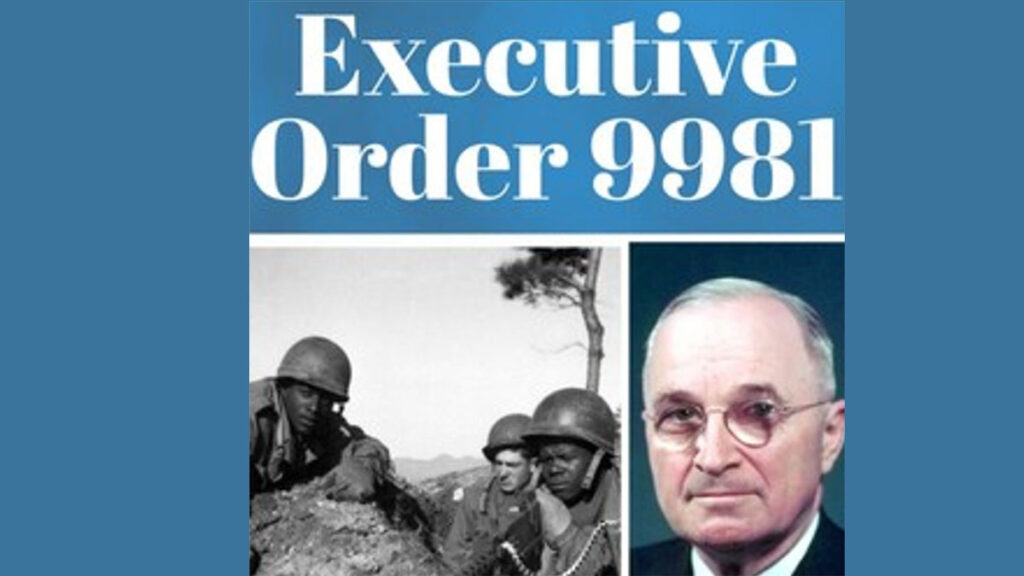
<p class="wp-block-paragraph">In a recent discussion about diversity in the military, CNN host Victor Blackwell referred to President Truman’s ending segregation in the armed forces in 1948. ; That is not quite accurate.</p>


<p class="wp-block-paragraph">Facing threats of a march on Washinton led by the NAACP – when Truman was running for reelection &#8212; he reluctantly agreed to sign Executive Order 9981, calling for the end of segregation in the military. ; However, he did little to implement the order for several years after winning reelection. ; It was President Eisenhower who put the cap on segregation in the military. ; Ironically, it was Eisenhower, as Supreme Allied Commander, who was the first to integrate military units in World War II years before Truman’s EO.</p>


<p class="wp-block-paragraph"></p>


<h2 class="wp-block-heading has-text-align-center" id="h-find-this-book-on-amazon-now"><a href="https://www.amazon.com/Who-Put-Blacks-That-PLACE/dp/1964251117">Find this book on Amazon now!</a></h2>


<figure class="wp-block-image aligncenter size-large is-resized has-lightbox"><a href="https://www.amazon.com/Who-Put-Blacks-That-PLACE/dp/1964251117"><img src="https://punchingbagpost.com/wp-content/uploads/2024/09/larrysbookguy87e-1024x576.jpg" alt="" class="wp-image-30183" style="width:624px;height:auto"/></a></figure>


<p class="wp-block-paragraph">Here is an excerpt from my book, <strong>“Who Put Blacks in That PLACE? – The long sad history of the Democratic Party’s oppression of Black Americans – to this day.”</strong>, that provides greater detail.</p>


<p class="wp-block-paragraph"><em>“Approaching the 1948 presidential election, Truman was in trouble – especially with Black Americans. ; Further complicating the situation was the fact that the Republican Party had made desegregation of the armed forces a plank in the Party’s 1948 platform which the Democratic Party had refused to do. ;</em></p>


<p class="wp-block-paragraph"><em>In response, Truman took a much stronger civil rights position in his campaign. ; He officially reversed two of Wilson’s most discriminatory actions – the segregation of the armed forces and the Executive Branch of the federal government. ;</em></p>


<p class="wp-block-paragraph"><em>According to an article on the Library of Congress website entitled “NAACP &#8211; A century in the fight for freedom,” the decisive pressure to integrate the armed forces also came from the NAACP, which threatened street demonstrations throughout the country.</em></p>


<p class="wp-block-paragraph"><em>On July 21, just months before the General Election, Truman opened federal employment to Blacks with Executive Order 9980, and on July 26, he issued Executive Order 9981 which ordered the desegregation of the United States armed services. ; In so doing, Truman undertook two actions that were promised by Roosevelt but never delivered despite his twelve-plus years in the Oval Office. ; It was also an action that Truman did not take during his first three years as President.</em></p>


<p class="wp-block-paragraph"><em>Truman got the response he wanted. ; The Black newspaper, the Chicago Defender, carried a bold banner headline: “PRESIDENT TRUMAN WIPES OUT SEGREGATION IN THE ARMED FORCES.”</em></p>


<p class="wp-block-paragraph"><em>The facts did not live up to the headline. Once reelected, Truman did virtually nothing to enforce his own Order. ; It was not until 1954 that the last segregated military units were finally abolished by order of Secretary of Defense Charles Wilson, serving under Republican President Eisenhower. ; In just more than one year in office, Eisenhower ended segregation in the military – an accomplishment that Truman failed to achieve in almost eight years in office, and the four years following his Executive Order.”</em></p>


<p class="wp-block-paragraph">The book also explains Eisenhower’s role in integrating units during World War II.</p>


<p class="wp-block-paragraph"><em>“Though President Harry Truman is often given credit for desegregating the armed services, he did not blaze the trail. Republican General Eisenhower had called for desegregation of the military and had actually done so. ; Using his power as Supreme Commander, Eisenhower integrated some combat units during World War II &#8212; four years before Truman’s Executive Order, as reported in National Geographic:</em></p>


<p class="wp-block-paragraph"><em>‘One major breakthrough came during the Battle of the Bulge, in late 1944, says Ambrose. ; General Dwight D. Eisenhower, faced with Hitler&#8217;s advancing army on the Western Front, temporarily desegregated the army, calling for urgent assistance on the front lines. More than 2,000 black soldiers volunteered to fight.</em></p>


<p class="wp-block-paragraph"><em>Similarly, demands in Italy called the Tuskegee Airmen to action. In 1944, they began flying alongside white pilots in the European theatre, successfully running bombing missions and becoming the only U.S. unit to sink a German destroyer.</em></p>


<p class="wp-block-paragraph"><em>African American women also fought to serve in the war effort as nurses. Despite early protests that black nurses treating white soldiers would not be appropriate, the War Department <strong>relented</strong>, and the first group of African American nurses in the Army Nurse Corps arrived in England in 1944.’</em></p>


<p class="wp-block-paragraph"><em>The word “relented” is emphasized because it clearly shows that Eisenhower’s integration of black and white service personnel was not received with enthusiasm by Democrats in Washington.”</em></p>


<p class="wp-block-paragraph">So, there ‘tis.</p>

Truman did not end segregation in the armed forces