<p class="wp-block-paragraph"><strong><em>How the U.S. Fell Behind and What It Will Take to Become a World Leader Again</em></strong></p>


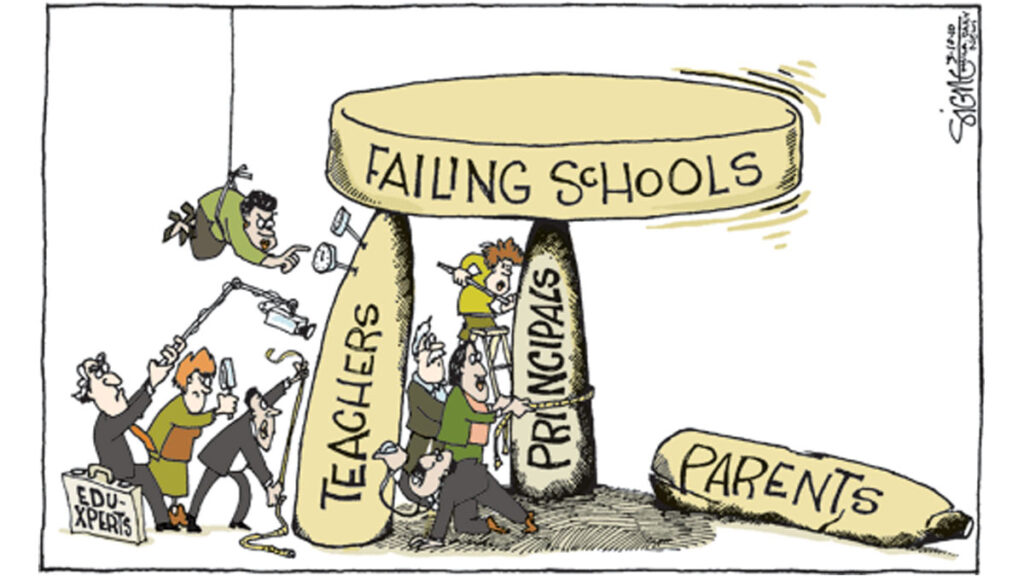
<p class="wp-block-paragraph">The American education system is in crisis. Test scores in reading and math have dropped to levels not seen in decades. Students are graduating without basic skills, and the United States consistently ranks behind many other developed countries in academic performance. Despite spending more on education than almost any other country in the world, American students are struggling—and it is costing them their future.</p>


<p class="wp-block-paragraph">Experts, policymakers, and educators from across the political spectrum agree that something has gone very wrong. Former President Donald Trump has called the system “a complete and total disaster,” and others have warned that if serious reforms are not made, the United States could fall even further behind. The reasons are complex, but there are clear steps that could help turn the situation around.</p>


<h3 class="wp-block-heading">A Nation Falling Behind</h3>


<p class="wp-block-paragraph">The numbers speak for themselves. According to the 2024 results from the National Assessment of Educational Progress (NAEP), also known as the Nation’s Report Card, 69 percent of fourth graders scored below grade level in reading. Among eighth graders, the number was even worse—70 percent failed to meet reading benchmarks. In math, 60 percent of fourth-grade students and 72 percent of eighth graders also scored below grade level.</p>


<p class="wp-block-paragraph">These results are not new. Martin West, vice chair of the National Assessment Governing Board, said during a 2024 panel that student performance has been “eroding for more than a decade.” He attributed the decline to “a softening of public school accountability and a new era of screen-based childhood,” where children spend more time on smartphones and less time on schoolwork. “Sobering would be a good word for it,” West told a group of state legislators.</p>


<p class="wp-block-paragraph">On the international stage, American students continue to lag behind their peers. In the 2023 Trends in International Mathematics and Science Study (TIMSS), the United States ranked 22nd out of 44 countries. In the 2022 Program for International Student Assessment (PISA), the U.S. ranked 18th out of 80 nations overall. While American students placed ninth in reading and 16th in science, they ranked a troubling 34th in math. David Steiner of Johns Hopkins University called these results “respectable but not ideal” and warned that American students raised on social media struggle with traditional reading tests that require attention and critical thinking.</p>


<p class="wp-block-paragraph">These trends are especially concerning because the United States spends so much on education. According to the National Center for Education Statistics, the U.S. spends more than $15,500 per student—a figure that is 38 percent higher than the average for other developed nations. Yet that spending is not translating into better outcomes.</p>


<h3 class="wp-block-heading">Trump’s Call for Reform</h3>


<p class="wp-block-paragraph">Former President Donald Trump has positioned himself as a leading critic of the American education system. He argues that the federal Department of Education has become bloated, ineffective, and too focused on politics rather than performance. “We are spending more money than any other country, and what do we have to show for it?” Trump asked during a 2024 campaign rally. “Our students are falling behind while other countries surge ahead.”</p>


<p class="wp-block-paragraph">Trump has proposed eliminating the Department of Education entirely and returning control of schools to the states. He also supports universal school choice, allowing parents to use education funding to enroll their children in private, charter, or home schools. In addition, Trump wants to remove progressive ideology from the classroom, including programs based on critical race theory (CRT), diversity, equity, and inclusion (DEI), and social-emotional learning (SEL). According to Trump, “We’re going to give power back to parents, eliminate the woke indoctrination, and make our schools great again.”</p>


<p class="wp-block-paragraph">Critics have pushed back on Trump’s proposals, saying they could undermine public schools. But many parents and reform advocates agree with his call for a return to academic basics and a rejection of politically charged content in the classroom.</p>


<h3 class="wp-block-heading">The Epoch Times Says&#8230;</h3>


<p class="wp-block-paragraph">In a March 2025 report by The Epoch Times, education writer Aaron Gifford identified three core problems that must be addressed if the United States is going to restore excellence to its K–12 education system: lack of accountability, relaxed academic standards, and disengaged students. These three issues are central to why American schools continue to fall behind, despite increased spending and new educational technology.</p>


<p class="wp-block-paragraph">According to the report, “Education policy experts identify three significant barriers to catching up to higher-performing nations in classroom performance: lack of accountability, relaxed standards, and lack of engagement.”</p>


<p class="wp-block-paragraph"><strong>1. Accountability Must Be Real</strong></p>


<p class="wp-block-paragraph">Standardized testing has been controversial for years, but many education experts argue it is still one of the only ways to measure performance across schools and districts. Under Presidents George W. Bush and Barack Obama, programs like No Child Left Behind and Race to the Top sought to hold schools accountable for results. However, teacher unions and some community leaders resisted these reforms, arguing they created too much pressure.</p>


<p class="wp-block-paragraph">Today, many states are moving away from tying teacher evaluations and tenure decisions to test results. According to the National Council on Teacher Quality, most states have decoupled student test scores from teacher evaluations. In some places, school districts have even taken legal action to prevent test results from being published. In Texas, several districts sued the state education agency to stop it from releasing school accountability scores.</p>


<p class="wp-block-paragraph">Former charter school teacher Catrin Wigfall argued that this resistance shows who is really in control. “Teacher unions, not school boards or state education leaders, are in control of a top-down system,” she said. Without real accountability, she warned, student performance will continue to decline.</p>


<p class="wp-block-paragraph"><strong>2. Academic Standards Have Collapsed</strong></p>


<p class="wp-block-paragraph">One of the most alarming trends is the widespread lowering of academic standards. In 2024, 41 states no longer required high school seniors to pass a final exam to graduate. In Hartford, Connecticut, a student who could not read or write received a diploma and was even admitted to college. That student, Aleysha Ortiz, is now suing the school district.</p>


<p class="wp-block-paragraph">Carol Gale, president of the Hartford Federation of Teachers, said the school district has lowered expectations and ignored chronic absenteeism in order to improve graduation rates. “The district doesn’t police its chronic absenteeism policy and has lowered student expectations,” she said, adding that these changes were made so the graduation numbers would look better.</p>


<p class="wp-block-paragraph">Teacher certification standards have also been weakened. In Minnesota, educators no longer have to pass a basic skills exam to receive a top-tier teaching license. In Texas, 34 percent of newly hired teachers entered classrooms without certification, and many do not last even one year. Texas Education Commissioner Mike Morath warned lawmakers that many new teachers are not prepared. “We are setting these folks up for a very rough ride,” he said.</p>


<p class="wp-block-paragraph"><strong>3. Students Are No Longer Engaged</strong></p>


<p class="wp-block-paragraph">The third major issue identified by Gifford is the lack of student engagement. More and more, students are being taught in ways that do not challenge them or prepare them for the real world. Experts say American classrooms rely too heavily on flawed teaching strategies and unproven trends.</p>


<p class="wp-block-paragraph">For example, reading instruction in many schools still uses the “three-cueing system,” a theory that teaches children to guess words using pictures and context instead of learning phonics. Margaret Goldberg, a literacy coach in Oakland, said she saw firsthand how damaging this approach can be. “I did lasting damage to these kids,” she said. “It was so hard to ever get them to stop looking at a picture to guess what a word would be.”</p>


<p class="wp-block-paragraph">The same disengagement is visible in math instruction. U.S. students are often taught through compartmentalized lessons that do not reinforce concepts across units. In contrast, Singapore Math emphasizes depth, consistency, and application. According to its creators, students “must think through concepts and apply them in new ways from the very start.”</p>


<p class="wp-block-paragraph">Wigfall also pointed out that schools in other countries do not incorporate ideological content like DEI or CRT. “Teach that at home if you want, but not at school,” she said. She also criticized the growing use of SEL programs that require teachers to act as counselors and social workers in addition to educators. “We ask too much of our teachers, and there are only so many hours in a school day.”</p>


<h3 class="wp-block-heading">A System Designed for Failure</h3>


<p class="wp-block-paragraph">David Steiner of Johns Hopkins University argues that these problems are not just accidental—they are built into the design of the system. “We have eroded the instructional core and designed our education system for failure,” he said.</p>


<p class="wp-block-paragraph">According to Steiner, American schools start failing students from the beginning. Preschool programs are inconsistent, early assessments are delayed until age eight, and teacher preparation programs are not aligned with classroom needs. “Curricula, tests, and teacher education programs exist in deep silos,” he explained. “Tests don’t test students’ mastery of the materials, and teachers aren’t trained to teach what their schools require.”</p>


<p class="wp-block-paragraph">Steiner also criticized the disconnect between high school and college expectations. Most states do not require an exit exam to graduate, and students are admitted to college based on GPA and unrelated standardized tests like the SAT.</p>


<p class="wp-block-paragraph">He also warned that schools are prioritizing vague ideas like “grit” and “growth mindset” over actual academic achievement. “Academic achievement itself is increasingly out of fashion,” he said. “Students cannot think critically about nothing in particular; mastery of content is a prerequisite.”</p>


<h3 class="wp-block-heading">What Needs to Be Done</h3>


<p class="wp-block-paragraph">If the United States wants to return to being a global leader in education, reforms must be deep, consistent, and focused on students. These are the core recommendations offered by The Epoch Times, Aaron Gifford, and other education experts:</p>


<ul class="wp-block-list">
<li>Reinstate rigorous academic standards at every grade level</li>


<li>Require exit exams for high school graduation</li>


<li>Align teacher training with research-backed methods</li>


<li>Restore accountability through fair but firm testing systems</li>


<li>Limit ideological content and return focus to core subjects</li>


<li>Promote reading instruction based on the science of reading</li>


<li>Expand school choice and empower families to make decisions</li>


<li>Reduce screen time and prioritize teacher-led learning</li>


<li>Provide real career and technical pathways tied to workforce needs</li>
</ul>


<p class="wp-block-paragraph">As Martin West put it, “There was bipartisan support for standards-based reform and accountability. I do think we’ve seen a softening of accountability.” That softening has come at a cost.</p>


<p class="wp-block-paragraph">Rebuilding American education will take more than funding or technology. It will require a commitment to excellence, a willingness to face uncomfortable truths, and a belief that all students deserve the opportunity to succeed, not through shortcuts or lowered expectations, but through hard work and meaningful learning.</p>

Three Things Needed to Save American Education