<p class="wp-block-paragraph">There is a widely held belief that unions benefit workers specifically and the economy in general. That argument may have been valid in the early days of industrialization &#8212; during a period of trust, oppressive wage policies, and child labor. One can heartily agree that unions played an important role in bringing about better pay and working conditions in those days.</p>


<p class="wp-block-paragraph">But improvements in wages, benefits, working conditions and working hours were not the exclusive result of unions. Legislation impacting all workers and employers &#8212; and competition &#8212; played important roles. That is evident in the fact that improvements in wages and working conditions occurred in non-union enterprises – often better than union shops. In fact, among the best wage and benefit packages in America are in non-union enterprises – especially the new tech industries in which high wages were driven by competition more than anything. It is noteworthy that private sector union membership stands at a meager 5.9 percent of the American workforce. That means that almost 95 percent of wage and benefit increases – and better working conditions &#8212; are the result of factors other than union membership. They are mostly the result of free market competition, management policies and legislation.</p>


<p class="wp-block-paragraph">Unions also have a significant downside – and increasingly so since those egregious employment practices of the early twentieth century have long since vanished. The modern union contract settlements &#8212; with all those proclaimed higher wages, greater benefits, and shorter work hours &#8212; have had a devastating impact on a lot workers and businesses.</p>


<p class="wp-block-paragraph">Take the auto industry as one example. Today, there are fewer Americans building cars &#8212; and fewer American cars on the roads. There was a time when it was considered disloyal to park a foreign car in an automaker’s parking lot. Today those lots are overrun with foreign cars parked by the very workers whose unions helped drive domestic production overseas.</p>


<p class="wp-block-paragraph">This happened because the auto unions pressured for higher salaries and more expensive benefits. The increased costs made American manufacturers no longer competitive. To offset the imposed cost increases, the car companies had to (1) reduce the workforce, (2) move production out of the country and (3) invest in robotics to reduce the workforce. In other words, union demands and management acquiescence destroyed the American car industry. Economists have described the union-driven pay increases as a “short run sugar high with a long run hangover.”</p>


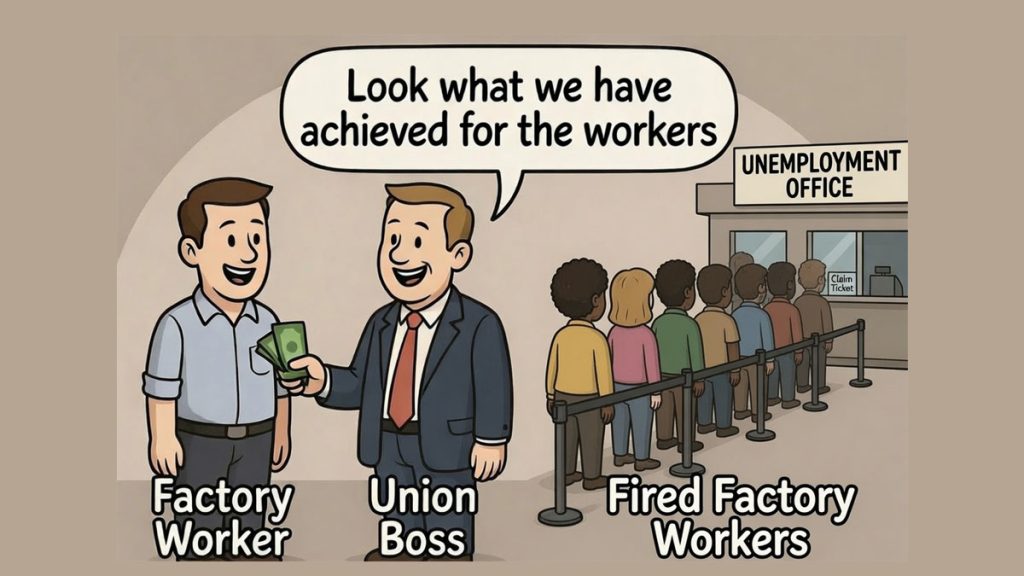
<p class="wp-block-paragraph">The auto unions bragged that their workers were paid the highest wages in the world with the best benefits. Of course, that only applied to those who still had jobs. In labor negotiations, wage and benefits increases were known as <strong>wins for the survivors</strong>.</p>


<p class="wp-block-paragraph">UPS provides another cautionary tale. In recent contract negotiations, the company gave in to union demands for a substantial pay raise &#8212; meaning the salary package for the average UPS driver rose to $170,000 per year.</p>


<p class="wp-block-paragraph">The increased costs caused a sharp drop in business &#8212; lost to competitors. In response to the extra costs &#8212; and in order to remain competitive &#8212; UPS adjusted operations by reducing the workforce by 20,000 workers and closing more than 70 facilities. When union leaders boast about the pay raises, they ignore the broader job and opportunity losses that generally follow such victories.</p>


<p class="wp-block-paragraph">My late father-in-law was head of the Michigan pipefitters union. He warned against excessive demands that threaten the viability of a business. “Getting more,” he said, “is not a win for workers if it hurts a company’s ability to succeed.”</p>


<p class="wp-block-paragraph">That was precisely the case with Yellow Corp &#8212; one of the largest long-haul shippers in America. The company was already facing financial gproblems. Company officials warned the Teamsters union that their salary demands would make it impossible for the company to compete – and would literally put them out of business.</p>


<p class="wp-block-paragraph">Despite the warning, the Teamsters pressed hard and threatened to strike. Faced with two untenable options, the company acquiesced to the pay increases. Shortly thereafter, Yellow Corp ceased all operations &#8212; putting approximately 30,000 workers out of their jobs. Union intransigence turned a struggling enterprise into a graveyard of lost livelihoods.</p>


<p class="wp-block-paragraph">One need not stop at the private sector. The unique problems with government unions prove even more insidious. In the public sector, unions face no real market discipline. There exists no imperative to compete, no necessity to meet the demands of customers who can take their business elsewhere, and &#8212; most critically &#8212; a seemingly unlimited pool of taxpayer money to fund extravagant demands.</p>


<p class="wp-block-paragraph">Government unions negotiate with management that often includes active or former union members or sympathetic political appointees &#8212; creating a pro-labor dynamic where the foxes guard the henhouse.</p>


<p class="wp-block-paragraph">Taxpayers foot the bill without a seat at the table. Unlike private companies that must generate profits or perish, government entities simply raise taxes, issue bonds, or print more promissory notes for future generations to honor. This leads to bloated payrolls, unsustainable pensions, and work rules that prioritize job security over service delivery.</p>


<p class="wp-block-paragraph">One need only to look at cities and states drowning in unfunded pension liabilities and sky-high labor costs. Public sector unions extract premiums far above private counterparts while delivering services that citizens cannot easily refuse. Government has no competition.</p>


<p class="wp-block-paragraph">The broader danger unions pose extends beyond notable failures. They distort labor markets, reduce flexibility, and create an adversarial culture that stifles innovation. While promising to protect workers, they often become the very force that renders those workers redundant &#8212; whether through offshoring, automation, or outright business collapse. The sugar high of immediate gains masks the hangover of lost competitiveness and vanished opportunities.</p>


<p class="wp-block-paragraph">Despite their notable downsides, unions possess political power and influence beyond their numbers. It is largely due to romanticized perceptions based on the past; the enormous amounts of money they pour into political coffers (disproportionally Democrat coffers); a long history of state and federal protective legislations; friendly courts; mandatory union contracting by government agencies and private companies with government contracts; and such institutions as labor relations boards and the Department of Labor. The latter operates almost exclusively as an advocate for organized labor despite the fact that almost 95 percent of American labor is not unionized.</p>


<p class="wp-block-paragraph">In a free economy, workers thrive when companies succeed. Unions, in their modern form, too often engineer the opposite outcome. They may once have served a purpose in correcting genuine abuses, but today they are a relic that too often harm the very workers and the companies needed to provide the work. It is time to recognize the myth for what it is and prioritize policies that foster genuine prosperity rather than forced redistribution through thumb-on-the-scale collective bargaining.</p>


<p class="wp-block-paragraph">So, there ‘tis.</p>


<p class="wp-block-paragraph"></p>

The Myth of Union Benefits