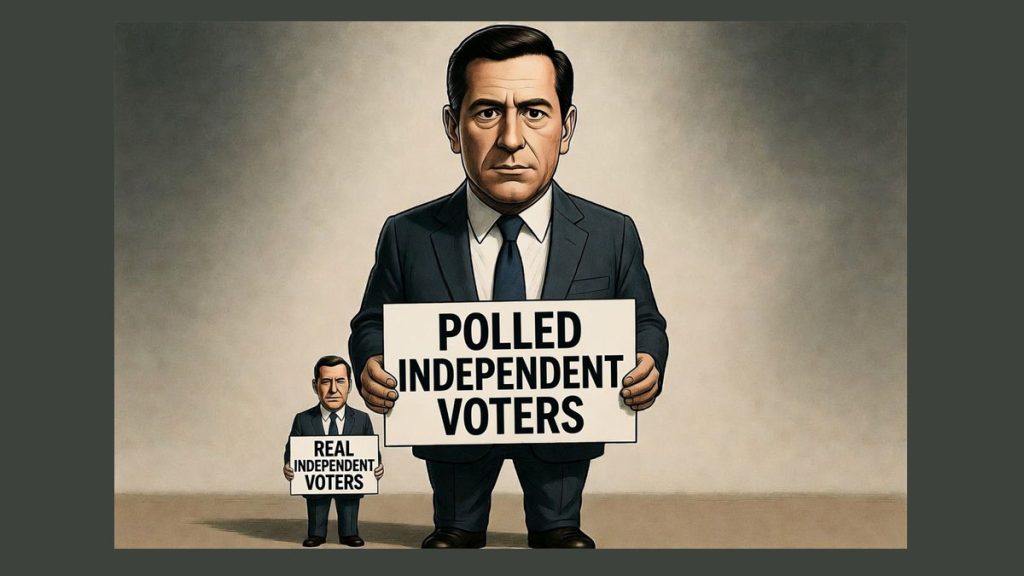
<p class="wp-block-paragraph">There has been a lot of reporting on the so-called independent voters – those who do not register with either the Republican or the Democratic Party. The theory is that the “independents” do not go along with either party’s platform or candidates &#8212; but are more likely to split their votes between parties and candidates nominated by the Republican or Democratic parties.</p>


<p class="wp-block-paragraph"><strong>What is the real number of independent voters?</strong></p>


<p class="wp-block-paragraph">According to the latest Gallup Poll, independents represent a plurality of voters at 45 percent – with Republicans and Democrats split evenly at 27 percent each.</p>


<p class="wp-block-paragraph">Many so-called independents are not truly independent of political party loyalty – even though the pollsters count them as independent. They are members of other parties – Libertarian Party, Democratic Socialist Party, Communist Party, The Green Party and a plethora of state and local parties. According to Ballotpedia, 4.46 of registered voters are signed up with political partiers other than Republican and Democrat. That is another 5.4 million people the pollsters count as “independent.”</p>


<p class="wp-block-paragraph">Another flaw in the counting is that the major polls use all “eligible voters” – including those who do not check the independent box on the voting registrant form. Many do not register to vote &#8212; and do not vote. Only 75 percent of eligible voters are registered. That means approximately 60 million Americans who <strong>could</strong> register and vote do not. The percentage of registered voters who do not varies between 15 and 30 percent – or in numbers, another 20 to 50 million eligible voters. Put that together and one discovers that between 75 and 90 million eligible voters do not participate in elections. They do not vote – and yet the pollsters count them as “independent <strong>voters</strong>”.</p>


<p class="wp-block-paragraph"><strong>Are so-called independent voters really independent?</strong></p>


<p class="wp-block-paragraph">Independents too often tend to view their self-proclaimed political emancipation with an annoying level of arrogance. They assume a sense of intellectual sophistication and superiority over those who align with political parties. They are immune to party loyalty. So they say. But is it true?</p>


<p class="wp-block-paragraph">Having served as advisor to political candidates from the presidency to local alderman, This author has used the standard method to analyze voters. It generally consists of five columns – Registered Democrat, Leaning Democrat, Undetermined, Leaning Republican, Registered Republican.</p>


<p class="wp-block-paragraph">In terms of polling and reporting, the three middle categories would be counted as “independents” – but that is not how they vote. Those “leaning” are simply unaffiliated Democrats and Republicans. Their voting habits are very similar to the members of the party to which they “lean.” It is that small sliver of the Undecides, who can fairly be labeled as independents.</p>


<p class="wp-block-paragraph">If your remove the miscounted voters &#8212; and focus on only registered voters without any other party affiliation and who actually vote – the number of independent <strong>voters </strong>drops to a much smaller percentage than the publicly promoted 45 percent. It is somewhere between 15 and 20 percent – fewer than registered Republicans or registered Democrats.</p>


<p class="wp-block-paragraph"><strong>Breaking into party primaries.</strong></p>


<p class="wp-block-paragraph">Since independents are not registered members of either of the two major political parties, they are mostly banned from voting in party primaries. Yet, they lobby for “open primaries” – claiming that they are excluded from picking candidates and are only left with the choices of the major parties. But that is their choice.</p>


<p class="wp-block-paragraph">There is a movement among self-proclaimed independents to open up party primaries so they can participate. Their main argument is that they are precluded from selecting the candidates who appear on the ballot in General Elections. Of course, that is only because they choose not to participate.</p>


<p class="wp-block-paragraph">They have other options. If they do want to be affiliated with neither the Republican nor the Democratic parties, they can join any one of the alternative parties. Or they can run as or support independent candidates.</p>


<p class="wp-block-paragraph">Of course, the problem is obvious. Those options rarely lead to success on Election Day. In reality, the self-proclaimed independents want to influence the Republican or Democratic primaries without “paying dues”.</p>


<p class="wp-block-paragraph">Since most votes are binary choices along the conservative (Republican) to progressive (Democrat) continuum, it is natural for voters to divide and cohere to the juxtaposed philosophic or partisan poles. It is the reason why the two-party system has been so successful compared to one-party and multiple-party systems – and why the two-party system is employed by most democratic republics around the world.</p>


<p class="wp-block-paragraph">The two-party system, with party primaries, is one of the safeguards against democratic tyranny. It serves as minority protection – assuring that competitive views will be available to voters. You have a clear example of the problem in the California “jungle primary” in which all candidates appear on one ballot. The result? In the run-off, voters can only choose between one of two fungible progressive Democrat candidates. Same with the Los Angeles mayoral race. Millions of Republican voters have been disenfranchised in terms of the General Election. There is not chance a Republican could win because the open primary eliminated them.</p>


<p class="wp-block-paragraph"><strong>Summary</strong></p>


<p class="wp-block-paragraph">The two-party system has evolved with generally good results. But, even the Republican Party and the Democrat Party are vulnerable to challenge and change. It has happened in the past when the Federalists and Anti-Federalists morphed onto the Republican Democrats and the Whigs. They eventually gave way to the modern Democratic and Republican parties.</p>


<p class="wp-block-paragraph">For 250 years, the United States has avoided the oppression of one-arty systems and the chaos of multiple-party systems. The very idea of denigrating the two-party system with pseudo reforms that would destabilize the critical balance of political influence essential to a ground-up representative government is an ill-conceived assault on the Republic.</p>


<p class="wp-block-paragraph">If self-styled independents want to maximize their influence, they should stop whining and join a party</p>


<p class="wp-block-paragraph">So, there ‘tis.</p>


<p class="wp-block-paragraph"></p>

The Myth of Political Independent Voters