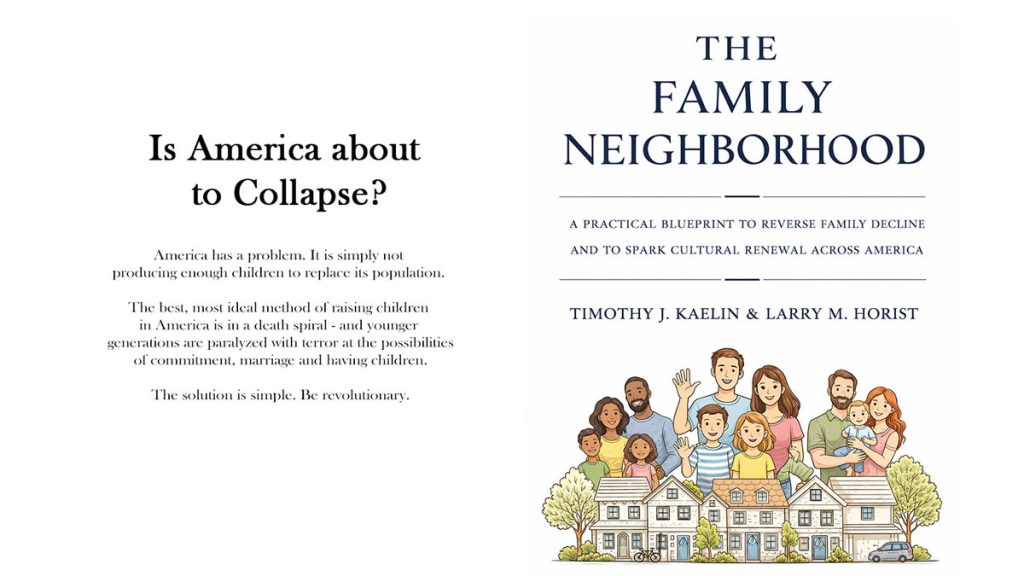
<p class="wp-block-paragraph"><em>This article is adapted from <strong><a href="https://www.amazon.com/Family-Neighborhood-practical-blueprint-cultural/dp/B0GT9BYVRF/">The Family Neighborhood: A Practical Blueprint to Reverse Family Decline and Spark Cultural Renewal Across America</a> </strong>by Timothy J. Kaelin and Larry P. Horist. The book explores the growing collapse of family formation in America, why it matters to the nation’s future, and bold proposals to make marriage, parenting, and family life more achievable again. <a href="https://www.amazon.com/Family-Neighborhood-practical-blueprint-cultural/dp/B0GT9BYVRF/">Available now on Amazon for $17.95.</a></em></p>


<p class="wp-block-paragraph">There are truths in public life that people quietly know but increasingly hesitate to say out loud.</p>


<p class="wp-block-paragraph">Here is one of them:</p>


<p class="wp-block-paragraph">Children do better with two parents.</p>


<p class="wp-block-paragraph">Not always. Not perfectly. Not without exceptions.</p>


<p class="wp-block-paragraph">But overwhelmingly, statistically, and across decades of research, the evidence points in the same direction.</p>


<p class="wp-block-paragraph">And modern America seems terrified to discuss it.</p>


<p class="wp-block-paragraph">The reason is understandable. Nobody wants to insult single mothers or fathers struggling to raise children under difficult circumstances. Many single parents perform acts of extraordinary sacrifice and devotion. Some raise remarkable, resilient children who thrive despite overwhelming odds.</p>


<p class="wp-block-paragraph">But public policy cannot be built around exceptions.</p>


<p class="wp-block-paragraph">It must confront reality.</p>


<p class="wp-block-paragraph">And reality is uncomfortable.</p>


<p class="wp-block-paragraph">Study after study has found that children raised in stable two-parent households tend to experience dramatically better outcomes across nearly every measurable category of life.</p>


<p class="wp-block-paragraph">The numbers are hard to ignore.</p>


<p class="wp-block-paragraph">Roughly <strong>90 percent of children from stable two-parent homes graduate high school</strong>, compared to about <strong>75 percent of children from single-parent households</strong>. College attendance follows a similar pattern. About <strong>62 percent of children raised in two-parent families enroll in college</strong>, compared to roughly <strong>41 percent from single-parent homes</strong>.</p>


<p class="wp-block-paragraph">The financial consequences are equally stark. Children raised in single-parent households are roughly <strong>three to four times more likely to experience poverty</strong> than children raised in stable two-parent families.</p>


<p class="wp-block-paragraph">Emotional and behavioral outcomes also diverge. Multiple studies have found that children raised amid family instability experience roughly <strong>two to three times higher rates of behavioral problems</strong>, while risks of depression, anxiety, insecurity, and emotional distress rise substantially.</p>


<p class="wp-block-paragraph">The consequences often continue into adulthood. Research linked to the U.S. Census Bureau found that children whose parents divorced early in life experienced approximately <strong>9 to 13 percent lower earnings as adults</strong>, suggesting that family instability can echo across an entire lifetime.</p>


<p class="wp-block-paragraph">This is not ideology.</p>


<p class="wp-block-paragraph">It is evidence.</p>


<p class="wp-block-paragraph">And the explanation is not mysterious.</p>


<p class="wp-block-paragraph">Raising children is extraordinarily hard.</p>


<p class="wp-block-paragraph">It requires time, money, supervision, patience, emotional bandwidth, transportation, logistics, discipline, encouragement, tutoring, healthcare decisions, and thousands of moments of guidance that often go unnoticed.</p>


<p class="wp-block-paragraph">Two engaged parents simply provide more capacity than one exhausted adult trying to manage everything alone.</p>


<p class="wp-block-paragraph">One parent can help with homework while the other cooks dinner.</p>


<p class="wp-block-paragraph">One can work late while the other attends a soccer game.</p>


<p class="wp-block-paragraph">One can provide emotional support while the other handles practical problems.</p>


<p class="wp-block-paragraph">There is more resilience when life goes sideways. More income when emergencies hit. More flexibility when schools call, children struggle, or jobs disappear.</p>


<p class="wp-block-paragraph">This should not be controversial.</p>


<p class="wp-block-paragraph">Children benefit from having more stable, loving adults invested in their future.</p>


<p class="wp-block-paragraph">Yet America increasingly treats this reality as politically dangerous.</p>


<p class="wp-block-paragraph">We are comfortable discussing almost every imaginable cause of inequality except perhaps one of the largest:</p>


<p class="wp-block-paragraph">Family structure.</p>


<p class="wp-block-paragraph">Poverty becomes easier to understand through this lens. One income is harder than two. One exhausted parent juggling rent, transportation, childcare, work schedules, and household responsibilities has less time, energy, and financial margin than two committed adults sharing the burden.</p>


<p class="wp-block-paragraph">Stress compounds.</p>


<p class="wp-block-paragraph">Exhaustion compounds.</p>


<p class="wp-block-paragraph">Children absorb it.</p>


<p class="wp-block-paragraph">And the consequences do not magically disappear when childhood ends.</p>


<p class="wp-block-paragraph">Research suggests that children raised amid instability are substantially more likely to struggle forming stable relationships themselves. Divorce, distrust of commitment, delayed marriage, and fear of family formation often become generational.</p>


<p class="wp-block-paragraph">In other words, family instability reproduces itself.</p>


<p class="wp-block-paragraph">A child who grows up doubting permanence may struggle to believe lasting commitment is possible. A young adult raised amid instability may delay marriage, fear commitment, or avoid family life altogether.</p>


<p class="wp-block-paragraph">And here is where the national implications become impossible to ignore.</p>


<p class="wp-block-paragraph">Family decline is not merely personal.</p>


<p class="wp-block-paragraph">It becomes societal.</p>


<p class="wp-block-paragraph">Schools spend more time addressing behavioral and emotional disruption. Welfare systems expand. Crime prevention becomes harder. Employers struggle to find resilient, dependable workers. Loneliness rises. Mental health deteriorates.</p>


<p class="wp-block-paragraph">The economic costs become staggering.</p>


<p class="wp-block-paragraph">But perhaps the deepest cost is cultural.</p>


<p class="wp-block-paragraph">A society built on weak family formation slowly loses confidence in itself.</p>


<p class="wp-block-paragraph">Young people begin to view marriage as dangerous, children as unaffordable, and permanence as unrealistic.</p>


<p class="wp-block-paragraph">They postpone adulthood.</p>


<p class="wp-block-paragraph">They retreat into isolation.</p>


<p class="wp-block-paragraph">They convince themselves they are waiting until life becomes stable enough to begin living.</p>


<p class="wp-block-paragraph">Often, that moment never comes.</p>


<p class="wp-block-paragraph">Before long, fewer people marry.</p>


<p class="wp-block-paragraph">Fewer children are born.</p>


<p class="wp-block-paragraph">Fewer grandparents exist.</p>


<p class="wp-block-paragraph">Communities weaken.</p>


<p class="wp-block-paragraph">The future quietly shrinks.</p>


<p class="wp-block-paragraph">Now comes the uncomfortable clarification.</p>


<p class="wp-block-paragraph">Recognizing the two-parent advantage is not an attack on single parents.</p>


<p class="wp-block-paragraph">It is not moral condemnation.</p>


<p class="wp-block-paragraph">It is not cruelty.</p>


<p class="wp-block-paragraph">And it certainly is not saying children raised by one parent cannot thrive.</p>


<p class="wp-block-paragraph">Many do.</p>


<p class="wp-block-paragraph">But society should stop pretending that harder and easier are the same thing.</p>


<p class="wp-block-paragraph">If one path consistently produces better outcomes, why are we afraid to admit it?</p>


<p class="wp-block-paragraph">If children benefit from stable families, why are we making family formation harder through crushing housing costs, social isolation, delayed adulthood, collapsing community support, and a culture that increasingly treats commitment as optional?</p>


<p class="wp-block-paragraph">America once understood something we seem to be forgetting.</p>


<p class="wp-block-paragraph">Strong families are not merely private choices.</p>


<p class="wp-block-paragraph">They are national infrastructure.</p>


<p class="wp-block-paragraph">They produce productive citizens, stable communities, future workers, future taxpayers, future parents, and social trust.</p>


<p class="wp-block-paragraph">When families weaken, the costs do not remain private. Eventually, everyone pays.</p>


<p class="wp-block-paragraph">The deeper question is no longer whether stable families matter.</p>


<p class="wp-block-paragraph">The data settled that argument long ago.</p>


<p class="wp-block-paragraph">The real question is this:</p>


<p class="wp-block-paragraph">If family structure matters this much, why are we doing so little to make stable family life easier, more affordable, and more achievable for the next generation?</p>


<p class="wp-block-paragraph"><em>This article is adapted from <strong><a href="https://www.amazon.com/Family-Neighborhood-practical-blueprint-cultural/dp/B0GT9BYVRF/">The Family Neighborhood: A Practical Blueprint to Reverse Family Decline and Spark Cultural Renewal Across America</a> </strong>by Timothy J. Kaelin and Larry P. Horist. The book explores the growing collapse of family formation in America, why it matters to the nation’s future, and bold proposals to make marriage, parenting, and family life more achievable again. <a href="https://www.amazon.com/Family-Neighborhood-practical-blueprint-cultural/dp/B0GT9BYVRF/">Available now on Amazon for $17.95.</a></em></p>


<p class="wp-block-paragraph"></p>

The Data Is Brutal: Children Do Better With Two Parents