<p class="wp-block-paragraph">Why all the drama over the budgeting process? ; How can a handful of legislators block the entire process? ; Why are they doing it?</p>


<p class="wp-block-paragraph">Establishing the federal budget is a long and very complicated and contentious process. I shall try to offer a simple explanation. ;</p>


<p class="wp-block-paragraph">Before getting into the issues of today, we need to understand the process of producing a federal budget – at least how it is supposed to work. ; The first thing to keep in mind is that the budget process officially starts in the House. So how does it all start?</p>


<ol class="wp-block-list" type="1">
<li>The various departments and agencies of government present budget requests. They always ask for more money than the previous year even if they have tons of money left over. ; They try to spend the overage asap at the end of the budget year so that they look like they need more money. ; It is called “fourth quarter dumping.” The requests go to various House committees for review.</li>


<li>The House also gets budget requests from the White House for new or expanded programs. This is known as the White House budget, but it is only a recommendation, the House establishes the official budget.</li>


<li>All the requests that flow into the various committees and subcommittees of the House are then consolidated into 12 major budget areas. ; These are then SUPPOSED to be considered and passed by 12 subcommittees of the Appropriations Committee. ; They are Agriculture, Commerce, Defense, Energy, Financial Services, Homeland Security, Interior, Labor, Legislative Branch, Military, Foreign Operations, and Transportation. ; Then the entire package is voted on by the ENTIRE House after debate.</li>


<li>The budget goes to the Senate which passes the budget after some debate. ;</li>


<li>When approved by both the House and the Senate, the budget goes to the President to be signed or vetoed.</li>
</ol>


<p class="wp-block-paragraph">It has worked that way for most of America’s history. ; But NOT in recent years. ; The Congress has devised a system of circumventing the budgeting process by … NOT producing and passing a budget.  ;In fact, Congress has not produced a budget since _____. ;  ;Instead, they use something called a “Continuing Resolutions” (CR) or “omnibus appropriation bills.” ; The Congress uses the CR to continue the old budget … almost. ; The CR carries the old numbers forward with a few tweaks to allow for increases, of course. ;</p>


<p class="wp-block-paragraph">A CR can extend the budget for months or merely days. ; It merely establishes the next crisis date. If the House fails to pass a CR, the government shuts down – well almost. ; Essential services continue operating for an extended period.</p>


<p class="wp-block-paragraph">Instead of Congress debating and passing the 12 appropriation bills as intended, they may lump them all into one gigantic and unmanageable bill called an “omnibus.”  ;It is much too large to debate, so the House votes on it with blinders on.</p>


<p class="wp-block-paragraph">What is going on today?</p>


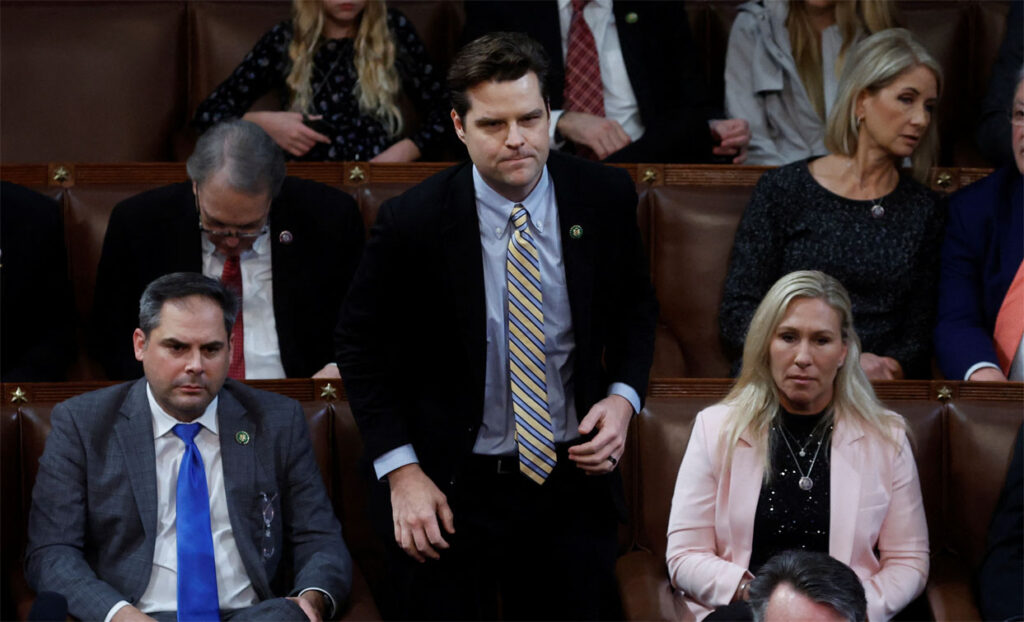
<p class="wp-block-paragraph">Based on media reports, you might think that a half dozen Republican legislators are holding up the entire budgeting process and causing a shutdown. But that is impossible. A handful of legislators cannot block the process unless it has help – lots of help. ; And where is that help coming from? ; THE DEMOCRATS. ; There are more than enough votes in the House to pass a CR – and even a bipartisan budget. ; But Democrats are standing on the sidelines. ; They are refusing to vote on any CR until all the Republicans first agree to vote on it. ; In which case they will not need to vote on it. ; They are refusing to participate because they do not like the GOP proposed bill.</p>


<p class="wp-block-paragraph">The second roadblock to resolution is Speaker McCarthy. ; He has the power to call up bills for a vote – or not. ; Under modern traditions of dysfunction, Speakers do not call for a vote until they have all the votes on their side locked in. If McCarthy puts the CR up for a vote, it would be up to the Democrats to either provide votes or be shown as the real culprits behind a shutdown.</p>


<p class="wp-block-paragraph">McCarthy has a unique problem. ; If he were to negotiate with Democrats, that handful of Republican holdouts would have the power to put his speakership on the line – perhaps even oust him. ; As a profile in courage, he should tell the holdouts to fall in line, or he WILL seek Democrat votes. ; And that is exactly what he should do.</p>


<p class="wp-block-paragraph">McCarthy does not have all the votes needed to advance a GOP-only measure.  ;Ergo … he does not call for a vote – and the Democrats watch from the gallery. ; That means gridlock – and that means shutdown.</p>


<p class="wp-block-paragraph">Even if McCarthy gets all the votes from his caucus to pass a purely Republican Budget in the House, it is likely to fail in the senate. ; That also means gridlock and shutdown. ; In short it is the Democrats and McCarthy that are enabling that handful of holdouts to control the process.</p>


<p class="wp-block-paragraph">If Democrats are to be involved, they want to be in on the debate. ; That means the process has to be bipartisan – which now it is not. ; House Minority Leader Hakeem Jeffries could go to McCarthy and say, “put more spending in the bill and I will give you all the votes you need.”  ; ;Spending is the great divide between Democrats and Republicans – especially those few holdouts refusing to vote for a CR that does not cut spending.</p>


<p class="wp-block-paragraph">In terms of the big picture, the handful of so-called nutcases are not wrong. ; Federal spending is dangerously out of control – and has been for a long time. ; Almost half of all federal spending (40%) is covered by borrowing.</p>


<p class="wp-block-paragraph">Every time we come up to one of these deadlines, the big spenders push for a quick and temporary resolution with a promise that afterward there will be serious efforts to cut the federal budget. ; ; But … that never happens – and the reckless spending goes on and on … and on.</p>


<p class="wp-block-paragraph">Those considered the nutcases – with some justification – are arguably the most fiscally responsible members of Congress. ; They want to get uncontrolled spending and borrowing reined in. ; They are taking the long-term view. ; McCarthy, most of the Republican caucus and all Democrats are following the business-as-usual approach.</p>


<p class="wp-block-paragraph">You can criticize their strategies and <em>modus operandi</em> of the holdouts, but at the bottom line, they are nutcases who are not entirely crazy.</p>


<p class="wp-block-paragraph">So, there ‘tis.</p>

The congressional nutcases have a point