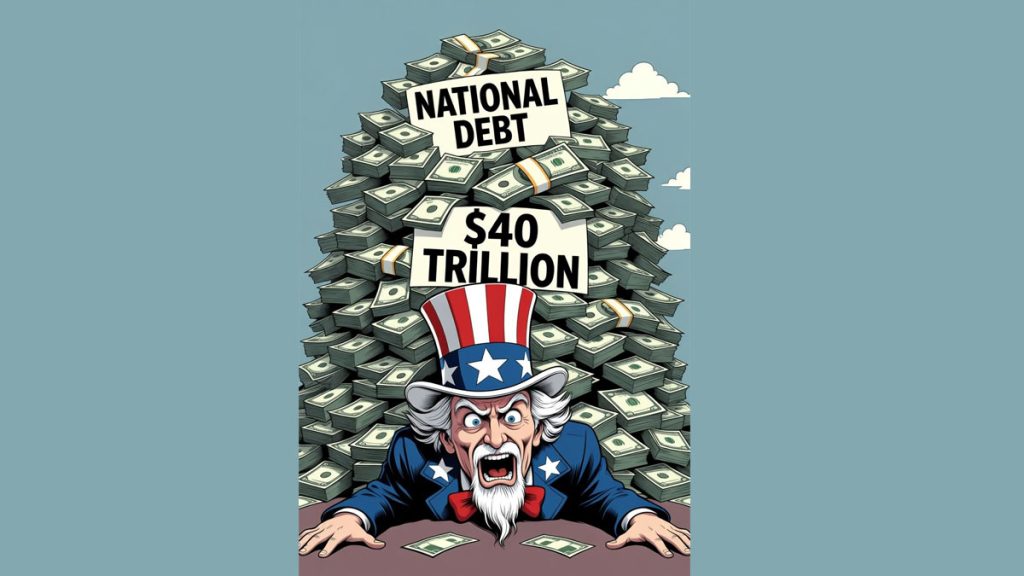
<p class="wp-block-paragraph">The United States of America has crossed a threshold that should every citizen. The United States national debt has now surpassed $40 trillion. That is not a typo. It is not a projection. It is the official figure recorded by the United States Treasury &#8212; $40 trillion. This is not merely an accounting inconvenience. It is an existential threat to the Republic, more immediate and more certain than climate change, foreign wars, street crime, or the ideological fever dreams of democratic socialism.</p>


<p class="wp-block-paragraph">We are on a trajectory toward the worst economic collapse in American history, and almost no one is treating it with the urgency it demands.</p>


<p class="wp-block-paragraph">Consider the scale. $40 trillion equals roughly the annual economic output of China, Germany, Japan, the United Kingdom, and India <strong>combined</strong>. It represents a debt of approximately $117,000 for every man, woman, and child in the country &#8212; or nearly $300,000 per household. The debt is growing at a rate of roughly $7 to $8 billion <strong>every single day</strong>.</p>


<p class="wp-block-paragraph">Interest payments alone now consume hundreds of billions of dollars annually, money that cannot be used to build roads, fund research, or strengthen national defense. We are paying more and more simply to keep the lights on in a house we can no longer afford. American no longer ha a triple-A rating from any agency. That means the cost of borrowing money increases.</p>


<p class="wp-block-paragraph">History provides the perspective that the present moment refuses to acknowledge. It took the United States nearly two centuries, from the founding through the early 1980s, to accumulate its first trillion dollars in debt. The second trillion arrived more quickly. The leap from ten trillion to twenty trillion took about nine years. From twenty trillion to thirty trillion required only five. The most recent ten trillion arrived in roughly four years. The acceleration is not gradual. It is exponential. Wars, recessions, and pandemics have always produced spikes. What is new is the permanent structural deficit driven by entitlement programs that expand without limit and without serious political resistance.</p>


<p class="wp-block-paragraph">The arithmetic is unforgiving. And yet the media and political establishments shrug and moved on to the next culture-war skirmish. The public, conditioned by decades of government checks and benefits, does the same.</p>


<p class="wp-block-paragraph">That public indifference is the most dangerous element of the crisis. The so-called welfare side of the federal budget has gone completely off the rails. Mandatory spending on Social Security, Medicare, Medicaid, and related income-support programs now dominate the federal ledger. These programs are not subject to annual appropriations in any meaningful sense. They grow automatically. They are politically sacred. Any serious proposal to restrain their growth is met with howls of cruelty. Discretionary spending, including national defense, is the smaller and more contested portion of the budget. The real engine of insolvency is the entitlement machine.</p>


<p class="wp-block-paragraph">One can, and should, blame the tax-and-spend politicians who have treated the national credit card as an infinite resource. Both parties have been complicit. Democrats have treated expanded benefits as moral imperatives disconnected from fiscal reality. Too many Republicans – pleading for fiscal responsibility – participate in the spending spree.</p>


<p class="wp-block-paragraph">Yet the deeper responsibility rests with the electorate. A greedy public elects politicians who promise more money, more services, more redistribution, and more protection from economic reality. The voters reward those who deliver the largest immediate transfer and punish those who speak honestly about arithmetic. The government has hooked the public on the continuous flow of benefits, and the public has reciprocated by demanding ever larger doses.</p>


<p class="wp-block-paragraph">The comparison to other threats is not rhetorical exaggeration. Climate change, whatever its long-term effects, does not currently force the Treasury to refinance trillions at rising interest rates. Foreign wars, however costly, remain discrete events with beginnings and ends. Crime, however corrosive, does not compound daily through the bond market. Democratic socialism, however destructive in theory, has not yet achieved the practical power to rewrite the fiscal rules of the largest economy on earth. In fact, socialist policies are a major driver in federal spending. The debt is different. It is already here. It is already growing. And it already constrains every other national priority.</p>


<p class="wp-block-paragraph">Imagine a family that has borrowed against every asset, refinanced every obligation, and now spends more on interest than on food or shelter. The parents continue to promise the children larger allowances and more gifts because the children have come to expect them. The parents know the trajectory ends in bankruptcy, yet they lack the courage to tell the children the truth. That is the United States in 2026. The children, in this case, are the voting public. The parents are the political class. And the bankruptcy, when it arrives, will not be a gentle restructuring. It will be a brutal recognition that the promises cannot be kept.</p>


<p class="wp-block-paragraph">The trajectory is clear. Without a fundamental change in the growth of mandatory spending and a corresponding shift in public expectations, future generations will face a fiscal crisis of historic magnitude. Interest costs will crowd out other spending. Markets will eventually demand higher premiums for American debt. The dollar’s once-privileged status will erode. The social fabric, already strained by political division, will fray further under the pressure of broken promises and reduced living standards. This is not alarmism. It is arithmetic.</p>


<p class="wp-block-paragraph">The $40 trillion debt is the nation’s suicide note, written in increments of billions and signed by a public that prefers comfort today to solvency tomorrow. The politicians who enable it are guilty. The media that ignores it is negligent. But the public that demands the benefits and elects the benefactors bears the ultimate responsibility. Until that truth is confronted, collapse remains not a possibility but an inevitability.</p>


<p class="wp-block-paragraph">So, there ‘tis.</p>


<p class="wp-block-paragraph"></p>

The $40 Trillion Suicide Note