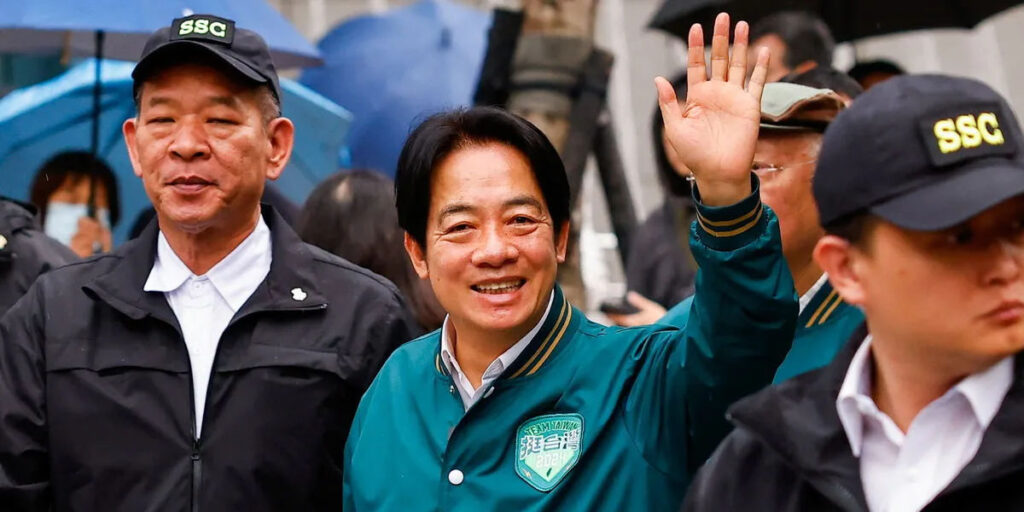
<p class="wp-block-paragraph">In an emphatic display of democratic defiance, Taiwan has once again boldly stood up to the pressures and threats of Communist China, marking a significant victory not only for itself but also for the Western world&#8217;s ideals of freedom and self-governance. The recent presidential election in Taiwan, resulting in the victory of Lai Ching-te, is a testament to the island&#8217;s unwavering commitment to charting its own course, distinct from the shadow of Beijing&#8217;s influence.</p>


<p class="wp-block-paragraph">The election was a historic moment for Taiwan, as Lai Ching-te, from the Democratic Progressive Party (DPP), secured a landmark third consecutive term for his party. This victory is significant in the context of the island&#8217;s strained relationship with mainland China. Beijing, which has never ruled Taiwan but claims it as its territory, has consistently denounced the DPP as a separatist force. The election of Lai, who secured 40% of the vote in a competitive three-way race, is a clear rebuke to Beijing&#8217;s intimidation tactics and an affirmation of Taiwan&#8217;s democratic values.</p>


<p class="wp-block-paragraph">Lai&#8217;s victory carries profound geopolitical implications. As he stated in his victory speech, &#8220;Taiwan has scored the first victory for democracy&#8221; in the global election year of 2024, setting a precedent for democratic resilience worldwide. Despite Beijing&#8217;s hardline stance, with a spokesperson from China’s Taiwan Affairs Office asserting that the election results would not alter their determination to bring Taiwan under its control, Taiwan has demonstrated its resolve to maintain</p>


<p class="wp-block-paragraph">its sovereignty and democratic integrity. This assertion of self-rule in the face of Beijing&#8217;s aggressive posture is not just a local triumph but a beacon of hope for democratic societies everywhere.</p>


<p class="wp-block-paragraph">The tensions between Taiwan and China are not just political but also deeply rooted in issues of identity and national sovereignty. The DPP&#8217;s victory underlines a growing sense of Taiwanese identity that is distinct from mainland China. The election results, with Lai beating Hou Yu-ih of the Kuomintang (KMT) by a significant margin, underscore this sentiment. The DPP&#8217;s platform, advocating for Taiwan&#8217;s separate identity and rejecting China&#8217;s territorial claims, resonates strongly with the Taiwanese electorate, especially in the context of Beijing&#8217;s increasing assertiveness in the region.</p>


<p class="wp-block-paragraph">The international community, particularly the United States, has closely watched the developments in Taiwan. The Biden administration has expressed its support for Taiwan&#8217;s democratic processes and called for a peaceful resolution of differences, free from coercion and pressure. This stance is crucial as it balances the need to support a democratic ally while managing a complex and sensitive relationship with China.</p>


<p class="wp-block-paragraph">Taiwan&#8217;s victory in this election is more than a political statement; it&#8217;s a stand against the dark shadows of authoritarianism cast by China. It showcases the island&#8217;s commitment to maintaining its democratic way of life, despite Beijing&#8217;s unrelenting pressure and threats. As Lai prepares to take office, he faces the challenge of navigating a complex international landscape, where Taiwan&#8217;s role is increasingly significant both as a symbol of democratic resilience and as a central player in global economic and geopolitical affairs.</p>


<p class="wp-block-paragraph">In conclusion, Taiwan&#8217;s recent presidential election is a landmark event that signifies the island&#8217;s defiance against Communist China&#8217;s pressures and threats. It is not just a victory for Taiwan but a significant triumph for democratic values and the principles of self-determination, serving as an inspiration for nations worldwide. As Taiwan continues to assert its identity and sovereignty, it remains a critical beacon of democracy in a region shadowed by the looming presence of an authoritarian giant.</p>

Taiwan Elections: Anti-Communist, Anti-China Lai Ching-te is New President