<p class="wp-block-paragraph"><strong>South Carolina Moves to the Front</strong></p>


<p class="wp-block-paragraph">The Democratic Party has voted to make South Carolina the first contest in its 2028 presidential nominating calendar, replacing decades of tradition that began with Iowa and New Hampshire. Party leaders say the change is designed to better reflect today&#8217;s Democratic coalition by giving greater prominence to Black and Latino voters. Yet almost immediately, political observers, notably liberal pubication <em>Politico</em>, began warning that the overhaul could produce the opposite result. Instead of increasing the influence of Black voters, they argue, the new calendar may actually reduce their ability to determine the party&#8217;s nominee.</p>


<p class="wp-block-paragraph">That apparent contradiction has become one of the biggest questions surrounding the Democratic Party&#8217;s latest effort to reshape its presidential nomination process. Why would a calendar designed to elevate Black voters end up weakening their influence?</p>


<p class="wp-block-paragraph"><strong>A Historic Calendar Shakeup</strong></p>


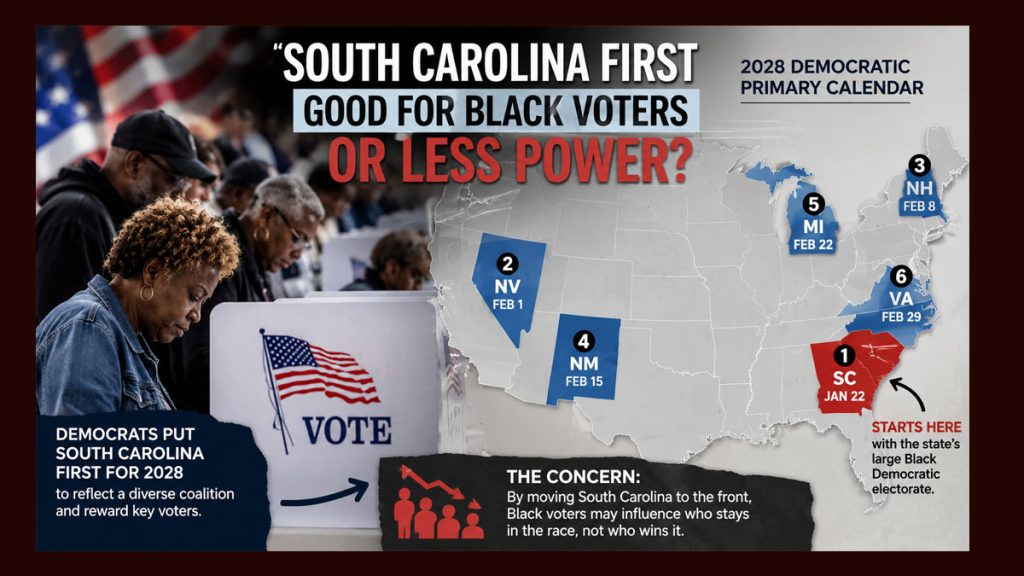
<p class="wp-block-paragraph">The Democratic National Committee&#8217;s Rules and Bylaws Committee voted to begin the 2028 primary season with South Carolina on January 22, followed by Nevada, New Hampshire, New Mexico, Michigan and Virginia before Super Tuesday.</p>


<p class="wp-block-paragraph">The decision continues the shift first made before the 2024 election, when President Joe Biden successfully pushed South Carolina to the front after the state&#8217;s Democratic primary rescued his struggling 2020 presidential campaign.</p>


<p class="wp-block-paragraph">The new schedule also removes Iowa from the early state lineup entirely, ending decades in which Iowa caucuses and the New Hampshire primary served as the traditional opening contests.</p>


<p class="wp-block-paragraph">Democratic leaders say the old system gave too much influence to two overwhelmingly white states that no longer reflected the party&#8217;s increasingly diverse coalition.</p>


<p class="wp-block-paragraph">&#8220;This calendar will battle test our candidates, ensure our nominee can appeal to broad swaths of the electorate and this calendar will allow voters, not money, but voters to be the ultimate decider,&#8221; DNC Chairman Ken Martin said after the vote.</p>


<p class="wp-block-paragraph"><strong>Why Democrats Wanted South Carolina First</strong></p>


<p class="wp-block-paragraph">Supporters argued that South Carolina deserves the opening position because its Democratic electorate includes the Black voters who have become the party&#8217;s most dependable constituency.</p>


<p class="wp-block-paragraph">Former DNC Chairman Jaime Harrison said keeping South Carolina first sends a message that Black voters matter.</p>


<p class="wp-block-paragraph">&#8220;I think we needed a strong statement to say to the most loyal members of our party, which are Black voters, that we&#8217;re going to stand up with you,&#8221; Harrison said. &#8220;We see you, we hear you, but most importantly, we&#8217;re gonna fight like hell for you.&#8221;</p>


<p class="wp-block-paragraph">Nebraska Democratic Party Chair Jane Kleeb made a similar argument.</p>


<p class="wp-block-paragraph">&#8220;Black voters didn&#8217;t just show up for this party in 2020. They saved us. They saved our entire country from Donald Trump.&#8221;</p>


<p class="wp-block-paragraph">Supporters say beginning with South Carolina ensures candidates must appeal to a coalition that resembles today&#8217;s Democratic Party instead of relying first on electorates that are much less diverse.</p>


<p class="wp-block-paragraph"><strong>The Unexpected Problem</strong></p>


<p class="wp-block-paragraph">Despite those intentions, Politico columnist Jonathan Martin argues that the move could actually reduce the political power of Black voters.</p>


<p class="wp-block-paragraph">His argument is not based on demographics. It is based on timing.</p>


<p class="wp-block-paragraph">For years, South Carolina voted after Iowa and New Hampshire. By then, weaker campaigns had already collapsed, leaving only a few serious contenders.</p>


<p class="wp-block-paragraph">That gave South Carolina&#8217;s heavily Black Democratic electorate enormous influence because it often decided which surviving candidate became the party&#8217;s standard bearer.</p>


<p class="wp-block-paragraph">The best example came in 2020.</p>


<p class="wp-block-paragraph">Black voters in South Carolina overwhelmingly backed Joe Biden after disappointing finishes elsewhere. Their support revived his campaign and effectively launched him toward the Democratic nomination.</p>


<p class="wp-block-paragraph">According to Martin, South Carolina became the contest that settled the Democratic race.</p>


<p class="wp-block-paragraph">Now, by moving the state to the very beginning, that role changes.</p>


<p class="wp-block-paragraph">Instead of deciding between two or three viable candidates, South Carolina voters may face a dozen campaigns splitting votes across multiple establishment and progressive candidates.</p>


<p class="wp-block-paragraph">Rather than producing a clear nominee, the state could simply eliminate the weakest candidates while leaving the real battle unresolved.</p>


<p class="wp-block-paragraph">In Martin&#8217;s view, South Carolina risks becoming what Iowa was for decades: the place where campaigns die rather than the place where nominees are chosen.</p>


<p class="wp-block-paragraph"><strong>Why Later States Could Matter More</strong></p>


<p class="wp-block-paragraph">Martin argues that the truly decisive contests may now shift to Michigan and Virginia, which appear later in the early calendar.</p>


<p class="wp-block-paragraph">By then, campaigns will have had time to raise money, organize supporters and build momentum.</p>


<p class="wp-block-paragraph">Candidates who perform well in those larger states could emerge as the true front runners just before Super Tuesday.</p>


<p class="wp-block-paragraph">If that happens, the heavily Black electorate in South Carolina would no longer occupy the pivotal position it held in previous Democratic nomination battles.</p>


<p class="wp-block-paragraph">Instead, states with significantly smaller Black voting populations could end up determining who carries the nomination forward.</p>


<p class="wp-block-paragraph">Martin notes another possibility.</p>


<p class="wp-block-paragraph">If several prominent Black candidates remain in the race, Black voters in South Carolina could divide their support among them. Because Democratic delegates are awarded proportionally rather than winner take all, that split could further reduce the state&#8217;s ability to produce a decisive result.</p>


<p class="wp-block-paragraph"><strong>Conflict Still Ahead</strong></p>


<p class="wp-block-paragraph">The calendar also creates conflict with two traditional early states.</p>


<p class="wp-block-paragraph">Iowa loses its privileged position entirely, while New Hampshire is expected to resist the change because state law requires it to hold the nation&#8217;s first presidential primary.</p>


<p class="wp-block-paragraph">The Democratic National Committee has warned that states violating the approved calendar could lose delegates, face financial penalties and see candidates excluded from official presidential debates.</p>


<p class="wp-block-paragraph"><strong>A Different Kind of Influence</strong></p>


<p class="wp-block-paragraph">Supporters of the new calendar believe beginning in South Carolina honors Black voters by placing them first in the nomination process.</p>


<p class="wp-block-paragraph">Critics argue that influence is measured not by voting first, but by casting votes when the field has narrowed enough for those votes to decide the outcome.</p>


<p class="wp-block-paragraph">That difference explains the unusual debate now unfolding inside the Democratic Party. South Carolina may receive more campaign visits, more national attention and more political spending than ever before. But if the decisive battles shift to larger states later in the calendar, the practical influence of South Carolina&#8217;s Black voters could be less than it was when the state voted third or fourth.</p>


<p class="wp-block-paragraph">The Democratic Party intended the calendar overhaul to elevate one of its most loyal voting blocs. Whether it has instead reduced that bloc&#8217;s power will become one of the defining questions of the 2028 Democratic presidential primary.</p>


<p class="wp-block-paragraph"></p>

South Carolina Chosen for First Democratic Primary: Will Black Voters Lose Power?