<p class="wp-block-paragraph">Abolition of the public sector means, of course, that ;<em>all</em> ;pieces of land, all land areas, including streets and roads, would be owned privately, by individuals, corporations, cooperatives, or any other voluntary groupings of individuals and capital. The fact that all streets and land areas would be private would by itself solve many of the seemingly insoluble problems of private operation. What we need to do is to reorient our thinking to consider a world in which all land areas are privately owned.</p>


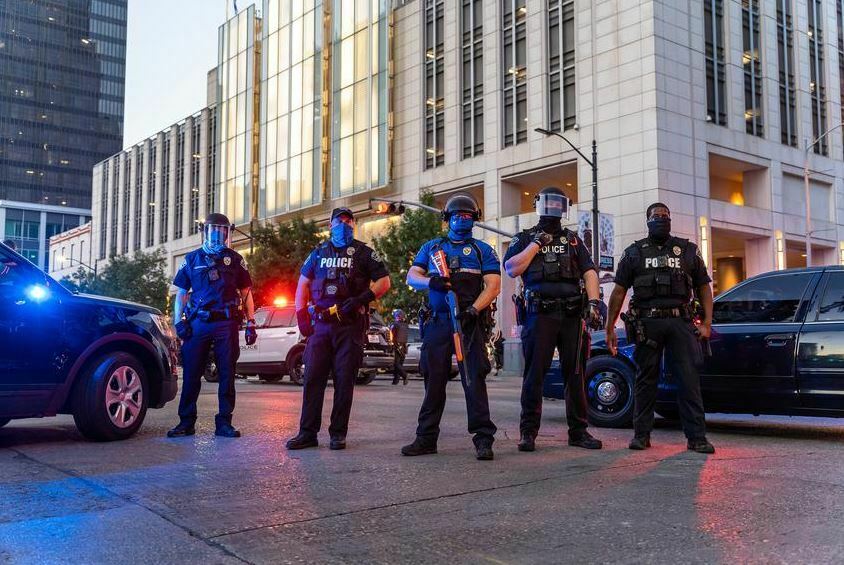
<p class="wp-block-paragraph">Let us take, for example, police protection. How would police protection be furnished in a totally private economy?</p>


<p class="wp-block-paragraph"><em>Part</em> ;of the answer becomes evident if we consider a world of totally private land and street ownership. Consider the Times Square area of New York City, a notoriously crime-ridden area where there is little police protection furnished by the city authorities. Every New Yorker knows, in fact, that he lives and walks the streets, and not only Times Square, virtually in a state of &#8220;anarchy,&#8221; dependent solely on the normal peacefulness and good will of his fellow citizens. Police protection in New York is minimal, a fact dramatically revealed in a recent week-long police strike when, lo and behold!, crime in no way increased from its normal state when the police are supposedly alert and on the job.</p>


<p class="wp-block-paragraph">At any rate, suppose that the Times Square area, including the streets, was privately owned, say by the &#8220;Times Square Merchants Association.&#8221; The merchants would know full well, of course, that if crime was rampant in their area, if muggings and holdups abounded, then their customers would fade away and would patronize competing areas and neighborhoods. Hence, it would be to the economic interest of the merchants&#8217; association to supply efficient and plentiful police protection, so that customers would be attracted to, rather than repelled from, their neighborhood. Private business, after all, is always trying to attract and keep its customers.</p>


<p class="wp-block-paragraph">But what good would be served by attractive store displays and packaging, pleasant lighting and courteous service, if the customers may be robbed or assaulted if they walk through the area?</p>


<p class="wp-block-paragraph">The merchants&#8217; association, furthermore, would be induced, by their drive for profits and for avoiding losses, to supply not only sufficient police protection but also courteous and pleasant protection. Governmental police have not only no incentive to be efficient or worry about their &#8220;customers'&#8221; needs; they also live with the ever-present temptation to wield their power of force in a brutal and coercive manner.</p>


<p class="wp-block-paragraph">&#8220;Police brutality&#8221; is a well-known feature of the police system, and it is held in check only by remote complaints of the harassed citizenry. But if the private merchants&#8217; police should yield to the temptation of brutalizing the merchants&#8217; customers, those customers will quickly disappear and go elsewhere. Hence, the merchants&#8217; association will see to it that its police are courteous as well as plentiful. Such efficient and high-quality police protection would prevail throughout the land, throughout all the private streets and land areas.</p>


<p class="wp-block-paragraph">Factories would guard their street areas, merchants their streets, and road companies would provide safe and efficient police protection for their toll roads and other privately owned roads. The same would be true for residential neighborhoods.</p>


<p class="wp-block-paragraph">We can envision two possible types of private street ownership in such neighborhoods. In one type, all the landowners in a certain block might become the joint ;<em>owners</em> ;of that block, let us say as the &#8220;85th St. Block Company.&#8221; This company would then provide police protection, the costs being paid either by the home-owners directly or out of tenants&#8217; rent if the street includes rental apartments. Again, homeowners will of course have a direct interest in seeing that their block is safe, while landlords will try to attract tenants by supplying safe streets in addition to the more usual services such as heat, water, and janitorial service. &#8216;</p>


<p class="wp-block-paragraph">To ask ;<em>why</em> ;landlords should provide safe streets in the libertarian, fully private society is just as silly as asking ;<em>now</em> ;why they should provide their tenants with heat or hot water. The force of competition and of consumer demand would make them supply such services. Furthermore, whether we are considering homeowners or rental housing, in ;<em>either case</em> ;the capital value of the land and the house will be a function of the safety of the street as well as of the other well-known characteristics of the house and the neighborhood.</p>


<p class="wp-block-paragraph">Safe and well-patrolled streets will raise the value of the landowners&#8217; land and houses in the same way as well-tended houses do; crime-ridden streets will lower the value of the land and houses as surely as dilapidated housing itself does. Since landowners always prefer higher to lower market values for their property, there is a built-in incentive to provide efficient, well -paved, and safe streets.</p>


<p class="wp-block-paragraph">Private enterprise does exist, and so most people can readily envision a free market in most goods and services. Probably the most difficult single area to grasp, however, is the abolition of government operations in the service of protection: police, the courts, etc.—the area encompassing defense of person and property against attack or invasion.</p>


<p class="wp-block-paragraph">How could private enterprise and the free market possibly provide ;<em>such</em> ;service? How could police, legal systems, judicial services, law enforcement, prisons—how could these be provided in a free market?</p>


<p class="wp-block-paragraph">We have already seen how a great deal of police protection, at the least, could be supplied by the various owners of streets and land areas. But we now need to examine this entire area systematically. In the first place, there is a common fallacy, held even by most advocates of laissez-faire, that the government must supply &#8220;police protection,&#8221; as if police protection were a single, absolute entity, a fixed quantity of something which the government supplies to all. But in actual fact there is no absolute commodity called &#8220;police protection&#8221; any more than there is an absolute single commodity called &#8220;food&#8221; or &#8220;shelter.&#8221;</p>


<p class="wp-block-paragraph">It is true that everyone pays taxes for a seemingly fixed quantity of protection, but this is a myth. In actual fact, there are almost infinite degrees of all sorts of protection. For any given person or business, the police can provide everything from a policeman on the beat who patrols once a night, to two policemen patrolling constantly on each block, to cruising patrol cars, to one or even several round-the-clock personal bodyguards.</p>


<p class="wp-block-paragraph">Furthermore, there are many other decisions the police must make, the complexity of which becomes evident as soon as we look beneath the veil of the myth of absolute &#8220;protection.&#8221; How shall the police allocate their funds which are, of course, always limited as are the funds of all other individuals, organizations, and agencies? How much shall the police invest in electronic equipment? fingerprinting equipment? detectives as against uniformed police? patrol cars as against foot police, etc.?</p>


<p class="wp-block-paragraph">The point is that the government has no rational way to make these allocations. The government only knows that it has a limited budget. Its allocations of funds are then subject to the full play of politics, boondoggling, and bureaucratic inefficiency, with no indication at all as to whether the police department is serving the consumers in a way responsive to their desires or whether it is doing so efficiently. The situation would be different if police services were supplied on a free, competitive market. In that case, consumers would pay for whatever degree of protection they wish to purchase.</p>


<p class="wp-block-paragraph">The consumers who just want to see a policeman once in a while would pay less than those who want continuous patrolling, and far less than those who demand twenty-four-hour bodyguard service. On the free market, protection would be supplied in proportion and in whatever way that the consumers wish to pay for it. A drive for efficiency would be insured, as it always is on the market, by the compulsion to make profits and avoid losses, and thereby to keep costs low and to serve the highest demands of the consumers. Any police firm that suffers from gross inefficiency would soon go bankrupt and disappear.</p>


<p class="wp-block-paragraph">One big problem a government police force must always face is: what laws ;<em>really</em> ;to enforce? Police departments are theoretically faced with the absolute injunction, &#8220;enforce all laws,&#8221; but in practice a limited budget forces them to allocate their personnel and equipment to the most urgent crimes. But the absolute dictum pursues them and works against a rational allocation of resources. On the free market, what would be enforced is whatever the customers are willing to pay for.</p>


<p class="wp-block-paragraph">Suppose, for example, that Mr. Jones has a precious gem he believes might soon be stolen. He can ask, and pay for, round-the-clock police protection at whatever strength he may wish to work out with the police company. He might, on the other hand, also have a private road on his estate he doesn&#8217;t want many people to travel on—but he might not ;<em>care</em> ;very much about trespassers on that road. In that case, he won&#8217;t devote any police resources to protecting the road. As on the market in general, it is up to the consumer—and since all of us are consumers this means each person individually decides how much and what kind of protection he wants and is willing to buy. All that we have said about landowners&#8217; police applies to private police in general.</p>


<p class="wp-block-paragraph">Free-market police would not only be efficient, they would have a strong incentive to be courteous and to refrain from brutality against either their clients or their clients&#8217; friends or customers. A private Central Park would be guarded efficiently in order to maximize park revenue, rather than have a prohibitive curfew imposed on innocent—and paying—customers. A free market in police would reward efficient and courteous police protection to customers and penalize any falling off from this standard. No longer would there be the current disjunction between service and payment inherent in all government operations, a disjunction which means that police, like all other government agencies, acquire their revenue, not voluntarily and competitively from consumers, but from the taxpayers coercively. In fact, as government police have become increasingly inefficient, consumers have been turning more and more to private forms of protection. We have already mentioned block or neighborhood protection.</p>


<p class="wp-block-paragraph">There are also private guards, insurance companies, private detectives, and such increasingly sophisticated equipment as safes, locks, and closed-circuit TV and burglar alarms. The President&#8217;s Commission on Law Enforcement and the Administration of Justice estimated in 1969 that government police cost the American public $2.8 billion a year, while it spends $1.35 billion on private protection service and another $200 million on equipment, so that private protection expenses amounted to over half the outlay on government police. These figures should give pause to those credulous folk who believe that police protection is somehow, by some mystic right or power, necessarily and forevermore an attribute of State sovereignty.</p>


<p class="wp-block-paragraph"><strong>[Excerpted from chapters 11 and 12 of <a href="http://mises.org/rothbard/newlibertywhole.asp#p215">For A New Liberty</a>.]</strong></p>

Should the Police Be Privatized?