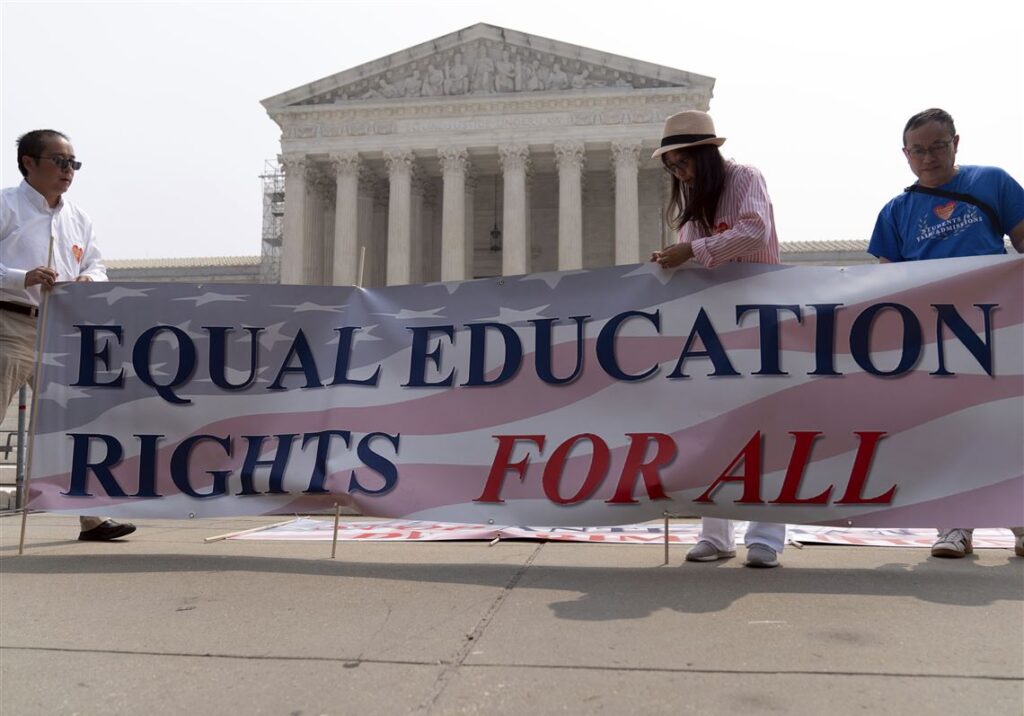
<p class="wp-block-paragraph">Minorities will no longer enjoy special consideration when applying to colleges and universities in the United States. ;</p>


<p class="wp-block-paragraph">As announced Thursday, university admissions programs can no longer consider race as a specific basis for granting admission. ;</p>


<p class="wp-block-paragraph">The Court&#8217;s conservative justices sided with the advocacy group Students for Fair Admissions, which viewed the affirmative action admissions programs being used at Harvard University and the University of North Carolina as unfair and unnecessary. ;</p>


<p class="wp-block-paragraph">In twin rulings split along ideological lines, the justices voted 6-2 against Harvard and 6-3 against UNC. Liberal Justice Ketanji Brown Jackson chose not to participate in the case against Harvard because she formerly served on the school’s Board of Overseers.</p>


<p class="wp-block-paragraph">Students for Fair Admissions had accused both schools of discriminating against Asian students, who often feel they are held to much higher standards than Black and Hispanic students. ;</p>


<p class="wp-block-paragraph">College applicants should be treated based on their “experiences as an individual [and] not on the basis of race,” wrote Chief Justice John Roberts in his 40-page majority opinion. The admissions programs at Harvard and UNC “cannot be reconciled with the guarantees of the Equal Protection Clause.”</p>


<p class="wp-block-paragraph">The Equal Protection Clause, located within the <em>14th Amendment</em>, guarantees that all individuals will be treated equally under the law. The clause, enacted in 1868, validated the protections granted to US citizens by the<em> Civil Rights Act of 1866. ;</em></p>


<p class="wp-block-paragraph"><strong>Though affirmative action admissions programs have been outlawed in nine states, an estimated 40% of colleges in the US still consider race when deciding which students to accept.</strong></p>


<p class="wp-block-paragraph">For too long, universities “have concluded, wrongly, that the touchstone of an individual’s identity is not challenges bested, skills built, or lessons learned, but the color of their skin,” wrote Roberts. “Our constitutional history does not tolerate that choice.” ;</p>


<p class="wp-block-paragraph">The Court’s decision treats the schools’ admissions polices for what they are, added Justice Clarence Thomas in his own, 58-page opinion, “rudderless, race-based preferences designed to ensure a particular racial mix in their entering classes. Those policies fly in the face of our colorblind Constitution and our Nation’s equality ideal. In short, they are plainly &#8211; and boldly, unconstitutional.” ;</p>


<p class="wp-block-paragraph">It was clarified in the majority opinion that the ruling does not prohibit admissions programs from taking into account the way a student’s race has affected his or her life &#8211; “be it through discrimination, inspiration, or otherwise.” ;</p>


<p class="wp-block-paragraph">Liberal Justices Sonia Sotomayor, Elena Kagan, and Ketanji Brown Jackson argued that affirmative action programs are not intended simply to increase racial diversity, but also to expand the talent pool and make room for different perspectives. ;</p>


<p class="wp-block-paragraph">“Today, this Court stands in the way and rolls back decades of precedent and momentous progress,” wrote Justice Sotomayor in a 69-page dissent. “The Court cements a superficial rule of colorblindness as a constitutional principle in an endemically segregated society where race has always mattered and continues to matter.” ;</p>


<p class="wp-block-paragraph">“Our country has never been colorblind,” wrote Justice Jackson in her own dissenting opinion. “The best that can be said of the majority’s perspective is that it proceeds (ostrich-like) from the hope that preventing consideration of race will end racism…If the colleges of this country are required to ignore a thing that matters, it will not just go away. It will take longer for racism to leave us.”</p>


<p class="wp-block-paragraph"><strong>Author’s Note: </strong>Giving advantage to college applicants based on race is in itself a form of racism. As many Republican lawmakers have noted, remedial preferences such as affirmative action admissions programs are not needed in modern society and can exacerbate feelings of division &#8211; not to mention the harm done to students who are turned away from schools due to the color of their skin. ;</p>


<p class="wp-block-paragraph">Indeed, when the Supreme Court voted to uphold the University of Michigan’s affirmative action admissions policy in 2003, Justice Sandra Day O’Connor said: “We expect that 25 years from now, the use of racial preferences will no longer be necessary to further the interest approved today.” ;</p>


<p class="wp-block-paragraph"><strong>Sources:</strong></p>


<p class="wp-block-paragraph"><a href="https://www.newsmax.com/headline/supreme-court-strikes/2023/06/29/id/1125377/">Supreme Court Outlaws Consideration of Race as a Factor in College Admissions ;</a></p>


<p class="wp-block-paragraph"><a href="https://www.foxnews.com/politics/supreme-court-rejects-affirmative-action-ruling-universities-using-race-admissions-decisions">Supreme Court rejects affirmative action in ruling on universities using race in admissions decisions ;</a></p>


<p class="wp-block-paragraph"><a href="https://www.politico.com/news/2023/06/29/supreme-court-ends-affirmative-action-in-college-admissions-00104179">Supreme Court guts affirmative action in college admissions ;</a></p>


<p class="wp-block-paragraph"><a href="https://www.cnn.com/politics/live-news/supreme-court-decisions/index.html">Justices Clarence Thomas and Ketanji Brown Jackson criticized each other by name in unusually sharp rebukes ;</a></p>

SCOTUS Rules: Race Cannot be a Factor in College Admissions