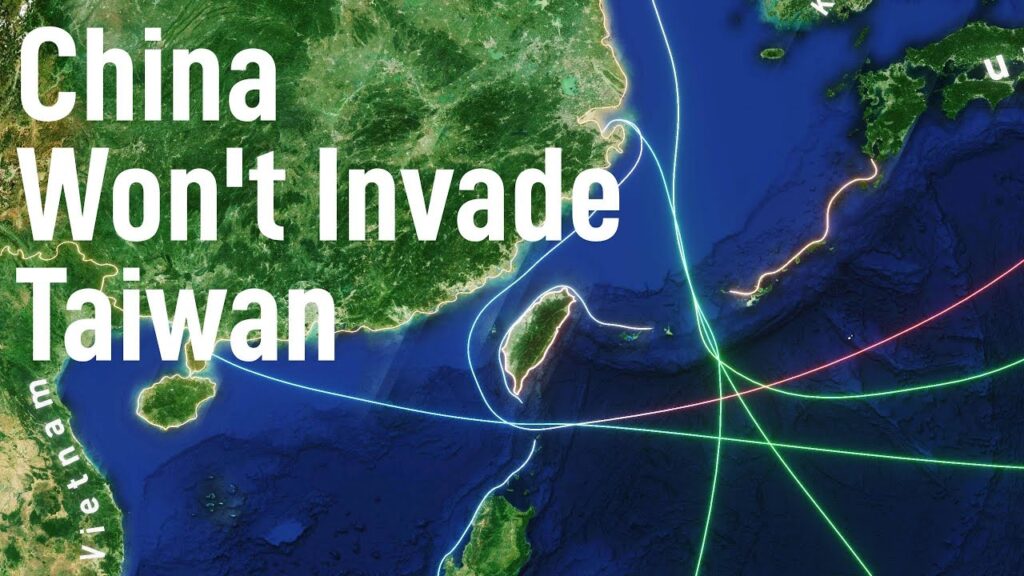
<p class="wp-block-paragraph">Of the many legitimate concerns we might have regarding China, an invasion of Taiwan is not one of them. ; I have expressed that opinion in several earlier commentaries. ; Apparently, the big guys are agreeing.</p>


<p class="wp-block-paragraph">This time the opinion was expressed by former Defense Secretary Robert Gates in a podcast discussion with Britain’s former M16 head Sir Richard Dearlove and international reporter Julia Macfarlane.</p>


<p class="wp-block-paragraph">According to the report of the discussion in <em>The Hill</em>, Gates said the possibility of an invasion is “very low.” ; I put it close to zero. ; Although Gates and I proffered different reasons, they go to the same conclusion. ; Gates noted that “The Chinese have never undertaken an amphibious operation. It would look something like D-Day, and it would have to be huge, and it would require a lot of softening up.”</p>


<p class="wp-block-paragraph">The report in <em>The Hill</em> contained a grievous error that leads to a lot of misunderstanding of the China/Taiwan relationship. ; It stated that “Taiwan says it is an independent country, while Beijing insists the island is part of China.” ; Actually, the island has never declared itself as an independent nation. ; Furthermore, no nations treat it as an independent nation – with less than half a dozen maintaining a formal embassy on the island. ; ;</p>


<p class="wp-block-paragraph">Yes, the United States provides defensive weapons to Taiwan – and maintains a critical trade relationship – but does not recognize Taiwan as an independent nation. ; The United States maintains a “One China” policy, meaning that Taiwan is basically a break-away province of the Peoples’ Republic of China. That is why Taiwan is not a member of the United Nations – and why it participates in many international competitive events under the Mainland Chinese banner.</p>


<p class="wp-block-paragraph">According to Gates, China has a full range of options short of an invasion to “bring Taiwan to its knees.” ; He mentioned “enormous” cyber and economic pressures as a couple of options. ; He said these would “create huge incentives for Taiwan to have a very different attitude toward China.”</p>


<p class="wp-block-paragraph">As a top military strategist, Gates bases his opinion on raw power, but I see important cultural reasons why Xi Jinping will not be a Vladimir Putin.</p>


<p class="wp-block-paragraph">From the last days of the Qing Dynasty to a modern communist state, China has not been a conquering nation in the tradition of Russia. ; Outside of a few border disputes, China seems content to compete economically and diplomatically within its borders. ; That is not to say they are not adversarial to the interests of the United States – or do not engage in unfair and illegal practices – but just not into invading and subjugating.</p>


<p class="wp-block-paragraph">Also, the relations between Mainland China and Taiwan became congenial after China took down the so-called Bamboo Curtain. ; Tourism and trade began to flourish between Beijing and Taipei – with Taiwan becoming the number one investor in Mainland China.</p>


<p class="wp-block-paragraph">Many of the descendants of those who fled the Communist Revolution have ancestors buried on the Mainland. ; They still feel a connection. ; It would be a mistake to fail to realize that there is a sizeable minority in Taiwan who would like to see reunification with the Mainland – although some of Xi’s more autocratic policies may be chilling those thoughts.</p>


<p class="wp-block-paragraph">One has to keep in mind that Chiang Kai Shek did not escape to Taiwan. ; He invaded it. ; There remains a schism between the ancestor of Chiang and the indigenous Taiwanese. ; Even after more than 70 years, many of the original Taiwanese would like to see the invaders go home.</p>


<p class="wp-block-paragraph">Conversely, there is virtually no sentiment among the Mainland Chinese people for an invasion of Taiwan. ; Many view them as family. ; As long as they can visit back and forth – and do business – the idea of a bloody war is repugnant to both sides.</p>


<p class="wp-block-paragraph">The official U.S. policy is to promote a peaceful reunification of the Island and the Mainland. ; In many ways that was moving along rather smoothly until Xi started acting like a brutal autocrat. ; The most unsettling matter has been his crushing of the democracy movement in Hong Kong and the Orwellian-style social control. ; While the Taiwanese may envision reunification with Beijing, they do not want to be subjugated to the oppressive policies they see in Hong Kong or on the Mainland.</p>


<p class="wp-block-paragraph">That means that for the time being, Taiwan will function as a quasi-independent entity. ; Xi’s policies may have put off reunification to a more distant future, but the Chinese on both sides are very patient. ; There is nothing to precipitate an invasion.</p>


<p class="wp-block-paragraph">And Xi well understands that an invasion would be difficult, bloody, and require a prolonged period of Marshal Law and violent resistance. ; It would make Putin’s invasion of Ukraine look like a cakewalk.</p>


<p class="wp-block-paragraph">More concerning issues between China and the United States are corrupt trade policies and control of the South China Sea and the Straits of Taiwan. ; We engage the former with sanctions and tariffs and the latter with what was once called “gun boat diplomacy.” ; But those are issues for later commentaries.</p>


<p class="wp-block-paragraph">So, there ‘tis.</p>

Relax … China will not invade Taiwan