<p class="wp-block-paragraph"><strong>Planned Parenthood&#8217;s $47 Million Election Blitz Raises New Questions</strong></p>


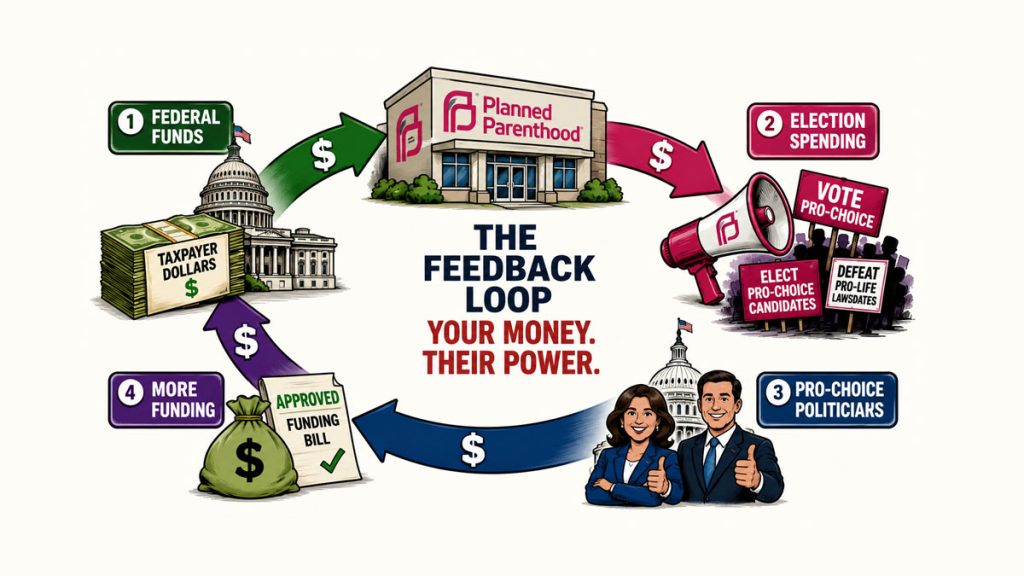
<p class="wp-block-paragraph">Just days after regaining access to hundreds of millions of dollars in federal Medicaid reimbursements, Planned Parenthood announced that its affiliated political organization plans to spend more than $47 million to defeat Republicans who voted to cut the organization&#8217;s funding. While Planned Parenthood insists that taxpayer dollars do not directly finance its political activities, this demonstrates how house of cards organizations can comply with the technical wording of the law while defeating its intended purpose.</p>


<p class="wp-block-paragraph">The political campaign, announced by Planned Parenthood Votes, will target ten competitive House races across seven states along with key Senate races in Michigan and Maine. Executive Director Sarah Standiford described the effort bluntly, saying, &#8220;We&#8217;re in the fight of our lives,&#8221; and pledged to &#8220;make sure members of Congress who voted against Planned Parenthood lose their jobs.&#8221;</p>


<p class="wp-block-paragraph">Those targeted include Representatives Bill Huizenga, Tom Barrett, Gabe Evans, Mariannette Miller-Meeks, Mike Lawler, David Valadao, Brian Fitzpatrick, Ryan Mackenzie, Juan Ciscomani, and likely Michigan Senate nominee Mike Rogers.</p>


<p class="wp-block-paragraph">According to the author, the campaign demonstrates that the fight over Planned Parenthood funding has never been solely about healthcare. It is also about political power.</p>


<p class="wp-block-paragraph"><strong>Hundreds of Millions in Federal Funding</strong></p>


<p class="wp-block-paragraph">Although Planned Parenthood argues that federal money pays only for non abortion medical services such as contraception, cancer screenings, and sexually transmitted infection testing, the organization has long relied on substantial taxpayer funding through Medicaid reimbursements and government grants.</p>


<p class="wp-block-paragraph">The following figures illustrate the level of government support received by Planned Parenthood in recent years.</p>


<figure class="wp-block-table"><table class="has-fixed-layout"><thead><tr><th>Fiscal Year</th><th>Government Reimbursements &; Grants</th><th>Approximate Share of Total Revenue</th></tr></thead><tbody><tr><td>2015-16</td><td>~$554 million</td><td>~43%</td></tr><tr><td>2018-19</td><td>~$616 million</td><td>~39%</td></tr><tr><td>2020-21</td><td>~$633 million</td><td>~34%</td></tr><tr><td>2022-23</td><td>~$699 million</td><td>~34%</td></tr><tr><td>2023-24</td><td>~$792 million</td><td>~39%</td></tr><tr><td>2024-25</td><td>~$832 million</td><td>~39%</td></tr></tbody></table></figure>


<p class="wp-block-paragraph">Last year Republicans temporarily prohibited Planned Parenthood from receiving Medicaid reimbursements through the One Big Beautiful Bill Act. The restriction lasted one year before expiring in early July after Congress failed to extend it.</p>


<p class="wp-block-paragraph">As a result, Planned Parenthood once again became eligible to receive hundreds of millions of dollars in annual Medicaid reimbursements.</p>


<p class="wp-block-paragraph">During the one year funding restriction, Planned Parenthood reported approximately 30 clinic closures. Other reporting cited 57 closures or consolidations across 20 states since January 2025, illustrating the financial pressure the organization experienced during the temporary funding cutoff.</p>


<p class="wp-block-paragraph">Only days after federal funding resumed, Planned Parenthood announced one of the largest election spending campaigns in its history &#8211; $47 million.</p>


<p class="wp-block-paragraph">According to the author, that sequence of events raises obvious questions for taxpayers.</p>


<p class="wp-block-paragraph"><strong>The Legal Wall Between Taxpayer Dollars and Politics</strong></p>


<p class="wp-block-paragraph">Federal law contains several safeguards intended to prevent taxpayer money from being used to influence elections or lobby government officials.</p>


<p class="wp-block-paragraph">The Anti-Lobbying Act prohibits appropriated federal funds from being used to influence Congress outside official channels.</p>


<p class="wp-block-paragraph">The Byrd Amendment prohibits recipients of many federal grants, contracts, and loans from using those federal funds to lobby Congress or federal agencies regarding those awards.</p>


<p class="wp-block-paragraph">OMB Uniform Guidance classifies lobbying costs as generally unallowable expenses under federal grants and requires organizations to maintain accounting records demonstrating compliance.</p>


<p class="wp-block-paragraph">In addition, organizations organized as 501(c)(3) charities are prohibited from participating or intervening in political campaigns supporting or opposing candidates for public office and may engage in only limited lobbying.</p>


<p class="wp-block-paragraph">On paper, these protections appear comprehensive.</p>


<p class="wp-block-paragraph">However, Planned Parenthood&#8217;s structure is more complicated.</p>


<p class="wp-block-paragraph">Planned Parenthood Federation of America operates as a 501(c)(3) nonprofit organization that receives government reimbursements and grants through its affiliates.</p>


<p class="wp-block-paragraph">Its political activities are conducted by legally separate organizations, including Planned Parenthood Votes and Planned Parenthood Action Fund, which are organized under different sections of federal tax law and are permitted to engage in political advocacy using non federal funds.</p>


<p class="wp-block-paragraph">Planned Parenthood maintains that federal reimbursements are carefully separated from political expenditures and that it complies with all applicable federal laws.</p>


<p class="wp-block-paragraph"><strong>PB Editor: </strong>I&#8217;m sure all of this is &#8220;legal&#8221; from an accounting standpoint. The point stands, taxpayer dollars to influence elections.</p>


<p class="wp-block-paragraph"><strong>The Loophole Debate</strong></p>


<p class="wp-block-paragraph">According to the author, the legal distinction misses the larger issue.</p>


<p class="wp-block-paragraph">Money is fungible. Every dollar received from taxpayers for one purpose allows another privately raised dollar to be spent elsewhere.</p>


<p class="wp-block-paragraph">Taxpayer funding indirectly strengthens the organization&#8217;s overall financial position, allowing affiliated organizations to spend tens of millions of dollars attempting to influence elections and defeat lawmakers who sought to reduce that funding.</p>


<p class="wp-block-paragraph">While the arrangement may satisfy existing legal requirements, it undermines the spirit of laws designed to prevent organizations supported by federal taxpayers from becoming major political players.</p>


<p class="wp-block-paragraph">This debate is not about accounting practices. It is about public trust and illegal influence in elections.</p>


<p class="wp-block-paragraph"><strong>Politics Before Patients?</strong></p>


<p class="wp-block-paragraph">The announcement also comes as Planned Parenthood continues to close clinics around the country.</p>


<p class="wp-block-paragraph">According to the organization, the temporary Medicaid funding restriction forced clinic closures and reduced access to preventive healthcare.</p>


<p class="wp-block-paragraph">Yet, one may reasonably question how an organization capable of directing $47 million toward election campaigns simultaneously argues that it lacks sufficient resources to keep health centers open.</p>


<p class="wp-block-paragraph">Whether that reflects difficult financial choices or strategic political priorities will remain a matter of debate.</p>


<p class="wp-block-paragraph"><strong>A Question for Congress</strong></p>


<p class="wp-block-paragraph">The current legal framework does not prohibit Planned Parenthood&#8217;s affiliated political organizations from spending private funds to influence elections.</p>


<p class="wp-block-paragraph">However, perhaps Congress should ask whether current law adequately protects taxpayers from indirectly financing partisan political operations.</p>


<p class="wp-block-paragraph">If organizations receiving hundreds of millions of dollars in government reimbursements can simultaneously devote tens of millions to defeating elected officials who attempted to reduce those reimbursements, then perhaps lawmakers should examine whether existing statutes have become little more than accounting exercises.</p>


<p class="wp-block-paragraph">Regardless of one&#8217;s position on abortion, the underlying question extends far beyond Planned Parenthood.</p>


<p class="wp-block-paragraph"></p>

Planned Parenthood Plans $47M to Defeat Pro-Lifers in Midterms – Its Taxpayer Money