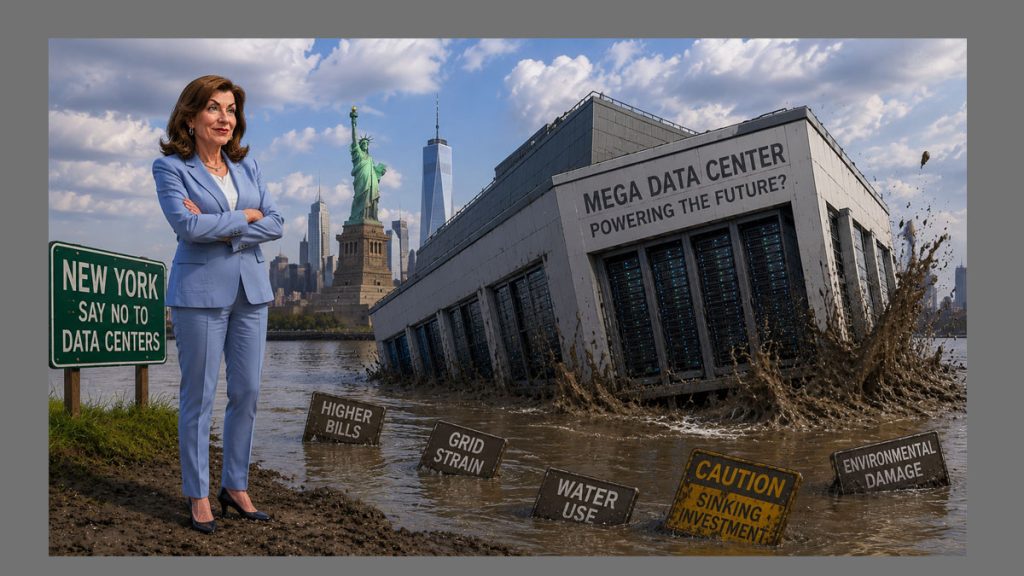
<p class="wp-block-paragraph"><strong>New York&#8217;s statewide pause on large AI data centers may win political headlines, but it risks driving billions of dollars in investment, jobs, and technological leadership somewhere else.</strong></p>


<p class="wp-block-paragraph"><strong>A First-of-Its-Kind Ban</strong></p>


<p class="wp-block-paragraph">New York has become the first state in the nation to impose a statewide moratorium on new hyperscale data centers, placing a one-year pause on facilities requiring 50 megawatts or more of electricity while state regulators develop new environmental standards. Governor Kathy Hochul signed the executive order, saying the move is necessary to protect New Yorkers from rising utility bills, environmental damage, and growing uncertainty surrounding the rapid expansion of artificial intelligence infrastructure.</p>


<p class="wp-block-paragraph">In announcing the moratorium, Hochul declared, &#8220;As data center development threatens to hike up utility bills, deplete our natural resources, and create uncertainty for New Yorkers, it&#8217;s my responsibility to take action and lead.&#8221;</p>


<p class="wp-block-paragraph">She also stated that the pause would remain in place while New York develops what she described as &#8220;the strongest possible framework&#8221; to protect communities, reduce risks to the electrical grid, minimize land disruption and noise pollution, and safeguard the state&#8217;s water resources.</p>


<p class="wp-block-paragraph">Whether one agrees with those concerns or not, New York has now positioned itself squarely against the rapid expansion of one of the world&#8217;s fastest growing industries.</p>


<p class="wp-block-paragraph"><strong>What New York Wants to Stop</strong></p>


<p class="wp-block-paragraph">The state&#8217;s concerns are not difficult to identify.</p>


<p class="wp-block-paragraph">Officials argue that hyperscale data centers consume enormous amounts of electricity, place additional strain on already stressed power grids, require substantial water for cooling, increase noise, and could ultimately contribute to higher electric bills for residents. The executive order directs regulators to study environmental impacts, energy demand, water consumption, and other effects before additional projects are approved.</p>


<p class="wp-block-paragraph">Hochul has also suggested requiring future hyperscale facilities to either generate more of their own electricity or pay more for the power they consume. She additionally intends to pursue legislation repealing sales tax exemptions previously available to large data centers.<br>Supporters view these measures as sensible safeguards.</p>


<p class="wp-block-paragraph">Critics see something very different.</p>


<p class="wp-block-paragraph"><strong>The Other Side of the Ledger</strong></p>


<p class="wp-block-paragraph">Every regulation has a cost.</p>


<p class="wp-block-paragraph">While New York focuses on what large data centers consume, it necessarily gives less attention to what they produce.</p>


<p class="wp-block-paragraph">Modern AI campuses represent some of the largest private infrastructure investments anywhere in the country. They generate construction employment, permanent technical jobs, expanded electrical infrastructure, upgraded roads, improved water systems, workforce training programs, tax revenue, and long-term economic development.</p>


<p class="wp-block-paragraph">One industry executive warned that New York&#8217;s one-year pause &#8220;will likely push investments outside of New York,&#8221; arguing that responsible growth would be a better solution than an outright statewide freeze.</p>


<p class="wp-block-paragraph">That warning appears particularly relevant when looking south.</p>


<p class="wp-block-paragraph"><strong>Louisiana Chose a Different Path</strong></p>


<p class="wp-block-paragraph">While New York is putting projects on hold, Louisiana is aggressively welcoming them.</p>


<p class="wp-block-paragraph">Meta has expanded its Hyperion AI campus in Richland Parish into one of the largest data center developments ever announced. The facility will ultimately approach 10 million square feet and consume as much as five gigawatts of power, making it one of the world&#8217;s largest AI computing campuses.</p>


<p class="wp-block-paragraph">The project reaches far beyond computer servers.</p>


<p class="wp-block-paragraph">Meta plans to invest another $1 billion in roads, water infrastructure, wastewater improvements, and other community projects. The company has committed to funding clean energy development while paying the infrastructure costs associated with serving the facility, an arrangement expected to save existing utility customers billions of dollars over time.</p>


<p class="wp-block-paragraph">The economic benefits are equally significant.</p>


<p class="wp-block-paragraph">Construction is expected to support approximately 7,500 jobs while creating roughly 1,000 permanent operational positions and another 1,900 indirect jobs throughout northeast Louisiana. Louisiana businesses have already secured more than $1.6 billion in contracts related to the project.</p>


<p class="wp-block-paragraph">Local schools have seen dramatic increases in available funding. Richland Parish Superintendent Sheldon Jones described teacher bonuses that climbed from roughly $10,000 to more than $50,000, calling the change &#8220;life altering for our teachers and their families, and it&#8217;s transforming our schools.&#8221;</p>


<p class="wp-block-paragraph">Meta has also committed funding to every public school in the parish and established scholarships for graduating seniors pursuing data center related technical education.</p>


<p class="wp-block-paragraph">That is what one community chose to embrace.</p>


<p class="wp-block-paragraph">New York chose to press pause.</p>


<p class="wp-block-paragraph"><strong>Political Symbolism or Economic Strategy?</strong></p>


<p class="wp-block-paragraph">In the author&#8217;s opinion, the timing raises unavoidable political questions.</p>


<p class="wp-block-paragraph">President Trump has repeatedly argued that the United States should accelerate AI development and reduce regulatory barriers for major technology investments. His administration has emphasized expanding domestic energy production and speeding environmental approvals for projects exceeding $1 billion.</p>


<p class="wp-block-paragraph">Against that backdrop, New York&#8217;s decision places the state on the opposite side of that national strategy.</p>


<p class="wp-block-paragraph">Supporters will describe the moratorium as responsible oversight.</p>


<p class="wp-block-paragraph">Critics will see it as another example of using regulation to make a political statement while other states compete aggressively for investment.</p>


<p class="wp-block-paragraph">Whatever the motivation, businesses considering billion-dollar AI campuses now have another factor to evaluate before choosing where to build.</p>


<p class="wp-block-paragraph"><strong>The Opportunity Cost</strong></p>


<p class="wp-block-paragraph">There is no question that massive AI data centers require electricity, water, careful planning, and thoughtful regulation.</p>


<p class="wp-block-paragraph">Those are legitimate issues.</p>


<p class="wp-block-paragraph">But there is another side to the equation.</p>


<p class="wp-block-paragraph">Every project rejected or delayed represents construction jobs that never materialize, technical careers that never develop, infrastructure improvements that never happen, tax revenue that never reaches local schools, and technology ecosystems that grow somewhere else.</p>


<p class="wp-block-paragraph">In the author&#8217;s opinion, New York appears willing to sacrifice those opportunities in pursuit of political positioning and additional regulation. Whether that ultimately protects New Yorkers or simply encourages investment to migrate toward states that actively welcome AI infrastructure remains to be seen.</p>


<p class="wp-block-paragraph">The irony is difficult to ignore.</p>


<p class="wp-block-paragraph">At the very moment one state is telling the world&#8217;s largest technology companies to wait, another is inviting them to build the future.</p>


<p class="wp-block-paragraph"></p>

New York Gov Hochul Declares War on Data Centers. Who Really Pays the Price?