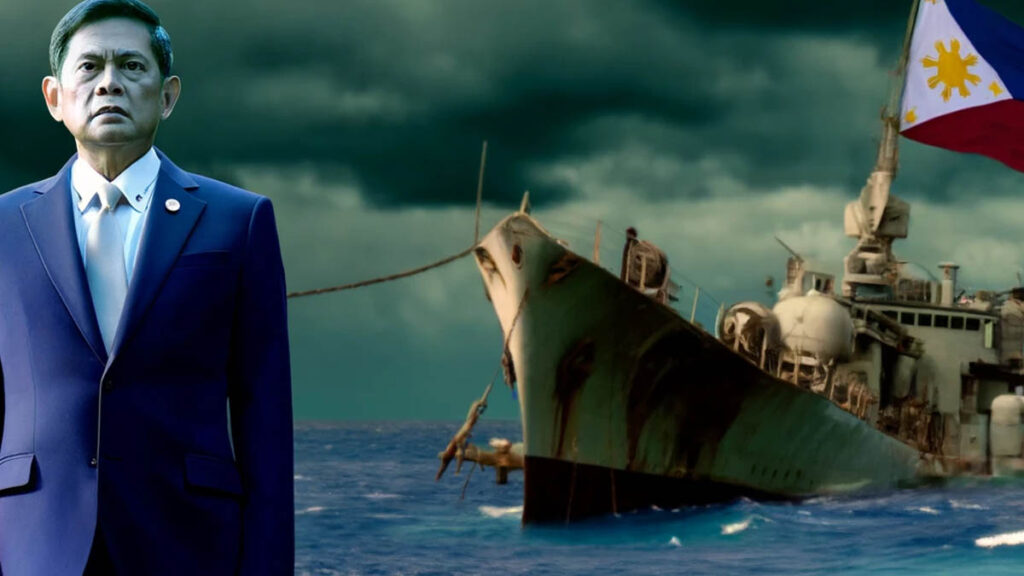
<p>In a striking revelation that has captured the national consciousness and stirred international interest, Philippine President Ferdinand Marcos Jr. has forcefully refuted claims of a covert &#8220;gentleman’s agreement&#8221; purportedly established between his predecessor, Rodrigo Duterte, and the Chinese government. This alleged pact centered around the turbulent and strategically crucial South China Sea—a region infamous for its geopolitical tensions, underscored by a mélange of competing territorial claims, particularly between the Philippines and China.</p>


<p>The focal point of this diplomatic imbroglio is the BRP Sierra Madre, a vestige of World War II naval history, deliberately marooned on the Second Thomas Shoal (Ayungin Shoal to the Filipinos) since 1999. This act of maritime brinkmanship aimed to assert Philippine sovereignty over its territorial waters, directly challenging China&#8217;s sweeping claims over almost the entire South China Sea. According to Duterte’s former mouthpiece, Harry Roque, an agreement was tacitly made with Beijing to preserve the &#8220;status quo&#8221; in these disputed waters, specifically stipulating that the Philippines would abstain from any efforts to refurbish or reinforce the deteriorating BRP Sierra Madre.</p>


<p>The news of such a clandestine arrangement has provoked a strong response from President Marcos Jr., who expressed his dismay and apprehension at the prospect of his nation&#8217;s sovereignty being compromised. In his own words, Marcos articulated the gravity of the situation: “I am horrified by the idea that we have compromised, through a secret agreement, the territory, the sovereignty, and the sovereign rights of the Filipinos.” This stark declaration highlights the profound unease at the thought of any negotiation that might surreptitiously undermine the country&#8217;s autonomy and territorial integrity.</p>


<p>The unfolding controversy brings to light the intricate dynamics of sovereignty in the sphere of international relations and the precarious nature of agreements that lack transparency and mutual consent. Sovereignty, the supreme authority within a territory, is a sacrosanct principle of international law, implying a state&#8217;s inherent right to govern itself without external interference. The alleged &#8220;gentleman&#8217;s agreement&#8221; appears to contravene this principle by insinuating that the Philippines must seek China&#8217;s approval to undertake activities within its own territorial waters. Marcos Jr. underscored the problematic nature of such an arrangement, stating, “What that agreement is saying is that we need to seek permission from another country to move in our own territory. That kind of agreement is hard to honor.”</p>


<p>Furthermore, the ambiguity surrounding the agreement&#8217;s legality and its enforceability has sparked intense debate. For any international agreement to be considered legally binding, it must be entered into willingly by all parties involved, with a clear understanding of its terms and an explicit intention to be bound by it. The lack of any formal documentation, acknowledgment, or even a briefing about the supposed agreement upon Marcos Jr.&#8217;s ascension to office casts doubt on its legitimacy and raises questions about its validity as a binding treaty. This opacity not only muddies the waters of diplomatic engagement but also challenges the foundational norms of international law and state sovereignty.</p>


<p>China&#8217;s expansive claim over the South China Sea, dismissing the territorial claims of the Philippines and other neighboring countries, exacerbates the situation, illustrating the broader geopolitical struggle for control over this pivotal maritime region. This contest is not only about territorial rights but also about the assertion of national sovereignty against external assertions and encroachments.</p>


<p>In his response to the controversy, President Marcos Jr. has sought to engage with both Chinese officials and members of the Duterte administration in a bid for clarity and resolution. Yet, the persistent lack of transparency and the conflicting narratives offered by various stakeholders have only deepened the intrigue and complicated efforts to discern the truth of these diplomatic dealings.</p>


<p>Did Duterte actually make such an agreement? Or has China just paid off the Harry Rogue to say this, after the fact. What was the quid pro quo? Duterte was a tough character, he was not easily pushed around. And since this agreement apparently never made it onto a document of any kind, its verity will be tough to prove. ACZ experts doubt the validity, because China needs only to push the allegation, it is enough of an excuse to push its military into the middle of this disagreement. </p>


<p>It CIA terms it is &#8220;cover for action.&#8221;</p>

Marcos “Horrified” – Philippines Must Seek China’s Approval To Move on Its Sovereign Territory?