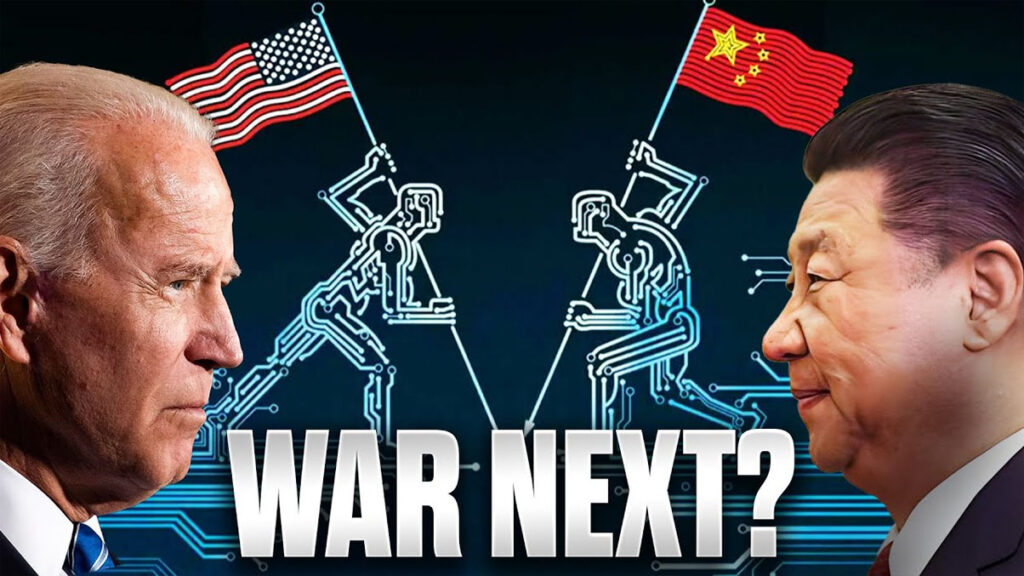
<p class="wp-block-paragraph">In recent years, the intensifying rivalry between the United States and China has sparked widespread speculation about the possibility of an armed conflict. This speculation has given rise to a plethora of books exploring the potential outcomes and strategies to prevent a war. While some authors argue that a U.S.-China war is inevitable, others advocate for diplomatic efforts and cooperation to avert such a catastrophic event. This clash of opinions reflects the inherent fascination with war narratives and the allure of dire scenarios over stories of peace. Let us delve into the key works and ideas that have shaped this ongoing debate.</p>


<p class="wp-block-paragraph">One prominent book that resonates throughout this discourse is Graham Allison&#8217;s &#8220;Destined for War: Can America and China Escape Thucydides&#8217;s Trap?&#8221; Drawing upon the ancient conflict between Athens and Sparta, Allison highlights the rise of China as a challenger to the United States&#8217; position as a global hegemon. He argues that a U.S.-Chinese war is more likely than not, given the historical tendency for conflict when a rising power threatens to displace a ruling power. Allison&#8217;s analysis underscores the structural stress inherent in such power shifts, raising concerns about the potential for military confrontation between the two nations.</p>


<p class="wp-block-paragraph">While the historical perspective is apt, it is important to note a certain fallacy. Historical examples tend to focus on cases where a rising power successfully challenges and goes to war with a ruling power, disregarding the numerous (and likely majority of) instances where the rising power either ceases its ascent or is defeated by the ruling power. I don&#8217;t find this perspective overly useful or predictive.</p>


<p class="wp-block-paragraph">Other works, such as &#8220;Danger Zone&#8221; by Hal Brands and Michael Beckley, present hypothetical scenarios that demonstrate the precariousness of the U.S.-China relationship. Brands and Beckley&#8217;s book envisions a surprise Chinese invasion of Taiwan, leading to a full-scale world war. They argue that China&#8217;s growing power, coupled with the United States&#8217; perceived decline and internal challenges, creates a dangerous environment where conflict becomes increasingly likely. The authors contend that the 2020s represent a critical decade when U.S.-Chinese competition reaches its highest level of danger.</p>


<p class="wp-block-paragraph">Similarly, in &#8220;The Avoidable War: The Dangers of a Catastrophic Conflict Between the US and Xi Jinping&#8217;s China,&#8221; Kevin Rudd explores ten distinct plotlines, many centered around the fate of Taiwan. Rudd raises the specter of an American &#8220;Munich moment,&#8221; where the United States chooses not to respond to Chinese aggression in Taiwan, leading to severe consequences for its global credibility. The book highlights various triggers for conflict, emphasizing the delicate balance between escalation and avoidance.</p>


<p class="wp-block-paragraph">This latter work is perhaps the scariest of all, since war in this case would depend on the strength and characater of the leadership of the US. Do we have such a weak leadership that this is possible?</p>


<p class="wp-block-paragraph">Imagining the Worst-Case Scenarios: A work of fiction, &#8220;2034&#8221; by Elliot Ackerman and James Stavridis, offers a chilling vision of a future war between the United States and China. Set in the South China Sea, the authors describe a chance standoff between U.S. and Chinese forces that rapidly escalates into a devastating world war. The novel illustrates the interplay of geopolitical rivalries, miscalculations, and the risks of military overconfidence. By portraying a potential worst-case scenario, Ackerman and Stavridis aim to stimulate reflection on the consequences of escalating tensions between the two nations.</p>


<p class="wp-block-paragraph">Central to the discussions on a U.S.-China war are the motivations and worldview of Chinese President Xi Jinping. In works such as &#8220;Party of One: The Rise of Xi Jinping and China&#8217;s Superpower Future&#8221; by Chun Han Wong, the author examines Xi&#8217;s consolidation of power, his focus on retaining power and national unity, and his drive to modernize the military. Xi&#8217;s efforts to stoke Chinese nationalism and restore China&#8217;s historical greatness shape the country&#8217;s ambitions and its perception of the United States as a rival.</p>


<p class="wp-block-paragraph">While opinions differ on China&#8217;s trajectory, several authors question the sustainability of China&#8217;s rise to power. Graham Allison contends that the economic balance has tilted significantly in China&#8217;s favor, making American pretensions to continued global hegemony unrealistic. However, Hal Brands and Michael Beckley offer a contrasting perspective, suggesting that China faces challenges such as mounting debt, inefficiencies, and demographic issues that could undermine its long-term stability and power projection capabilities. Nonetheless, they caution that China, driven by its aspirations and fears, might take aggressive actions before its power wanes, posing a significant risk to U.S. interests and security.</p>


<p class="wp-block-paragraph">Recent reporting seems to indicate the Brands and Beckley may be more accurate. China&#8217;s economy has slowed considerably and its customers in America and Europe are tending to pull out, rather than invest more. China could indeed react militarily as its economic miracle fades.</p>


<p class="wp-block-paragraph">Despite the dire predictions, authors also propose strategies to avoid a war. Kevin Rudd advocates for a concept known as &#8220;managed strategic competition,&#8221; emphasizing close communication between Beijing and Washington to establish a better understanding of each other&#8217;s red lines and minimize the risk of conflict arising from misunderstandings. Rudd contends that redirecting competitive energies toward economic, technological, and ideological arenas, while fostering cooperation on issues like climate change and arms control, could help mitigate tensions.</p>


<p class="wp-block-paragraph">While the perspectives on rising powers and historical context are valuable, they bring attention to the critical role of leadership in shaping the future of both China and the United States. China is currently led by President Xi Jinping, president for life, who has demonstrated ambitions for global dominance. On the other hand, the United States is under the leadership of President Joe Biden, who, some argue, lacks intellectual strength and is experiencing a noticeable decline in mental acuity. This contrast could be a determining factor.</p>


<p class="wp-block-paragraph">The New York Times posted an opinion piece by book editor Carlos Lozada entitled <strong><a href="https://www.nytimes.com/2023/07/18/opinion/china-usa-relations-books-war.html">A Look Back at Our Coming War With China</a></strong>, upon which this is based, adding commentary where appropriate, of course.</p>

Is War with China Inevitable?