<p class="wp-block-paragraph">The world of American adversaries appears to be shriveling under President Trump’s everything-all-at-once foreign policy. Nicolas Maduro is no longer the president of Venezuela. Even though many of his regime officials remain in place temporarily, they are weakened and intimidated. Russia’s power in the world is drastically weakened by Putin’s dirty little war in Ukraine and a floundering economy. North Korea remains a paper tiger surviving on a Chinese life support system.</p>


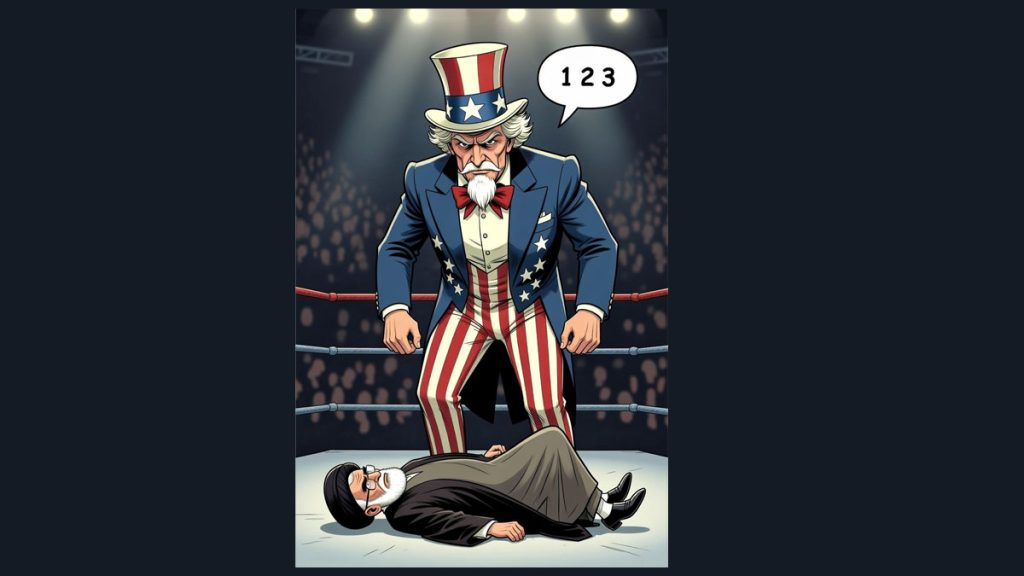
<p class="wp-block-paragraph">But the big news is the crumbling of the Islamic terrorist regime in Tehran. It is moving faster than most experts anticipated. To use the analogy from my previous column, the leadership in Iran is not longer on the ropes but now done for the count.</p>


<p class="wp-block-paragraph">For decades, the Islamic Republic of Iran has projected an image of ideological certainty, regional influence, and strategic patience. Yet today, the regime faces a convergence of pressures so severe that many analysts see the nation entering a period of profound instability—perhaps even an imminent systemic collapse. A failing economy, spiraling inflation, crippling sanctions, internal dissent, military pressure from Israel and the United States, and the weakening of its regional alliances have all converged to create a moment of unprecedented vulnerability. Each of these factors alone would be destabilizing. Together, they form a perfect storm.</p>


<p class="wp-block-paragraph"><strong>Economic Breakdown and Inflation</strong></p>


<p class="wp-block-paragraph">Iran’s economy has been deteriorating for years, but the current crisis is deeper and more structural than past downturns. The country faces runaway inflation, a currency that has lost most of its value, and chronic unemployment. International sanctions—especially those targeting oil exports and financial institutions &#8211; have strangled the regime’s most important revenue streams. Even when Iran manages to sell oil, it often does so at steep discounts through opaque channels, limiting the economic benefit.</p>


<p class="wp-block-paragraph">The result is a population squeezed by soaring prices, shrinking wages, and a government unable to provide basic services. The middle class, once a stabilizing force, is eroding. The poor are growing poorer. And the wealthy are prospering through the regime’s patronage networks &#8212; deepening resentment among ordinary citizens.</p>


<p class="wp-block-paragraph"><strong>Civil Unrest and the Erosion of Legitimacy</strong></p>


<p class="wp-block-paragraph">Economic hardship alone does not topple governments, but in Iran’s case it has fueled widespread civil unrest. The protests following the death of Mahsa Amini in 2022 marked a turning point. The protests were nationwide, youth-driven, and explicitly anti-regime. Unlike earlier demonstrations focused on economic grievances, today’s protests are political in nature, openly calling for the end of the regime.</p>


<p class="wp-block-paragraph">The regime responded with repression, but repression has limits. Each new crackdown widens the gulf between the rulers and the ruled. The younger generation—connected, globally aware, and overwhelmingly disillusioned—has no memory of the 1979 revolution and no loyalty to its alleged ideals. The protesters’ demands are not for reform but for transformation.</p>


<p class="wp-block-paragraph"><strong>Military Pressure and the Collapse of Proxy Power</strong></p>


<p class="wp-block-paragraph">For decades, Iran’s regional influence rested on its network of proxy groups &#8212; Hezbollah in Lebanon, Hamas in Gaza, and the Houthis in Yemen. These groups served as strategic buffers, tools of deterrence, and instruments of ideological expansion. But today, that network is under unprecedented strain.</p>


<p class="wp-block-paragraph">Israel and the United States have conducted targeted military operations that have degraded the capabilities of these organizations. Hamas suffered devastating losses in Gaza. Hezbollah faces sustained military pressure and a new less friendly leadership in Beirut. The Houthis, though still active, have drawn international retaliation for their attacks on shipping.</p>


<p class="wp-block-paragraph">Iran’s proxies were once its greatest strategic asset. Now they are becoming liabilities. Their weakening reduces Iran’s leverage and exposes the regime’s inability to protect or sustain its regional partners.</p>


<p class="wp-block-paragraph"><strong>A Weakened Russian Alliance</strong></p>


<p class="wp-block-paragraph">Iran’s partnership with Russia has long been a cornerstone of Putin’s geopolitical strategy in the Middle East. But the war in Ukraine has dramatically altered Moscow’s priorities. Russia is now heavily dependent on Iranian drones and munitions, but this dependency does not translate into meaningful protection for Tehran. Instead, Russia is increasingly isolated, economically strained, and militarily preoccupied.</p>


<p class="wp-block-paragraph">This leaves Iran with a weakened strategic ally at a moment when it needs strong partners most. The Kremlin’s ability to shield Iran diplomatically or militarily has diminished, and its willingness to confront Western powers on Iran’s behalf is limited by its own vulnerabilities.</p>


<p class="wp-block-paragraph"><strong>Internal Fractures and an Aging Supreme Leader</strong></p>


<p class="wp-block-paragraph">Perhaps the most underappreciated factor in Iran’s instability is the internal fragmentation of its leadership. Supreme Leader Ali Khamenei, now in his mid-80s, is visibly weakened by age. Succession battles are already underway behind the scenes, pitting factions within the Revolutionary Guard, the clerical establishment, and the political elite against one another.</p>


<p class="wp-block-paragraph">This internal dissension undermines decision-making and creates uncertainty at the highest levels of government. A regime that once prided itself on ideological unity is now fractured, with competing visions for Iran’s future and no clear path forward.</p>


<p class="wp-block-paragraph"><strong>Regional Isolation and Shifting Arab Alliances</strong></p>


<p class="wp-block-paragraph">Iran’s regional isolation has deepened dramatically in recent years. While it once positioned itself as the champion of “resistance” against Western influence, many Arab states now view Iran as a destabilizing force rather than a partner. The Abraham Accords—brokered by Trump—brought Israel into unprecedented cooperation with Gulf states such as the UAE and Bahrain. These agreements, and the broader warming of relations between Israel and Arab governments, have created historic coalitions that leave Iran increasingly isolated.</p>


<p class="wp-block-paragraph">Even Saudi Arabia, which briefly pursued détente with Tehran, remains deeply wary of Iran’s intentions. It is widely believed that Iran promoted the October 7 Hamas attack on Israel to thwart plans for Saudi Arabia to engage in an Abraham Accords-style agreement with Israel. The Arab world’s patience for Iran’s proxy warfare and ideological expansionism has worn thin. Iran is no longer seen as a revolutionary model but as a regional pariah.</p>


<p class="wp-block-paragraph"><strong>The Strait of Hormuz: A Dangerous Gamble</strong></p>


<p class="wp-block-paragraph">In moments of crisis, Iranian leaders often threaten to block the Strait of Hormuz, a vital chokepoint through which a significant portion of the world’s oil supply flows. But such a move would be suicidal. Any attempt to close the strait would invite overwhelming military retaliation and likely trigger the total collapse of Iran’s already fragile economy – and a possible regime change. The regime knows this, yet it continues to brandish the threat as a symbol of defiance. In reality, a blockade would be the coup de grâce—not for global energy markets, but for Iran itself.</p>


<p class="wp-block-paragraph">Iran today faces a convergence of crises unlike anything in its modern history. While predicting the exact trajectory of political collapse is always difficult, the structural weaknesses are undeniable. The Islamic Republic that once projected strength through ideology, proxies, and strategic patience, now projects desperation. And desperation is not a sustainable strategy.</p>


<p class="wp-block-paragraph">So, there ‘tis.</p>

Is Iran on the Verge of Collapse?