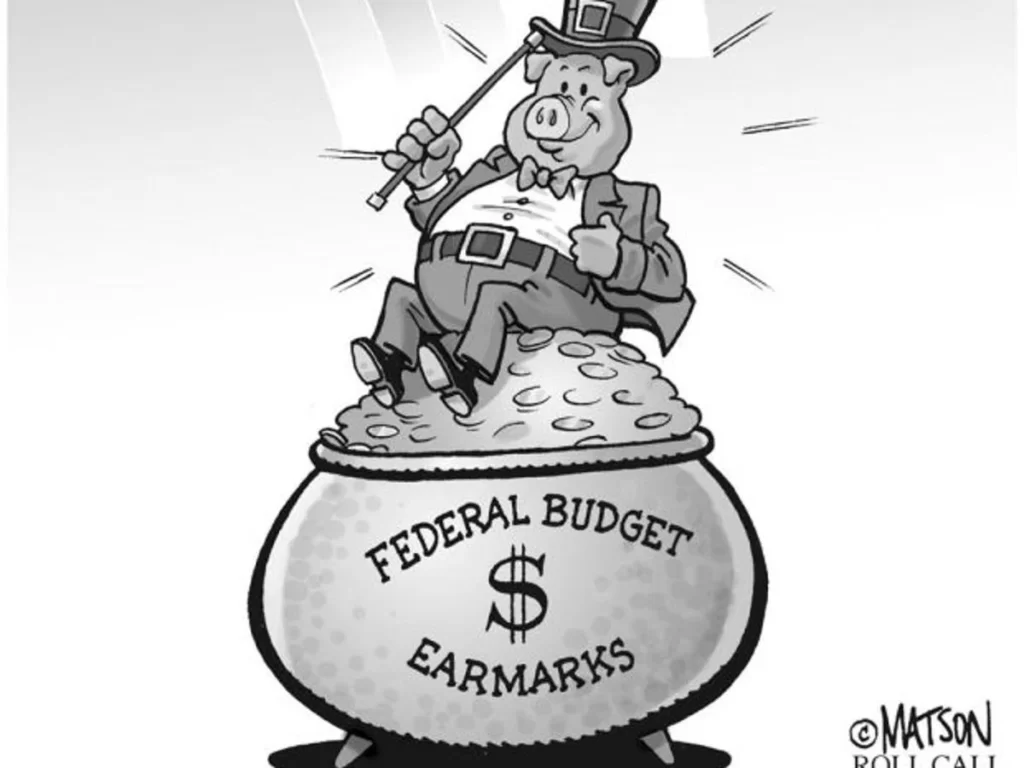
<p class="wp-block-paragraph">The tax and spend folks in Congress love “community project funding” – more commonly known as “earmarks.” These earmarks provide each member to grab a bit of taxpayer money to spend on a wide range of projects back home. ; In return, the member gets a political benefit. ; You will most likely see the congressman taking bows at some future ribbon-cutting ceremony.</p>


<p class="wp-block-paragraph">Earmarks have been very controversial – with Democrats loving them and (most) Republicans not so much.</p>


<p class="wp-block-paragraph">Other than to pump up a congressman’s political capital, there is no good purpose to be served by the earmark process – although a lot of members of congress will disagree emphatically.</p>


<p class="wp-block-paragraph">The first problem is that earmarks are needlessly costly. ; There is no cost/benefit analysis. ; It operates more like Santa Clause than Uncle Sam. ; Folks back home give Santa … oh … I mean Uncle Sam their wish list – and like a workshop elf, the congressman provides the gift. ; (The Santa analogy is even more apt when you consider that the Jolly Old Man – like Uncle Sam &#8212; is not paying for all those goodies in his sack.)</p>


<p class="wp-block-paragraph">A second problem with earmarks is that in many cases, there is no good reason why the national treasury should be used to fund many of the projects. ; Congress already uses the budgeting and appropriations processes to provide funds for major public works projects – such as tertiary treatment plants and airports. ; There are funds to support private-sector business start-ups – such as apartment buildings and factories. ; There are grants for almost everything.</p>


<p class="wp-block-paragraph">Earmarks are used more for what one might call “pet projects” – things that the local community or even the state should handle. ; Uncle Sam should not be the first choice – or even the last resort. ; These projects often include civic memorials, museums, and theaters. ; ;</p>


<p class="wp-block-paragraph">Earmarks can be used to provide a congressman with naming rights. ; You should check out how many locations are named after a member of Congress – buildings and parks. ; Some of that political advertising was purchased with earmarks.</p>


<p class="wp-block-paragraph">There are limits to earmarks. ; It is currently one percent of discretionary spending (about 30 percent of the federal budget). ; That may sound like a small amount, but it is a LOT of money – somewhere between $15 to $18 billion dollars. ; That is about $35 million per member.</p>


<p class="wp-block-paragraph">As part of the GOP’s efforts to reduce federal spending, House Speaker McCarthy is proposing a change in the guidelines that will cut the earmarks in half – to one-half of one percent of discretionary spending.</p>


<p class="wp-block-paragraph">In addition, the Republican plan would essentially ban the funding of projects with names of individuals or organizations. ; (Let them pay for their own advertising). ; It will also ban funding for “memorials, museums, and commemoratives.”</p>


<p class="wp-block-paragraph">Under the new rules, members who wish to steer money to their pet projects would have to provide a written statement indicating how the project justifies federal spending. ; To ensure that each project has a federal justification, only projects that qualify under federal authorization law will be funded.</p>


<p class="wp-block-paragraph">While traditionally, earmarks are attached to almost any appropriation legislation like tinsel on a Christmas tree, the new guidelines will prohibit earmarks on the appropriation bills for Defense, Health and Human Services, and Labor, among others.</p>


<p class="wp-block-paragraph">The sound you hear is a lot of Democrats caterwauling. ; They are calling the earmarks “essential.” ; ;</p>


<p class="wp-block-paragraph">Congresswoman Rosa DeLauro (D-CN) – the senior minority member on the House Appropriations Committee, said that earmarks are “opportunities for members to help people in their districts and to meet urgent needs directly”. ; She pointed to hospitals, blood centers, and universities. ; But the big spenders always declare every dollar spent as essential – a matter of life or death.</p>


<p class="wp-block-paragraph">Of course, the GOP proposal does not end earmarks but requires a higher standard of need. ; There will still be sufficient money to spread around to the places DeLauro cited. ; And one really needs to question whether universities – with their exorbitant tuition rates and huge endowment funds – need the money.</p>


<p class="wp-block-paragraph">A little belt-tightening in Washington is not only a good thing, it is an essential thing.</p>


<p class="wp-block-paragraph">So, there ‘tis.</p>

House Republicans Take a Whack at Earmarks