<p class="wp-block-paragraph">For nearly three decades, one political phrase has quietly shaped how many Americans think about children, parenting, and society: “It takes a village.”</p>


<p class="wp-block-paragraph">The phrase became inseparable from Hillary Clinton after the publication of her 1996 book <em>It Takes a Village</em>, which argued that raising children should involve not just parents, but schools, healthcare systems, government programs, nonprofits, employers, and society at large. The idea resonated because it seemed compassionate and practical. Parenting is difficult. Children need support. Families rarely succeed entirely on their own.</p>


<p class="wp-block-paragraph">At first glance, the slogan sounds difficult to oppose.</p>


<p class="wp-block-paragraph">But beneath its comforting simplicity lies a deeper question that America has spent far too little time asking: What kind of village are we talking about?</p>


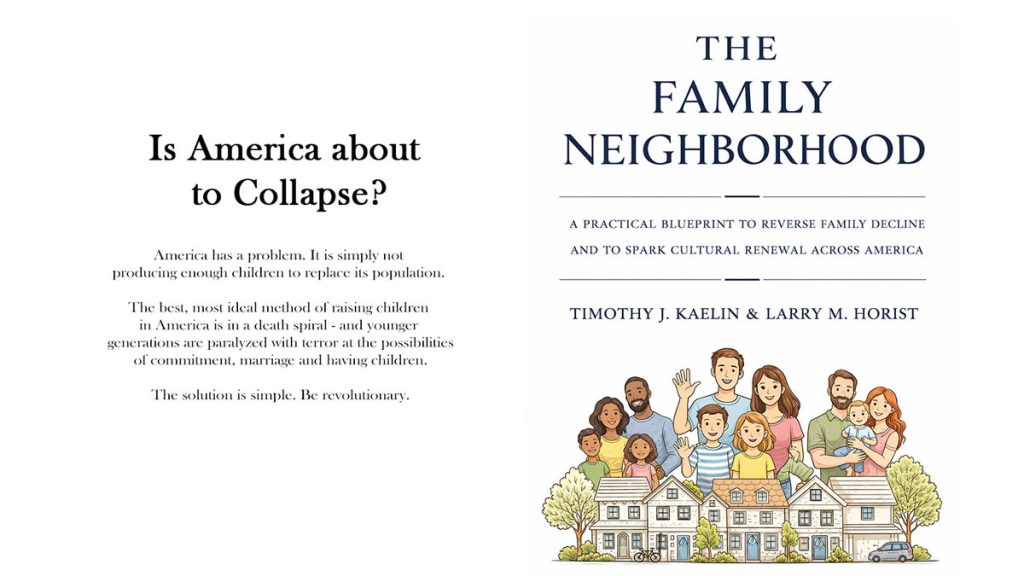
<p class="wp-block-paragraph">That distinction matters because, in the view advanced by <em>The Family Neighborhood</em>, Hillary Clinton was right about one thing and disastrously wrong about another. She was right that children need communities of support. She was wrong, the argument goes, about who should form the center of that village and what happens when institutions begin replacing what strong families once provided.</p>


<p class="wp-block-paragraph">The traditional village that helped raise children throughout most of human history was personal, local, relational, and deeply human. It consisted of grandparents who lived nearby, married neighbors who watched children after school, churches that reinforced expectations, coaches who mentored young boys and girls, civic organizations, cousins, aunts, uncles, and familiar adults who quietly shaped behavior through constant presence. Children were surrounded by people who knew their names, noticed their struggles, reinforced boundaries, and modeled adulthood.</p>


<p class="wp-block-paragraph">Most importantly, parents remained central.</p>


<p class="wp-block-paragraph">The village strengthened the family. It did not substitute for it.</p>


<p class="wp-block-paragraph">Yet over the last half century, America increasingly embraced a different approach. Rather than organizing public life around making families stronger, policymakers often attempted to cushion family decline by expanding institutions around children. Schools grew larger social responsibilities. Government programs multiplied. Experts, agencies, administrators, therapists, and professional systems increasingly stepped into spaces once occupied by intact families and tightly connected communities.</p>


<p class="wp-block-paragraph">The assumption, critics argue, was subtle but enormously consequential: if families weaken, institutions can compensate.</p>


<p class="wp-block-paragraph">If parents struggle, systems will intervene.</p>


<p class="wp-block-paragraph">If communities disappear, bureaucracy will fill the void.</p>


<p class="wp-block-paragraph">In hindsight, that assumption looks increasingly difficult to defend.</p>


<p class="wp-block-paragraph">The numbers tell a troubling story. In 1970, nearly <strong>70 percent of Americans ages 25 to 49 lived with a spouse and child</strong>. Today, that figure has fallen to roughly <strong>37 percent</strong>. America’s fertility rate, once around <strong>2.5 children per woman</strong>, has fallen to roughly <strong>1.6</strong>, well below the replacement level necessary to sustain the population over time. Marriage rates among younger adults have dropped sharply, while loneliness, anxiety, social isolation, and distrust have risen.</p>


<p class="wp-block-paragraph">At precisely the same moment that America expanded professional and institutional involvement in children’s lives, the core institution that historically stabilized children — the intact family — weakened dramatically.</p>


<p class="wp-block-paragraph">This does not automatically prove causation. Family decline has many causes: economics, cultural change, technology, delayed adulthood, housing costs, geographic mobility, and the sexual revolution all played roles. But critics of Hillary Clinton’s philosophy argue that <em>It Takes a Village</em> embodied and accelerated a dangerous intellectual shift: one that increasingly treated parents as merely one contributor among many instead of the primary institution around which social life should be organized.</p>


<p class="wp-block-paragraph">The shift changed expectations.</p>


<p class="wp-block-paragraph">Schools, for example, increasingly became responsible not only for education but for counseling, meals, emotional regulation, socialization, behavioral intervention, health screenings, mental health support, conflict mediation, and moral development. Teachers were gradually asked to become educators, therapists, surrogate authority figures, behavioral specialists, and social workers simultaneously.</p>


<p class="wp-block-paragraph">Meanwhile, government spending aimed at children, education, welfare, and family support expanded dramatically. Yet despite this growth in institutional involvement, many outcomes worsened. Family instability rose. Marriage rates declined. Birthrates fell. Loneliness surged. Children reported rising mental health struggles. Young adults increasingly delayed commitment and described marriage itself as emotionally and financially frightening.</p>


<p class="wp-block-paragraph">This is where conservative critics place serious blame on Hillary Clinton and the broader worldview represented by <em>It Takes a Village</em>.</p>


<p class="wp-block-paragraph">The critique is not merely partisan. It is philosophical.</p>


<p class="wp-block-paragraph">In this telling, Clinton’s model unintentionally encouraged Americans to view the state, professional systems, and bureaucratic institutions as substitutes for weakening families rather than treating strong families as the foundation upon which healthy communities must be built. The result was a quiet inversion of priorities. Instead of asking, “How do we strengthen marriage, neighborhood stability, family cohesion, and parental confidence?” America increasingly asked, “How do institutions manage the consequences of their decline?”</p>


<p class="wp-block-paragraph">The difference is profound.</p>


<p class="wp-block-paragraph">Bureaucracies can distribute resources. Schools can provide instruction. Therapists can offer intervention. Social workers can help during crisis. But institutions, no matter how well intentioned, cannot replicate the emotional continuity of stable parents. They cannot model lifelong sacrifice at the dinner table. They cannot quietly teach trust, patience, forgiveness, or responsibility through years of daily presence.</p>


<p class="wp-block-paragraph">Bureaucracy, for all its capabilities, cannot love a child.</p>


<p class="wp-block-paragraph">Ironically, Hillary Clinton’s slogan contained an important truth. Children do need villages. Parenting was never meant to happen in isolation, and one reason young Americans increasingly feel terrified of marriage and parenthood is precisely because the older village has collapsed. Grandparents live farther away. Churches weakened. Neighborhood trust deteriorated. Americans report fewer close friendships than previous generations, while many parents now describe child-rearing as exhausting precisely because they feel alone.</p>


<p class="wp-block-paragraph">But critics argue Clinton misunderstood what made villages work in the first place.</p>


<p class="wp-block-paragraph">Healthy villages are not bureaucratic systems surrounding weak families. Healthy villages are strong families surrounded by communities that reinforce them.</p>


<p class="wp-block-paragraph">The distinction matters because America’s current trajectory is alarming. Nearly <strong>four in ten adults under age 50 say they are unlikely to ever have children</strong>. Marriage continues to decline. Birthrates remain near historic lows. Many young people now view family life not as aspiration, but as stress, instability, sacrifice, and fear.</p>


<p class="wp-block-paragraph">If the dominant philosophy of family support over the last generation succeeded, critics ask, why do families appear weaker than ever?</p>


<p class="wp-block-paragraph">Why are young adults increasingly terrified of marriage?</p>


<p class="wp-block-paragraph">Why are parents more isolated?</p>


<p class="wp-block-paragraph">Why does raising children feel so exhausting?</p>


<p class="wp-block-paragraph">The uncomfortable conclusion offered in <em>The Family Neighborhood</em> is this: America did not fail because it lacked villages. America failed because it built the wrong kind.</p>


<p class="wp-block-paragraph">The answer was never to weaken the family and expand institutions around its absence. The answer was to rebuild the social conditions that make strong families possible in the first place.</p>


<p class="wp-block-paragraph">America does need a village.</p>


<p class="wp-block-paragraph">But villages are built by families, not bureaucracies.</p>


<p class="wp-block-paragraph"></p>

Hillary’s “It Takes a Village” Got the Family Problem Tragically Backward